























































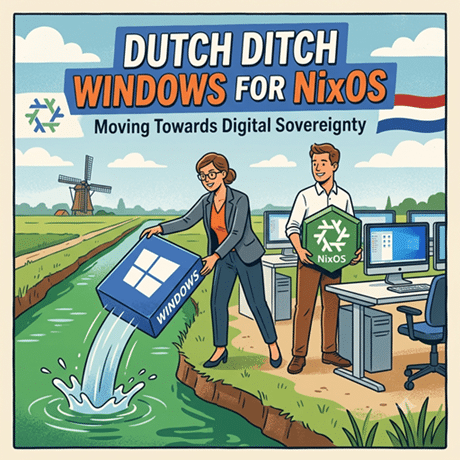

The Dutch government has officially thrown its weight behind a fully open source, sovereign digital workspace designed for public administration, anchored by a custom NixOS-based desktop environment.
When the US imposed sanctions on the International Criminal Court in 2025, the Netherlands was watching. The Hague is, after all, in the Netherlands, which had to respond with an initiative of its own.
Known as DAWO (Digitaal Autonome Werkomgeving Overheid or Digital Autonomous Government Work Environment), the initiative is not a monolithic application but a modular ecosystem. It integrates interchangeable tools spanning operating systems, cloud networks, AI utilities, messaging services and office collaboration suites.
Commissioned by the Ministry of the Interior and Kingdom Relations (BZK), the MijnBureau is a core self-hosted suite that integrates open source platforms like Nextcloud, Collabora, Element and OpenProject. Development is closely coordinated with similar sovereign tech pushes across Europe, including France’s La Suite and Germany’s openDesk. Project repositories are hosted on the internal Forgejo platform and mirrored on Codeberg to invite public contributions.
The project gained formal government backing in July when the Interdepartmental Committee on Government Operations (ICBR) commissioned three central IT service entities – DICTU, SSC-ICT and DUO’s ICT division – to engineer a standardized, vendor-independent desktop framework. Managed under the Association of Netherlands Municipalities (VNG), pilot participation has expanded from four to eight municipalities.
Developers evaluated several Linux distributions, including openSUSE and Fedora, before choosing NixOS as the ideal base for their client operating system. Beyond the intrinsic appeal of its Dutch roots (conceived by Eelco Dolstra, initially built into a distro by Armijn Hemel, and managed by a Netherlands-based foundation), NixOS presents distinct administrative advantages. Free from commercial vendor lock-in, its declarative configuration model and strictly reproducible builds simplify security auditing, maintenance and system deployment across thousands of civil service machines.