













































Thinking of investing in quantum computing? Begin by training a couple of engineers on it at zero cost with open source tools. That’s all you may need to do right now.
A client asked me in June whether they should buy a quantum computer. Genuine question, asked seriously, by a company that makes agricultural equipment. Someone on their board had read an article.
I told them ‘No’. And then spent the next hour on the more useful question: What does quantum computing look like from a developer’s chair in 2026? That conversation is in this article. Not physics. There are better people than me for physics, and honestly, physics is not what stops teams from getting started. What stops them is that the field is buried under two layers of noise. Vendor marketing on one side, promising commercial advantage that has not arrived. Academic material on the other, written for people who already know what a Hamiltonian is. Very little in between for a working engineer who wants to know how quantum computing is accessed, what it costs, and which tools are worth learning.
So: architecture, access, tooling. In that order.
What you are connecting to
Let’s start with the physical reality, because it explains every constraint that follows.
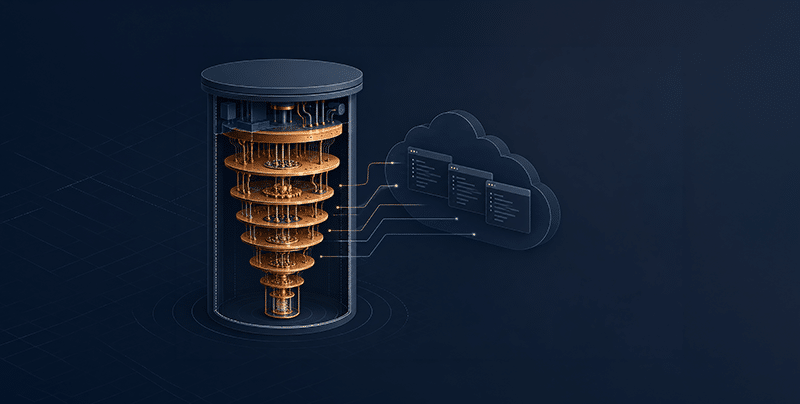
A gate-model quantum processor is a small chip that must be kept at roughly fifteen millikelvin, colder than deep space, inside a dilution refrigerator. If you have seen the photographs of a gold chandelier hanging in a lab, that is the refrigerator, not the computer. The actual processor is a fingernail-sized square at the bottom.
Superconducting machines from IBM, Rigetti and IQM work this way. Trapped-ion systems from IonQ, Quantinuum and AQT hold charged atoms in electromagnetic fields inside a vacuum chamber and manipulate them with lasers, which runs warmer but is no less fussy. Neutral-atom machines from QuEra and Pasqal arrange atoms in optical tweezers. Photonic systems from Xanadu and Quandela use light.
Every one of these needs a controlled room, specialist staff and constant recalibration. Machines drift. A processor that behaved one way this morning behaves slightly differently in the afternoon, which is why providers publish calibration data per device and update it daily.
That is why the cloud is not one delivery option among several for quantum computing. It is essentially the only one. Nobody is putting a dilution refrigerator in their office in Pune, and the handful of organisations buying on-premises systems are national labs and a few very large banks doing long-horizon research.
The architecture is a queue, not a socket
Here is the part that surprises people coming from ordinary cloud work.
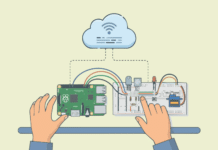
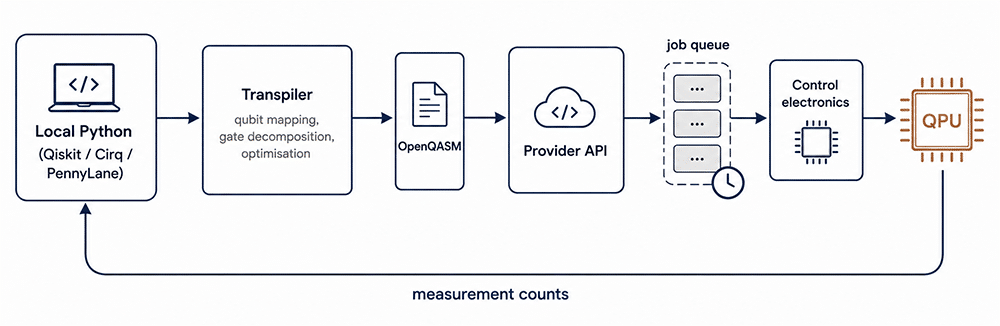
You do not open a connection to a QPU and issue instructions interactively. You submit a job. The job goes into a queue. At some point, minutes or hours later depending on demand, your circuit is loaded onto the hardware, executed a few thousand times, and the aggregated measurement results come back.
The path looks roughly like this. You write a circuit in Python on your laptop. A transpiler rewrites it to fit the target device, mapping your abstract qubits onto physical ones and decomposing your gates into the specific gate set that machine supports. The rewritten circuit is serialised, usually into OpenQASM, and posted to the provider’s API. It waits in a queue. Control electronics eventually translates it into microwave or laser pulses. The results, which are just counts of measured bit strings, travel back.
This has two consequences.
Latency is not a network problem. Your round trip is dominated by queue time, which no amount of colocation fixes. If somebody tells you they need a QPU in a specific region for latency reasons, they have misunderstood the model.
And because results are statistical, you run the same circuit repeatedly. A thousand shots, ten thousand, more. Each run is a sample from a probability distribution, and you need enough samples to see the shape of it. This is why quantum jobs are billed per shot or per task rather than per second.
Where the noise comes from
Skip this section if you already know it, but most explanations bury it and it matters for everything practical.
Qubits lose their quantum state. Fast. Coherence times on current hardware sit in the range of tens to hundreds of microseconds depending on the technology, and every gate operation you apply has an error rate attached, typically somewhere between one in a hundred and one in a thousand for two-qubit gates on good machines.
Errors compound. A circuit with a few hundred gates will accumulate enough errors that the output becomes indistinguishable from noise. That is the real limit on what you can run today, and it is why raw qubit counts are a poor way to compare machines. A five hundred qubit processor with mediocre gate fidelity may be less useful than a twenty qubit processor with excellent fidelity, because circuit depth is what you actually spend.
This is the NISQ (noisy intermediate-scale quantum) era, and the honest summary is that we are still in it. Error correction is progressing and the published roadmaps point at fault-tolerant machines around the end of this decade, but roadmaps are roadmaps. Plan for what exists.
Which brings me to the thing I say to every client who asks about this.
There is no verified case of a quantum computer beating a good classical algorithm on a real business problem today. Not one that has survived scrutiny. Several claimed results were later matched or beaten by improved classical methods running on ordinary hardware. If a vendor presents you with a quantum advantage claim for your industry, ask what the best classical approach achieves on the same problem, and ask who checked.
This is not a reason to ignore the field. It is a reason to be precise about why you are engaging with it, which for almost everybody right now is capability building rather than production work.
Four ways of access
Access is consolidated into a small number of routes, and they split cleanly by business model.
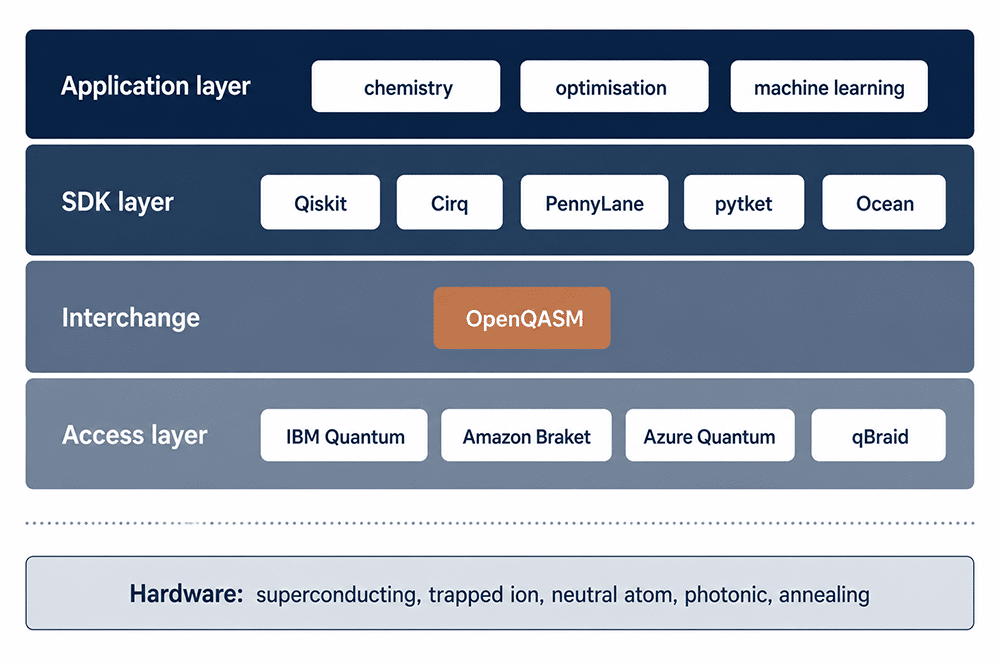
IBM Quantum builds its own superconducting hardware and offers it directly. Open access to real devices, deep free tutorial material, and Qiskit as the native SDK. If you want a first account, this is where I send people, because the learning path is the most complete.
Google Quantum AI also builds its own hardware, around superconducting processors, but access is oriented towards research partners rather than general developers. Cirq is the SDK.
Amazon Braket is an aggregator. AWS builds little general-purpose QPU hardware itself and resells a marketplace of partner machines, currently spanning superconducting devices from IQM and Rigetti, trapped-ion systems from IonQ and AQT, and neutral-atom hardware from QuEra. If you already live in AWS, the IAM and S3 integration will feel familiar, and Braket Hybrid Jobs handles the classical-quantum loop.
Azure Quantum is the other aggregator, with IonQ, Quantinuum, Rigetti and Atom Computing among its backends, plus Microsoft’s own Q# and the QDK. Sensible if you are already an Azure shop.
Then there are the independents worth knowing. qBraid and Strangeworks sit above the hyperscalers and give you one interface across several of them. D-Wave Leap is a different animal entirely and I will come back to it.
There is no Indian public cloud offering QPU access at the time of writing, though there is domestic hardware work underway under the National Quantum Mission. For now, expect your jobs to execute on machines in the US or Europe. If your organisation has data residency rules, raise this early with legal rather than late, because it has stopped more than one pilot I have been involved with.
Annealing is not the same thing
This is worth being blunt about, because the confusion is common and expensive.
D-Wave’s machines are quantum annealers. They do not run gate-model circuits. They find low-energy configurations of a problem you have expressed as a QUBO or Ising model, which makes them a fit for certain optimisation shapes and useless for Shor’s algorithm or quantum chemistry.
The practical difference for a developer: you write completely different code, using the Ocean SDK rather than Qiskit, and you cannot port between them. D-Wave has offered free metered access for years and their machines have far more qubits than any gate-model device, which is exactly why the qubit-count comparison misleads people. Different technology, different problem class.
If your problem is genuinely combinatorial optimisation, an annealer is worth an afternoon. Spend some time on running the same problem through a good classical solver like OR-Tools first, so you have something to compare against.
The open source layer
This is where the field is healthiest, and it is genuinely the most encouraging part of the whole picture. Almost every serious tool is open source and permissively licensed.
Qiskit is the centre of gravity. Apache 2.0, Python interface over a Rust core, and since version 2.0 there is a C API as well for people writing extensions or embedding it. Version 2.3 landed in January this year. The programming model is built around circuits, operators and two primitives: Sampler, which gives you measurement outcomes, and Estimator, which gives you expectation values of observables. Most tutorials you find will use one or the other. It also carries the most capable transpiler in the ecosystem, which matters more than beginners expect.
Cirq is Google’s framework, Apache 2.0, built with superconducting device constraints close to the surface. Strong for research and algorithm prototyping.
PennyLane from Xanadu takes a different angle. It treats a quantum circuit as a differentiable function, so you can compute gradients through it and plug the whole thing into PyTorch or TensorFlow. If your interest is quantum machine learning or variational algorithms, start here rather than with Qiskit.
pytket from Quantinuum is a compiler-first toolkit with a reputation for aggressive circuit optimisation. If you are trying to squeeze a circuit under the depth limit of a real device, it is worth benchmarking against Qiskit’s transpiler.
Ocean is D-Wave’s suite for annealing work. CUDA-Q from Nvidia targets GPU-accelerated simulation and hybrid workloads. Qibo covers simulation and self-hosted hardware control. Perceval is Quandela’s photonic framework.
And OpenQASM works underneath all of it as the interchange format, which is why cross-framework transpilation is possible at all.
A word on simulators, since this is where you will spend most of your time. Classical simulation of a quantum circuit costs memory that doubles with each qubit added. Around thirty qubits is comfortable on a decent workstation. Beyond forty you need serious hardware. Past roughly fifty, full state-vector simulation becomes impractical on anything. That ceiling is precisely why quantum hardware is interesting, and in the meantime, it means your development loop runs locally and free.
Actually running something
Enough of architecture. Here is the shortest useful path to run a quantum program.
Install Qiskit and the Aer simulator, build a Bell state, and run it locally. Two entangled qubits, the traditional first program.
python
from qiskit import QuantumCircuit
from qiskit_aer import AerSimulator
from qiskit import transpile
qc = QuantumCircuit(2, 2)
qc.h(0)
qc.cx(0, 1)
qc.measure([0, 1], [0, 1])
sim = AerSimulator()
result = sim.run(transpile(qc, sim), shots=1024).result()
print(result.get_counts())
You should see roughly 500 counts of 00 and 500 of 11, with nothing in between. That absence of 01 and 10 is the entanglement. Run it on real hardware later and you will see a few hundred stray counts in those buckets, which is the noise made visible.
Do not start on real hardware. I mean that as practical advice rather than gatekeeping. Simulator first, always, because a circuit that is wrong on a simulator will be wrong and slow, and possibly billed on a QPU.
When you are ready for hardware, the pattern is the same across providers: authenticate, pick a backend, transpile against that backend’s real coupling map and gate set, submit, wait, collect. The transpile step against the actual device is the part people skip and then wonder why their results are garbage.
On cost, the model varies but the shape is consistent. Braket charges per task plus per shot. IBM offers open access with monthly time limits on real devices and paid plans beyond that. D-Wave gives free metered time. Simulators are cheap or free everywhere.
The failure mode to avoid is a loop that submits jobs to hardware while you debug. Rate limits and budget alarms exist for the same reason they exist in any cloud service, and quantum jobs are billed in units that are unfamiliar enough that people misjudge them. Set a spending cap before your first hardware submission, not after.
What to actually do with quantum computing
My honest read, and clients do not always enjoy hearing it.
For the overwhelming majority of organisations, the correct engagement level right now is one or two engineers spending a few hours a month learning, plus standing watch on developments in your specific industry.
The exceptions are real but narrow — pharmaceutical and materials work, where molecular simulation is the most credible near-term application, and certain logistics and portfolio optimisation problems, though check the classical baseline first and expect to be disappointed. Cryptography, which is a different conversation entirely and the one that actually has a deadline.
That last one deserves a sentence on its own. Post-quantum cryptography is not speculative. NIST standards are published, migration guidance exists, and the harvest-now-decrypt-later risk means data you transmit today with classical encryption may be readable later. If your organisation handles anything with a long confidentiality horizon, post-quantum cryptography migration is a present-tense infrastructure project, and it has nothing to do with whether you ever run a quantum circuit.
I find that distinction gets lost constantly. Quantum computing is a research capability you are watching. Post-quantum cryptography is work you should have already started.
Where this leaves us
The agricultural equipment company did not buy a quantum computer. Two of their engineers now have IBM Quantum accounts and one of them has become genuinely good at this, which is a far better outcome for roughly zero rupees.
That is the shape of the opportunity in 2026. The hardware is remarkable, the results are not yet commercially useful, and the barrier to learning has collapsed to nearly nothing because the entire software layer is open source and the simulators run on your laptop. You can spend a weekend getting properly oriented for free.
The organisations that will benefit when the hardware matures are not the ones buying access now. They are the ones that will have people who understand the problem shapes, know what a variational algorithm is, and can tell a real advantage claim from a marketing one. That is a training question, and training takes years, which is the honest argument for starting now rather than waiting.
Install Qiskit. Build the Bell state. Read the calibration data for a real device and sit with what the error rates mean. That is a genuinely useful afternoon, and it costs you nothing.