






















































The emergence of quantum computing is bound to be disruptive, but organisations that learn to complement it with existing digital infrastructure will benefit.
Quantum computing has moved from the edges of theoretical physics into the centre of strategic technology planning. For decades, it was discussed mainly as a scientific possibility, admired for its elegance but viewed as distant from everyday use. That perception is changing. Governments, universities, cloud providers, startups, and large enterprises are now treating quantum technologies as part of a serious long-term innovation agenda. The next decade will not necessarily bring a universal quantum computer sitting on every desk, but it is very likely to reshape how organisations think about computation, security, materials discovery, optimisation, and scientific modelling.
The road ahead is both exciting and uneven. Quantum computing is advancing rapidly, yet it remains constrained by engineering realities such as qubit stability, error correction, cooling requirements, and the difficulty of converting laboratory breakthroughs into reliable industrial systems. The coming years will therefore be marked by a careful balance between ambition and practicality. The most successful organisations will be those that understand quantum computing not as a sudden replacement for classical computing, but as a specialised capability that will mature gradually and complement existing digital infrastructure.
Assessing progress: Where are we now?
At present, quantum computing is still largely in the noisy intermediate-scale quantum era, often described as the stage in which machines have enough qubits to demonstrate meaningful physical behaviour but not enough reliability to solve most commercial problems better than classical systems. Current processors can run experiments, support algorithm research, and help scientists test error-mitigation techniques, but their results are limited by noise and short circuit depths. This does not make today’s systems insignificant; rather, it places them in the same category as many early technologies that were scientifically promising before they became operationally dependable.
The most important progress is no longer just the number of physical qubits on a chip. The central question is whether these can be organised into logical qubits that correct errors reliably enough to run deep computations. Recent industry roadmaps and market assessments point to a transition from isolated demonstrations towards early fault-tolerant components, with commercial interest also increasing as hundreds of organisations explore quantum use cases and capability building. This suggests that quantum computing is not yet broadly useful in production, but is becoming too mature for technology leaders to ignore.
Predictions: What’s likely in five and ten years?
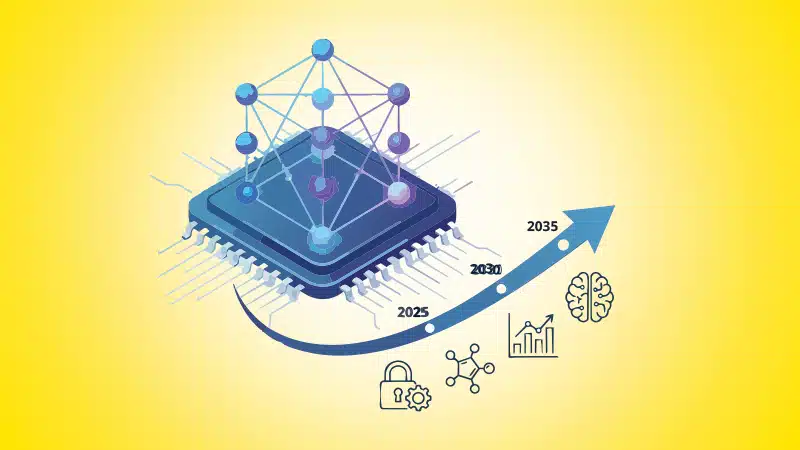
Over the next five years, the most credible progress is likely to occur in error correction, hybrid quantum-classical workflows, quantum software tooling, and cloud-based access models. Enterprises may not run large mission-critical workloads on quantum machines by default, but they will increasingly experiment with quantum algorithms through cloud platforms and specialised partnerships. Industries with complex optimisation, simulation, and risk-modelling needs will continue to test whether quantum-inspired and early quantum approaches can create advantage in narrow problem areas.
Within ten years, the picture may look more substantial, though still selective. If fault-tolerant systems scale as expected, quantum computers may begin to show practical value in chemistry, materials science, logistics, drug discovery, and certain forms of cryptanalysis. However, the decade ahead should not be imagined as a single dramatic leap. It will probably unfold as a sequence of domain-specific successes, where quantum systems solve carefully chosen problems alongside classical supercomputers, artificial intelligence models, and high-performance data platforms.
Quantum’s impact on society and workforce
Quantum computing could influence society in ways that extend beyond faster calculation. Its ability to model molecular structures, optimise complex systems, and accelerate certain classes of mathematical problems may affect healthcare, energy, finance, climate research, and national security. These benefits will not arrive evenly across the world. Countries and companies that invest early in talent, infrastructure, and responsible deployment may gain a significant advantage, while others may find themselves dependent on external platforms and expertise.
The workforce impact will be equally important. Quantum computing will create demand for physicists, mathematicians, computer scientists, control engineers, materials experts, cybersecurity professionals, and business translators who can connect quantum capabilities to real organisational problems. It will also change the profile of existing roles. Software engineers may need to understand quantum algorithms at a conceptual level, security architects will need to plan for post-quantum cryptography, and enterprise architects will need to evaluate when quantum services fit into broader technology portfolios.
Policy, regulation, and ethical considerations
Policy and regulation will become central as quantum computing matures. One of the most urgent concerns is the long-term security of public-key cryptography. Even before a cryptographically relevant quantum computer exists, sensitive data that is captured today could be decrypted later if it remains valuable. This ‘harvest now, decrypt later’ risk is why governments and standards bodies have been accelerating post-quantum cryptography guidance. Organisations should begin migration planning early because cryptographic change is rarely quick, especially in large enterprises with legacy systems, embedded devices, vendor dependencies, and long-lived data.
Ethical questions will also grow more complex. Quantum advantage could deepen inequality if only a small number of nations or corporations control the most powerful systems. There are also dual-use concerns, since capabilities that support scientific discovery may also be relevant to defence, surveillance, and cyber operations. Responsible quantum governance should therefore encourage innovation while setting expectations for transparency, security, access, and accountability. The goal should not be to slow scientific progress, but to ensure that progress is aligned with public trust and shared benefit.
Education and preparing for the quantum age
Preparing for the quantum age requires a broader educational approach than training only a small group of specialists. Universities will remain essential for deep research in quantum physics, mathematics, and engineering, but enterprises will also need practical learning pathways for technologists and decision-makers. A security leader does not need to design a dilution refrigerator, but they should understand why post-quantum cryptography matters. A business executive does not need to derive quantum algorithms from first principles, but they should know when quantum claims are credible and when they are exaggerated.
Organisations can begin now by building quantum literacy programs, supporting experimentation through cloud-based quantum platforms, and encouraging collaboration between domain experts and technical teams. The most valuable preparation may be the ability to identify suitable problems rather than to operate quantum hardware directly. Employees who understand optimisation, simulation, cryptography, data science, and systems architecture will be well positioned to translate quantum capabilities into practical enterprise value as the technology matures.
Potential disruptions across industries
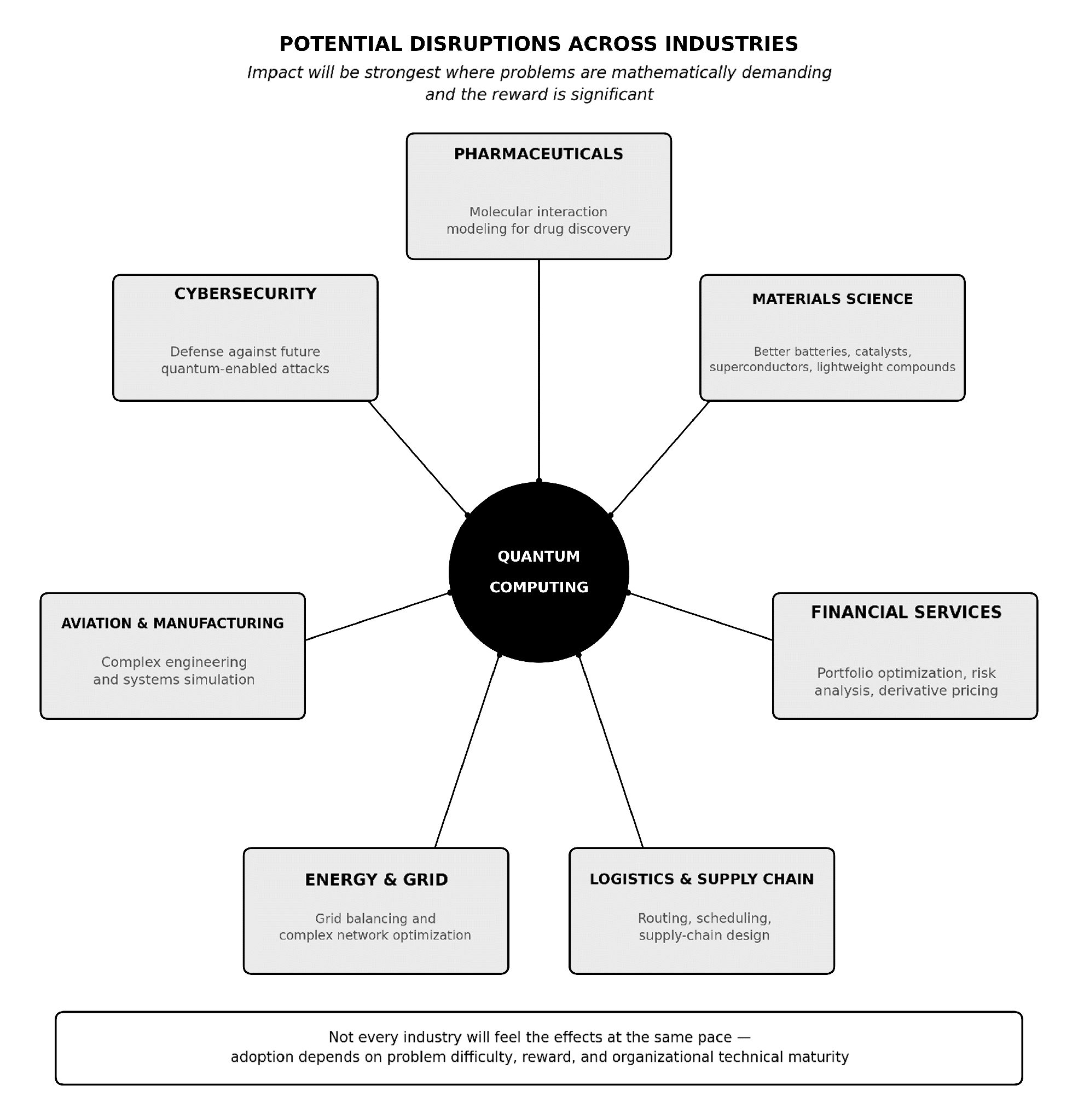
The industries most likely to experience early disruption are those in which small improvements in prediction, simulation, or optimisation can produce large economic gains. Pharmaceutical companies may use quantum methods to explore molecular interactions more effectively, while materials firms may search for better batteries, catalysts, superconductors, and lightweight compounds. Financial institutions may investigate portfolio optimisation, risk analysis, and derivative pricing, although such applications will need careful validation because speed alone is not enough; accuracy, explainability, and regulatory confidence will matter just as much.
Logistics, energy, aviation, and manufacturing may also feel the effects as quantum techniques are applied to routing, scheduling, grid balancing, supply-chain design, and complex engineering simulations. Cybersecurity will face a different kind of disruption, driven less by commercial optimisation and more by the need to protect information against future quantum attacks. Taken together, these changes suggest that quantum computing will not transform every industry at the same speed. Its impact will be strongest where the problem is mathematically demanding, the reward is significant, and the organisation has enough technical maturity to integrate quantum results into real decision-making.
Investing in quantum solutions
The industrial opportunities described above create an immediate strategic question: how should capital be committed while hardware is improving but commercial advantage remains selective? A sensible answer is portfolio-based investment rather than a single large bet. Governments and universities can fund foundational physics, fabrication, cryogenics, control electronics, error correction, testbeds and open research, while enterprises concentrate first on quantum literacy, problem discovery, cloud access and integration skills. The European Union’s 2025 Quantum Europe Strategy follows this broader logic by linking research, shared infrastructure, startup growth, resilient supply chains, security and skills instead of treating the processor as the entire market.
For most organisations, investment should progress through three horizons. The first is readiness: appoint a small cross-functional team, map high-value computational bottlenecks, inventory quantum-vulnerable cryptography and establish relationships with cloud providers and research partners. The second is disciplined experimentation through Quantum-as-a-Service, which provides access to different hardware modalities without premature capital expenditure. Candidate problems in molecular simulation, materials, scheduling, portfolio construction or grid optimisation should be tested through proofs-of-concept. Every result must be compared with strong, classical, high-performance computing and quantum-inspired baselines using total runtime, solution quality, energy and access cost, data-loading overhead, reproducibility and operational relevance. Only validated cases should move into the third horizon of pilots and hybrid production integration.
Investment decisions must therefore look beyond physical-qubit counts. More useful indicators include logical error rates, executable circuit depth, gate fidelity, throughput, compiler performance, availability, interoperability, and the cost of connecting quantum output to an existing decision process. Current vendor roadmaps place ambitious fault-tolerant systems near the end of the decade, but these remain engineering targets rather than guaranteed capacity. Diversification across hardware approaches, software layers and partners can reduce modality risk, vendor lock-in and dependence on a single roadmap while preserving intellectual-property options.
One investment can begin immediately: cryptographic modernisation. NIST’s finalised post-quantum standards are available for implementation, and its migration programme emphasises cryptographic inventories, risk prioritisation, interoperability and benchmarking. Organisations should build crypto-agility into procurement and architecture now, especially where data must remain confidential for many years. The strongest quantum portfolio will ultimately combine measured experimentation with practical security work and invest in the interfaces through which quantum processors will cooperate with AI, cloud and supercomputing platforms.
Quantum as part of convergent technologies
Those interfaces place quantum within a convergent architecture rather than a separate computing silo. Quantum computing, quantum communication and quantum sensing must first be distinguished. Computing uses controlled qubits to execute specialised algorithms; communication distributes quantum states or keys across networks; sensing exploits quantum effects for precise measurements of time, fields or motion. Their maturity, infrastructure and use cases differ, although all three may eventually interact with AI, cloud platforms, high-performance computing, cybersecurity and advanced engineering.
A practical converged workflow will be heterogeneous. Data from laboratories, enterprise systems, digital twins or IoT sensors will be prepared by classical software. An orchestration layer will schedule work across CPUs, GPUs, supercomputers and, only where justified, a quantum processing unit. The QPU may evaluate a molecular state, sample a circuit or handle a formulated optimisation subproblem; a classical optimiser or AI model will interpret the measurements, update parameters, quantify uncertainty and return the result to the application. This loop matters because quantum machines require classical control, error decoding, compilation and post-processing, while data-encoding costs, latency and repeated measurements can erase a theoretical advantage.
The infrastructure is already moving in this direction. EuroHPC’s 2026 access programme allows European users to request several quantum technologies through the ecosystem used for supercomputers. Its LUMI-IQ initiative goes further by proposing an experimental platform combining HPC, AI and emerging quantum capabilities. Such developments make the quantum processor resemble a specialised accelerator within a shared computational fabric rather than a replacement for classical machines.
Convergence can also create compound capabilities. Peer-reviewed work on AlphaQubit showed that transformer-based machine learning can improve decoding of experimental quantum error-correction data, illustrating how AI may help stabilise future processors. In chemistry and materials discovery, quantum routines could estimate selected electronic properties, while HPC performs large-scale preprocessing and machine learning searches wider chemical spaces. In digital twins, a quantum optimiser might explore constrained alternatives while classical simulation verifies safety and feasibility. For 6G, robotics and distributed IoT, near-term quantum contributions may come more from sensing, timing and secure communications than from placing fragile QPUs at the edge.
Real value will depend on open source toolchains, common intermediate representations, portable APIs, workload schedulers, provenance and shared benchmarking. Post-quantum cryptography must protect the surrounding data and control plane, while quantum key distribution should be evaluated separately for specialised links. With these foundations, convergence becomes a disciplined method for assigning each technology the task it performs best.
The next decade is unlikely to deliver instant transformation across every sector, but it will steadily redefine what is computationally possible in areas where classical methods struggle to scale. Quantum’s greatest value will emerge when organisations treat it as part of a wider technology ecosystem, working alongside artificial intelligence, cloud platforms, high-performance computing, and advanced security practices. To benefit from this shift, leaders will need to invest early in skills, governance, experimentation, and cryptographic readiness, while remaining realistic about technical limits. The future of quantum computing will belong not only to those who build powerful machines, but also to those who understand how to translate emerging capability into responsible, practical, and lasting impact.