

























































A graph-based knowledge layer that connects enterprise data, business relationships and AI memory to improve agent reasoning, accuracy and operational reliability.
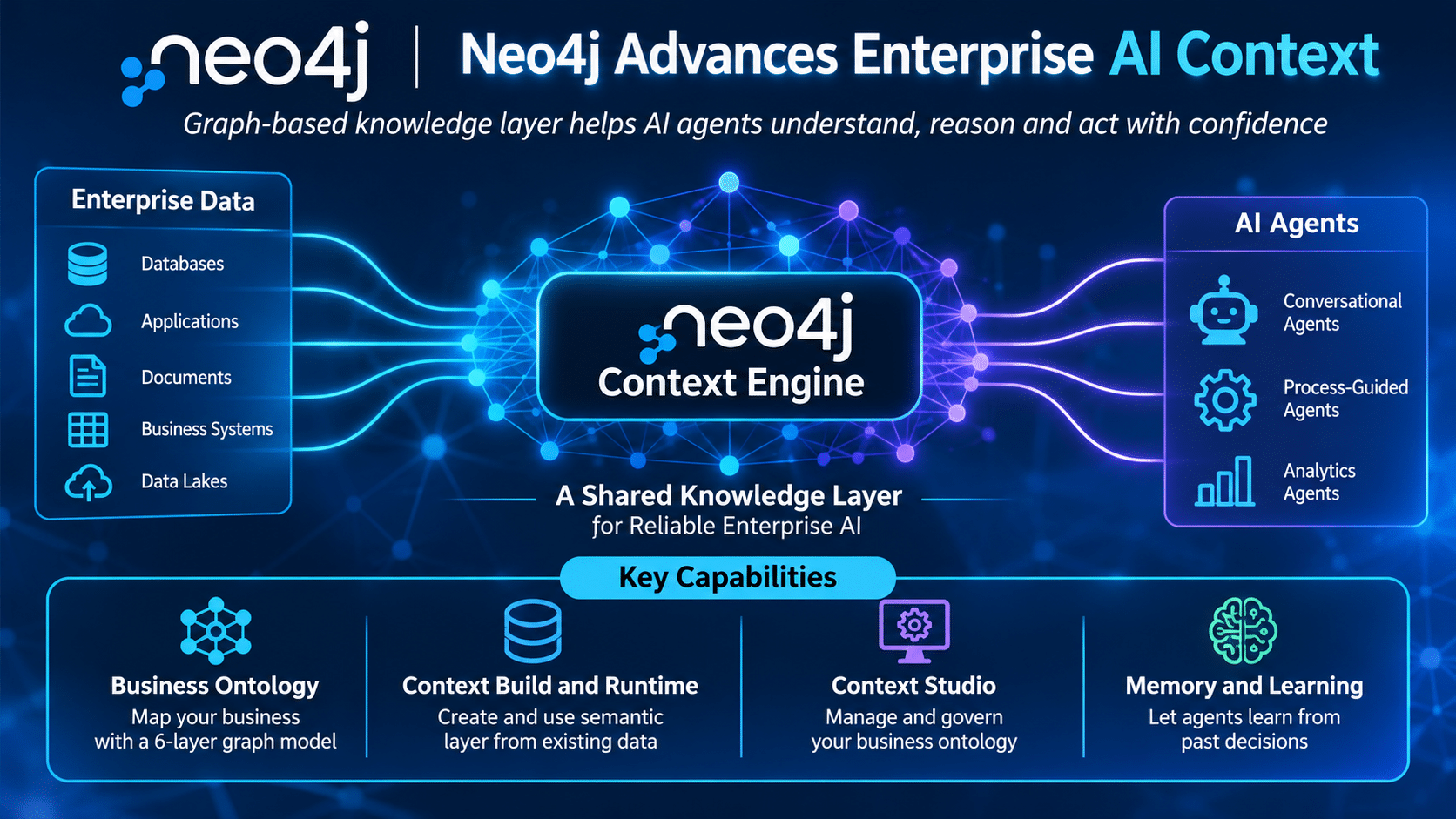
Neo4j has introduced a graph-based Context Engine designed to improve the accuracy, explainability and reliability of enterprise AI agents by providing a shared knowledge layer that connects business data, processes and relationships across different systems. Announced on October 21, 2026, the platform aims to address a key limitation of agentic AI: the inability of AI agents to inherently understand how business concepts and data relate within an organisation.
Unlike conventional data retrieval approaches, which primarily focus on accessing information, the Neo4j Context Engine uses graph technology to represent relationships between entities such as customers, suppliers, accounts and business processes. This enables AI agents to understand not only what information exists but also how different data points are connected and why those relationships matter. The shared knowledge layer allows multiple agents to access consistent business context rather than relying on individually configured knowledge sources.
The platform combines four major capabilities: Business Ontology, Context Build and Runtime, Context Studio, and Memory and Learning. Its six-layer Business Ontology provides a predefined graph model for mapping enterprise structures, processes, data and AI assets. Context Build and Runtime creates this semantic layer using existing data platforms, including Databricks and Snowflake, while Graph Retrieval-Augmented Generation (GraphRAG) retrieves relevant context for AI applications.
Context Studio provides a central environment for managing business ontologies, workflows and AI agent configurations. It also supports Model Context Protocol (MCP) servers and developer tools. Meanwhile, the graph-native Memory and Learning layer enables agents to retain short-term, long-term and reasoning memory. It tracks agent decisions and operational paths, while graph algorithms identify recurring patterns and convert them into reusable knowledge to improve future responses.
By separating enterprise knowledge management from individual AI agent configurations, the approach aims to simplify governance and support AI deployment across multiple business domains. It also enables organisations to maintain a consistent representation of business information as agentic applications become more complex. The Neo4j Context Engine is currently available in private preview, with enterprises invited to participate as design partners.