



























































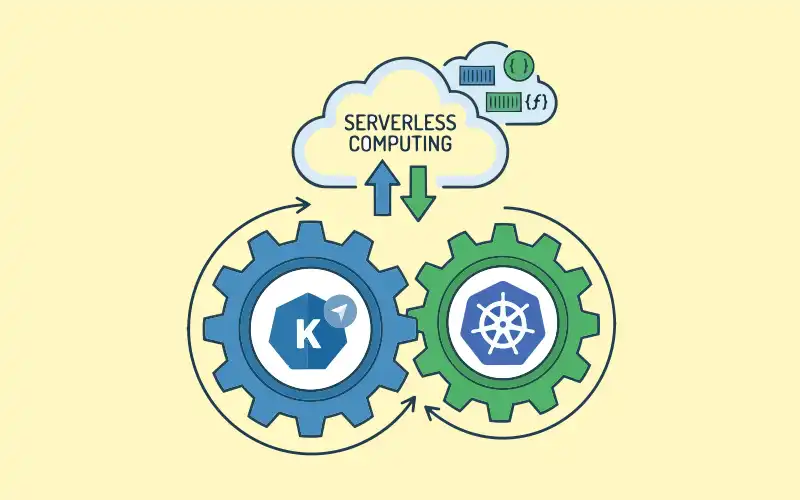

Knative adds high-level features to Kubernetes that make serverless computing so much easier.
Serverless computing has changed the way we deploy and scale modern apps. Developers can run code on platforms like AWS Lambda without having to worry about servers. This speeds up development cycles and lets the code automatically scale. But many companies quickly run into a big problem: vendor lock-in. When apps are tightly linked to a private cloud provider, it can be hard and expensive to move workloads or use a multi-cloud strategy.
Knative is one of the most important things that has happened in this field. Built on top of Kubernetes, it offers a way to do serverless computing that is native to Kubernetes. Instead of hiding containers completely, it adds high-level features to Kubernetes, like automatic scaling, event-driven workloads, and easier deployment of stateless services.
What is Knative?
Kubernetes does not need to be replaced by Knative. Instead, the latter adds features to Kubernetes that make it easier to run applications that don’t need servers and are event-driven. It adds more parts that take care of scaling, routing, and event management, but it still uses Kubernetes for the main container orchestration. The main parts are:
Serving
This part oversees deploying and managing workloads that don’t need a server. It automatically takes care of scaling, deploying containers, and routing traffic. One of its best features is scale-to-zero, which means that inactive services don’t use any resources until a request comes in.
Eventing
Knative Eventing is a way to make architectures that are based on events. It lets services talk to each other through events instead of direct requests. Developers can link event producers, brokers, and consumers in flexible pipelines, which makes it possible for workflows like processing data in real time, messaging systems, and orchestrating microservices.
Build (historical background)
In earlier versions of Knative, there was a Build component that made it easier to create container images right in the platform. But this feature was eventually split and turned into separate tools like Tekton. CI/CD pipelines are usually managed by someone else these days, while Knative focuses on serving and running events.
Model of the architecture
Knative’s architectural model is meant to add serverless features to containerised environments while keeping Kubernetes’s flexibility. Knative doesn’t depend on proprietary infrastructure; instead, it adds a set of abstractions that make it easier to deploy, scale, and manage traffic for modern apps.
Autoscaling to 0
Another important feature is the ability to automatically scale down to zero. When Kubernetes runs traditional containerised services, they often use resources even when they aren’t doing anything. When no requests are being processed, Knative automatically scales services down to zero instances to fix this.
Dividing traffic
Knative also has advanced tools for managing traffic. Developers can send traffic to different versions of a service, which lets them roll out changes slowly and use safer deployment methods. For instance, a new version of an app might get a small amount of traffic while the stable version handles most of the requests.
Workloads that are event-driven
Knative’s eventing system lets you run event-driven workloads in addition to request-based ones. Apps can react to events that come from different places, like messaging systems, data streams, or other services.
Why teams use Knative in production
Deployments in hybrid and multi-cloud
Knative is especially useful for teams that work in environments with more than one cloud. It can be run on Kubernetes, which means that the same application architecture can be used on different cloud providers or even in private data centres.
Rules and regulations that apply on-site
Some industries have strict rules or regulations that stop them from using public cloud services for sensitive workloads. In these situations, Knative lets teams build modern, scalable applications that meet security and compliance standards on their own infrastructure without having to worry about servers.
Control over networking in small steps
Another good thing is that it can work with advanced networking tools like Istio or Kourier. These technologies give you a lot of control over routing, security policies, and how well you can see what’s going on. As a result, platform teams can set up advanced networking settings that many managed serverless platforms can’t do.
When companies use Knative in production, they often build systems that strike a balance between scalability, security, and operational efficiency. Knative runs on top of Kubernetes, so a lot of best practices come from how to set up a Kubernetes cluster, but they also consider things that are unique to serverless.
Design for a multi-tenant cluster
In a common production scenario, multiple teams or applications share the same Kubernetes infrastructure in a multi-tenant cluster. In such places, it’s important to keep things in control.
Separation of namespaces
Namespaces help keep things organised in a Kubernetes cluster. Each team or project can work in its own namespace, which lets them deploy Knative services, configurations, and event resources separately. This separation lowers the chance of team conflicts and makes it easier to manage access.
RBAC limits
Another important way to manage multi-tenant environments is through role-based access control (RBAC). Kubernetes RBAC policies say who can create, change, or delete resources.
Networking and ingress
Setting up the gateway
An ingress layer is what Knative uses to make services available to the outside world. A lot of deployments work with a service mesh like Istio or use lightweight ingress controllers like Kourier.
Services inside and outside the company
Not every service needs to be public in a lot of architectures. Some services only work inside the cluster, like internal APIs or background processors. Knative lets teams set up services so that they can only be accessed from inside the cluster or from the outside.
Autoscaling in the real world
One of the most important parts of Knative is autoscaling, but in real-world deployments, it needs to be carefully tuned to get the best performance.
Tuning for concurrency
Knative lets administrators set the maximum number of requests that a single container instance can handle at the same time. Changing the limits on concurrency helps find a balance between latency and resource use. Lower concurrency can speed up response times, while higher concurrency can cut down on the number of instances that are running.
Preventing cold starts
Because Knative can scale services down to zero, the first request after a period of inactivity may have to wait longer to start. Teams often get around this by keeping a minimum number of warm instances or speeding up the time it takes for containers to start up.
Architectures based on events
One of Knative’s best features is that it supports event-driven architectures, which let services respond to events instead of just waiting for requests to come in. This method makes systems more scalable, separates their parts, and lets data streams be processed in real time.
A model based on brokers and triggers is used by Knative Eventing. In the system, a broker is like an event router. It gets events from producers and sends them to the right consumers. Triggers set the rules for filtering and routing that decide which events should go to which services. This architecture lets developers make flexible pipelines where services can respond to events without having to be directly connected to each other.
Observability and operations
To run serverless workloads in production, you need strong monitoring and observability tools. Because serverless services can change size and run for short periods of time, it’s very important to be able to see how the system is working.
Logging that is organised
Structured logging is popular in cloud-native environments because it makes log entries that machines can read. Logs are structured data instead of plain text messages. This makes it easier to search, filter, and analyse them automatically. This method makes it easier to fix problems and helps teams find problems faster in distributed systems.
Working with Prometheus
Collecting metrics is another important part of observability. Knative works well with monitoring tools like Prometheus, which keeps track of things like request rates, latency, and resource usage. These metrics let operators keep an eye on when the application is working, spot problems, and set up automatic alerts when certain levels are reached.
Fixing problems in production
Even systems that are well-designed fail from time to time, which is why debugging tools and deployment strategies are so important. With Knative’s revision-based deployment model, operators can quickly go back to an older version of a service if a new one causes problems. Because each revision can’t be changed, rolling back means sending traffic back to a stable revision.
Traffic splitting for safe deployments
A useful feature is traffic splitting. Operators can slowly send a small amount of traffic to a new version while keeping an eye on performance and error rates. If there are problems, traffic can be quickly redirected so that users don’t have to deal with much trouble.
SLOs and dependability
To keep things running smoothly in production environments, you need to have clear service level objectives (SLOs). When teams use Knative on top of Kubernetes, they need to keep an eye on performance metrics and set limits on how the system can behave.
Measuring cold start latency
Cold start latency is an important measure of reliability. The first request after a period of inactivity may take longer because Knative can scale services down to zero instances while a new container instance starts.
Setting performance budgets
Performance budgets set limits on how long it takes to respond, how many errors can happen, and how often the system is available. Teams can check if their serverless workloads are meeting operational goals by setting clear budgets.
The Horizontal Pod Autoscaler (HPA) in Kubernetes already lets you scale by changing the number of pods based on resource metrics like CPU usage. Knative has its own autoscaling system that works best with workloads that are based on requests.
Workflows for CI/CD and GitOps
To use Knative services in production, you need good version control and automation. Declarative YAML manifests are used to define most Knative deployments. These manifests describe services, revisions, and event resources.
Delivery that gets better over time
Knative’s traffic management tools make it possible to use progressive delivery strategies. Canary deployments and blue-green releases are two ways that teams can slowly roll out new versions of services while keeping an eye on how the system works
Standards for pod security
One important way to protect yourself is to follow Pod Security Standards (PSS). These rules limit what containers can do inside the cluster, such as giving them host access, root-level execution, and unsafe capabilities.
Signing images
You should always check container images before you deploy them. Image signing tools make sure that images come from reliable sources and haven’t been changed.
Policies for the network
Network policies give you very precise control over how services talk to each other within the cluster. These rules limit traffic between services or namespaces, making sure that only authorised communication paths are allowed.
Safety in the supply chain
Software supply chain security is becoming increasingly important because modern applications depend heavily on things outside of themselves. Before deployment, automated scanning tools can find flaws in container images and dependencies.
Risks of multi-tenant isolation
When multiple teams or organisations share a cluster, multi-tenant isolation becomes a big problem. Weak isolation policies can let workloads from one tenant get in the way of or use resources that belong to another tenant.
Trade-offs and performance benchmarks
When looking at serverless platforms, companies often compare open source options like Knative with managed services like AWS Lambda. Each method has pros and cons when it comes to performance, scalability, and cost of doing business.
Managed serverless platforms usually offer a very optimised environment where the cloud provider takes care of all the infrastructure management. This lets developers only work on the code for the application. Knative, on the other hand, offers a similar serverless experience but runs on Kubernetes clusters that businesses manage themselves.
Characteristics of scaling throughput
Knative works well in places where you need a lot of throughput and the ability to scale up or down as needed. It can scale horizontally by starting more container instances on different cluster nodes because it runs on Kubernetes.
Modelling costs
The structures of the costs are very different. Managed serverless platforms charge based on how many times a function is called and how long it takes to run, which is great for workloads that don’t happen all the time.
Easy workload
If you need a small application or a simple background job, using a full Kubernetes-based serverless platform might make things more complicated than they need to be. Managed services like AWS Lambda can often give you results faster with little to no setup.
Knative works best in companies that are willing to spend money on engineering teams that take care of the infrastructure and tools for developers.