
























































A new 32-billion-parameter reasoning model combines perception, planning and decision-making across the autonomous driving stack, while a companion simulation framework helps train vehicles on complex scenarios before they hit public roads.
The race to commercialise robotaxis received a fresh boost with the debut of a new open reasoning model designed to help autonomous vehicles think through complex road situations rather than simply react to them.
Built as a 32-billion-parameter vision-language-action (VLA) model, the technology is designed to handle perception, reasoning, planning and action across the full driving stack. The goal is to accelerate the development of Level 4 autonomous vehicles, where cars can operate without human intervention in defined environments.
The key features are:
- 32-billion-parameter vision-language-action reasoning model
- Supports perception, planning and action across the full driving stack
- Designed for scalable Level 4 robotaxi development
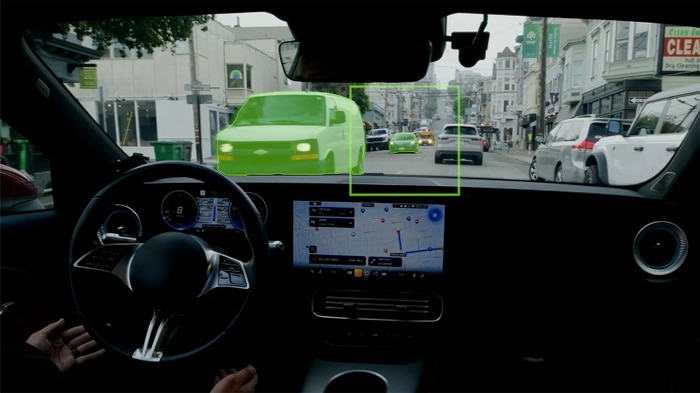
- Full 360-degree situational awareness capability
- Closed-loop reinforcement learning framework for simulation-based training
Unlike conventional autonomous driving models that focus mainly on trajectory prediction, the new platform is designed to interpret surrounding conditions, understand intent, evaluate options, and execute driving decisions. Developers can also use it for tasks such as scene understanding, automated data labelling, model evaluation and knowledge distillation into smaller vehicle-ready systems.
A key addition is support for full-surround situational awareness, allowing the model to process information from a vehicle’s complete sensor suite rather than relying primarily on forward-facing views. This broader perception capability is intended to improve decision-making in dense urban environments and unusual traffic situations.
Alongside the model, developers are getting access to a new reinforcement-learning framework that trains autonomous systems in simulation before deployment. The platform enables vehicles to learn from the consequences of their driving decisions in closed-loop environments, helping engineers test edge cases and rare scenarios without exposing vehicles to real-world risk.
The release reflects a broader industry shift toward reasoning-based autonomy, where AI systems are expected to explain and justify driving decisions instead of relying solely on pattern recognition. As competition intensifies among robotaxi developers worldwide, increasingly sophisticated AI models and simulation tools are becoming critical for achieving scalable and safe autonomous transportation.