


























































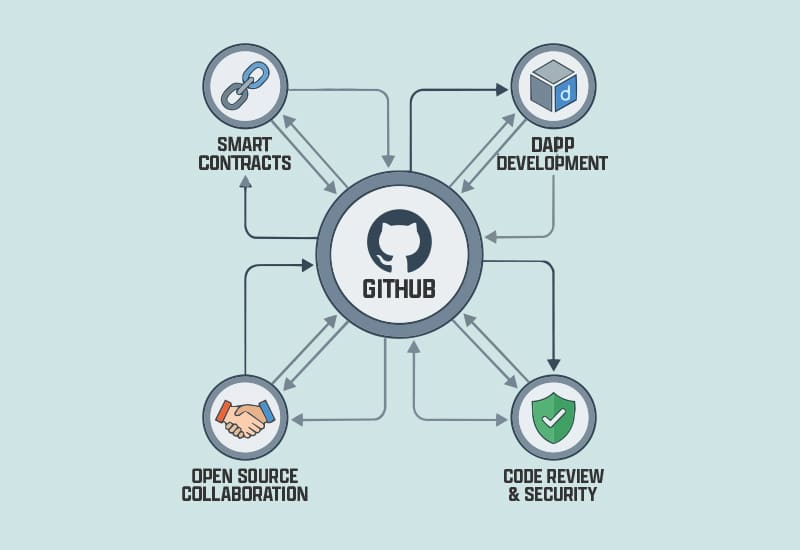

GitHub is a key enabler of blockchain development as it formalises code collaboration and helps to transparently validate it before deployment. By embracing the principles of open source software, it allows contributors from around the world to develop, review and improve blockchain solutions.
GitHub is a foundational platform for all blockchain project management. It helps to track versions of code in a structured fashion, allows code to be shared openly, and facilitates collaboration by providing workflow tools that demonstrate the decentralised aspects of the blockchain. Developers use GitHub to develop smart contracts, manage their updates, maintain bug-tracking records, and coordinate their contributions among multiple geographic locations.
As a real-world example, developers use GitHub repositories to build and host a large part of Ethereum-based dApps. A developer creates a specific smart contract module (e.g. ERC20 Token), and other developers review it for possible vulnerabilities before it is integrated by a third party into a live application. This cycle of continual validation by other developers ensures that the contribution is a safe piece of code for deployment on an unalterable blockchain.
Developers can use GitHub as a means of learning to evolve their careers. Many developers entering the Web3 ecosystem start by browsing the publicly available open source repositories, explore how others have built off those repositories, and then contribute their own smaller fixes or enhancements. Eventually, these contributions serve as a public portfolio, showing that the developer possesses relevant skills as well as experience working with others.
When attending a blockchain hackathon, students generally create clones of existing repositories and modify the logic of their smart contracts before contributing via pull requests to show the improvements made to each project. This activity facilitates the operation of blockchain startups and decentralised development teams.
Web3 technologies like DeFi, NFT and DAO have strengthened the pivotal role of GitHub as a foundational resource for blockchain development. GitHub enables people from all around the world to collaborate on projects, creates transparency in the evolution of code, and facilitates scalable collaborative development in a decentralised environment. This has an impact on not only how applications are created, but also on how innovation is disseminated, validated and maintained in today’s decentralised ecosystem. Hence GitHub can be viewed as more than a development platform — it can be seen as a collaborative validation layer that confirms code reliability before it becomes part of an unalterable blockchain.
Why GitHub is the backbone of blockchain development
There’s a significant level of transparency and co-operation required to be built on top of a
blockchain compared to traditional software systems; however, once deployed on a blockchain, the code is immutable (which means that if there’s an error in it or a vulnerability, the consequences cannot be corrected). Therefore, the stakes are high and it’s critical to use a development platform that allows for structured workflows, ongoing validation of the code and global peer oversight. GitHub provides the tools necessary to meet these requirements by being an effective version control system, enabling developers to view and track every change made to the codebase. In addition, creating branches in which to explore or develop new functionality, reviewing all the differences between versions of the code and reverting to the previous version when needed, helps ensure that the final product is stable and ready for deployment.
A key aspect of GitHub’s alignment with the fundamental values of blockchain is transparency. Everyone can see all the public repositories. Therefore, users (and any other stakeholders) can independently verify how each application operates (rather than relying on an opaque implementation), suggest modifications, and identify any vulnerabilities (e.g., bugs) that need to be remedied. This creates trust between users and within the wider community.
Another component of GitHub’s contribution to blockchain is the enabling of global collaboration. Developers are (asynchronously) contributing to projects from all around the world, and they have continuous access to these projects regardless of what time zone they are in. This is similar in principle to the decentralised governance model of DAOs (decentralised autonomous organisations) wherein both the decision-making and the developmental effort are shared/distributed among all network participants rather than centralised in one entity.
GitHub provides many development tools. One of these is GitHub Actions, which can create automated testing and deployment pipelines for developers. These tools can be extremely beneficial for developers to validate their smart contracts during the testing phase (prior to real world deployment), significantly reducing the risk of making costly mistakes. GitHub supports the development of products and acts as a pre-validation layer where developers can confidently test the logic of their smart contracts before these become part of the immutable blockchain.
GitHub workflow in blockchain projects
The immutable code deployed on a blockchain makes it imperative that blockchain projects follow a disciplined development process. Once a smart contract is deployed on the blockchain network, it cannot be changed easily; therefore, projects must perform thorough validations and collaborate with each other prior to deployment.
GitHub provides a structure that supports the development, review and deployment of blockchain projects. A typical blockchain project hosted on GitHub adheres to a defined repository structure that separates the components of the overall project. For example, smart contracts are maintained in their own directory, while front-end user interfaces, configuration scripts and documentation are organised into separate modules. This leads to clarity of project components, ease of maintainability, and efficiency of collaboration among distributed teams when developing decentralised applications.
Version control system (VCS) branching is a vital mechanism for codebases in the blockchain. Branches are created for new functionality or to address error/malfunction issues without altering the current coding structure. Branching allows developers to create new functions and correct errors away from the live smart contract, so that there is an isolated area for functionality development as well as experimental results until development is complete. Upon completing development, developers submit their change for approval through a process called a pull request. This allows for collaborative validation of the proposed changes before they are merged into the main codebase.
Because of the collaborative validation of pull requests, contributors can find and fix any logical errors within their code before it is deployed. Due to the significant financial and security implications of smart contracts, developers must conduct more thorough reviews than are needed for traditional software applications. GitHub provides several tools to assist with reviewing code, including in-line comments, threaded discussions, and approval processes. These help ensure that only the highest quality codes are accepted into the main codebase.
Integrating CI/CD into the blockchain development process allows developers to use automated systems to test and validate their code changes to instantiate and execute smart contracts. GitHub Actions provides a way to automate the execution of smart contract testing using frameworks so that each code change can be checked against pre-established conditions. Automating testing through CI/CD pipelines mitigates human error and helps ensure consistent results before deploying to the underlying blockchain networks.
The GitHub workflow creates a controlled environment for blockchain logic, providing a framework to test, refine and validate the code before it is deployed to production.
Trends in blockchain development on GitHub
Blockchain development fundamentally involves a large shift from centralised systems to decentralised ones, as well as a major transformation in how developers contribute to those systems through GitHub. One good example of this is the exponential increase in the number of repositories related to the Web 3.0 ecosystem on GitHub, as an increasing number of developers are contributing to numerous different projects focused upon using the Ethereum blockchain as the underlying technology to build decentralised applications (dApps). These projects include, but are not limited to, those that use smart contract frameworks and blockchain infrastructures such as Hyperledger. In addition, there is an overall trend towards creating more community-based systems that increase levels of cooperation and collaboration between developers and facilitate more community-driven innovation.
Furthermore, developers working on GitHub have recently begun exploring ways that artificial intelligence can integrate with blockchain development. Examples include AI generated smart contracts, AI-enabled automated code audits, and AI-supported predictive vulnerability detection. Combining these two technologies is reshaping GitHub and creating a unique environment for intelligent toolsets that will improve how blockchain projects are built.
The patterns of open source contribution are also changing. Independent developers, researchers, and startups are more involved in contributing to blockchain projects than in traditional enterprises. Examples include reporting issues, submitting pull requests, and collaborating on problem solving — all of which contribute to creating a decentralised development culture that aligns with the principles of blockchain technology. Developers are focused on understanding security and audit practices to develop their project repositories’ structure and workflow. They prioritise secure coding practices, formal verification, and automated testing of smart contracts to minimise risks related to vulnerabilities in smart contracts. Developers who want to secure their code are establishing security-specific repositories and audit frameworks within the larger GitHub ecosystem.
The modular and reusable components of the blockchain are becoming ever more important. Developers are creating libraries, SDKs, and protocol layers (that can be used across many different projects) at an accelerating rate. The modularity of these components allows for a faster total development time, as well as providing opportunities for standardisation to occur across application interfaces.
GitHub, which has started to serve as a source of credibility and visibility for blockchain developers, is evaluating developers based on their contribution history, activity level in their own repositories, and their level of involvement in open source work, all of which are indicators of technical knowledge, ability, and level of community involvement. Due to this, many hiring processes in blockchain startups and decentralised organisations are increasingly taking these indicators into account as part of their selection process.
The move towards decentralised development models is further strengthening GitHub’s position as a source of credibility for blockchain developers. The collaborative workflows that take place on GitHub resemble the way that DAOs operate because GitHub contributors are allowed to participate in governance through discussions, proposals, and consensus-based approvals. This trend represents a continued shift away from centralised development teams and towards decentralised, community based ecosystems.
Challenges in open source blockchain development
While working with blockchain technology on GitHub presents opportunities for innovation, the combination of open source collaboration along with the highstakes nature of decentralised systems creates a few challenges. The risks associated with public access to platform-level code mean there are additional considerations around risk management and structured development processes. Security is one of the most significant challenges faced by developers when creating their open source blockchain projects. Smart contracts are used to process financial transactions as well as other sensitive operations, making them prime targets for attack. Exposing these smart contracts through public repositories allows malicious actors a wide avenue for identifying vulnerabilities in the code. Although
transparency through accessible code is important, it can increase the likelihood that some malicious actor will take advantage of the vulnerability. In addition, even the smallest logical error will result in actual dollars being lost once deployed onto an immutable blockchain network. Contributors to blockchain projects have diverse backgrounds, skills and expertise, resulting in different forms of coding standards or lack thereof, as well as documentation practices and architectural decisions. Without strictly enforced review mechanisms, this variability can contribute to the fragmentation of the overall codebase resulting in reduced maintainability.
The open source blockchain project governance and decisionmaking process can also be very complex. In traditional organisations, organisational hierarchies dictate how assets are developed within an organisation. However, the development of blockchain assets is often performed through decentralised models, where the contribution of all developers impacts the overall direction of a project. Therefore, without a clearly defined governance framework, there is a high probability of conflict, delays in the decision-making process, and inconsistent evolvement of the project. In addition to the complicated nature of collaborative project management, the scalability of repository management can also prove troublesome when trying to develop a large blockchain project with a lot of different components, including smart contracts, front-end applications, APIs, and infrastructure scripts. Therefore, as a project increases in size, it becomes more difficult to manage complex repositories while also having the appropriate version controls and collaborative efforts across contributors.
Open source blockchain development also has a risk of code misuse and the creation of unauthorised forks, as public access to code allows any individual to copy, alter, or deploy a similar asset. These actions affect the credibility of the original asset while also adding to the confusion of the entire ecosystem. Using external tools and integrations also adds another level of complexity to open source blockchain development. Workflow processes related to blockchain require multiple frameworks and methodologies to test and deploy assets. Therefore, as the integration of these external tools and processes into GitHub based workflows takes place, continuous monitoring and regular updates across the integration are required to ensure compatibility and stability.
The future
Blockchain coding on GitHub is likely to make major strides due to the development of decentralised technology and broader developer communities. Emerging technologies will lead to GitHub’s strategic use as both a communication and a cognitive layer to facilitate the creation and verification of digitally distributed systems. AI will have a significant influence on the integration of digital technologies into the development of blockchain applications. The use of AI-enabled coding tools will provide smart contract template generation capabilities, detect/identify logical flaws in smart contracts, and provide techniques to improve code structure efficiency. These tools will assist developers and improve productivity by decreasing the hazards associated with manual coding errors in the blockchain space.
A key opportunity for automated security and verification mechanisms to evolve is their integration with the GitHub development pipeline. The use of advanced testing frameworks, formal verification tools, and constant audit pipelines will improve the security and reliability of smart contracts prior to their deployment, solving one of the major challenges faced in the development of blockchain technology. The impact of decentralised development ecosystems may also alter GitHub’s future role as well as peer-topeer networks on distributed version control (e.g., Git) systems, which were created to reduce dependency on centrally hosted services. If GitHub were to be incorporated into a network of decentralised storage and collaborating technologies, it could change the way developers create and maintain their blockchain projects over time.
The aim is for GitHub to serve as the main identity platform for developers building on the blockchain. The more developers evaluate their own experiences and contributions to the community, including things like their contribution history, activity in the various repositories, and involvement in community-based projects, the more they will have an established level of credibility and be able to leverage the many global opportunities in Web3.
With the increase in adoption of blockchain technology, there will be increased needs for standardisation of the methodologies used to develop software. Creating similar methods around how to structure repositories, and how to test and deploy all pieces of development by teams, will improve collaboration among GitHub projects. This evolution will support the overall goal of making technology more accessible, inclusive, and decentralised.