
















































Small language models are democratising access to artificial intelligence with their ability to achieve specific goals on tablets, laptops and edge devices, without a need for the internet. Enhanced privacy and low latency are additional advantages.
Researchers at a university in a developing country, studying regional literature from past centuries, can now get the same results on an open model as they would have got from million-dollar data-centre access earlier.
This is not a forecast for 2035. This is true in February 2026!
The field of giant language models is currently experiencing a shift towards small language models (SLMs) that achieve near-state-of-the-art results while operating on mobile devices, computers, and edge devices. The products of these technologies operate at lower costs, deliver faster performance, consume less power, and provide users with greater control of their data.
Artificial intelligence has entered its phase of accessibility for everyone.
The dawn of compact AI
A doctor can today work at a rural clinic and use her smartphone to access a lightweight AI tool that gives her instant diagnostic results. Small language models (SLMs) are ‘compact titans’. They demonstrate that larger systems do not always deliver superior performance because their technology enables both multinational companies and independent researchers to access artificial intelligence.
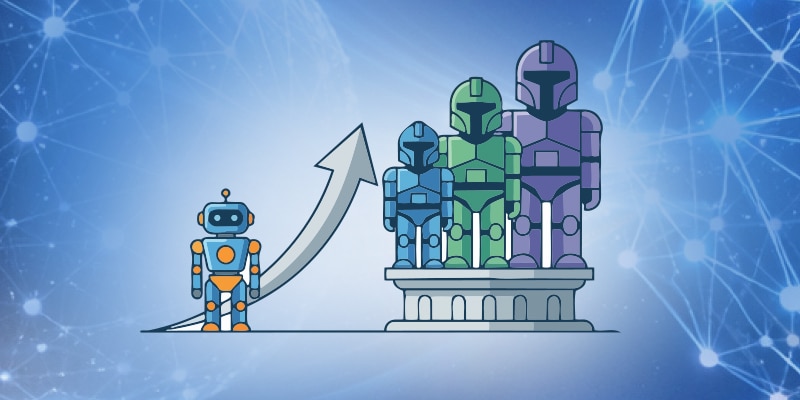
SLMs have emerged as efficient underdogs. The Phi-3 model from Microsoft, the Gemma 2B model from Google, and Mistral’s products demonstrate that the path to success does not always need raw power — efficient design can get the same results. Model fine-tuning enables the achievement of advanced research goals, while making artificial intelligence accessible even to users who have no technical expertise.
Decoding small language models
Think of large language models (LLMs) as massive cargo ships that have the power to transport extensive knowledge across the oceans yet operate with slow speed and high operational costs, and require excessive fuel consumption. SLMs resemble agile speedboats that possess the ability to navigate specific routes with exceptional speed because they operate with high agility and low fuel consumption. SLMs like Phi-3.5 (3.8B), Gemma 2 (2B-9B), Mistral Nemo (12B) and Qwen3 variants reach high performance levels and require fewer resources. The systems operate on laptops, smartphones, and edge devices to provide quicker inference times and reduced operational expenses, when compared with their larger competing systems.
The Phi series developed by Microsoft achieves exceptional performance in reasoning and code tasks while Qwen3-0.6B dominates the market through its ability to support multiple languages. Enterprises use SLMs to perform specialised tasks for fraud detection and customer support as these models are accurate, while avoiding the environmental impact and delay associated with using cloud-based LLMs. Quality data, together with focused training methods, can achieve benchmark performance that rivals broader models. Powerful AI today depends on systems that are more efficient and offer specialised solutions to achieve better results.
How LLMs and SLMs differ from each other
| Large language models (LLMs) | Small language models (SLMs) | |
| Parameter count | Hundreds of millions to billions | Millions to low billions |
| Computational resources | High; require extensive hardware and memory | Low to moderate; can run on less powerful devices |
| Training data | Extensive, diverse corpora | More specific datasets or smaller subsets |
| Inference speed | Slower due to complexity | Faster, useful for real-time applications |
| Cost | High training and deployment costs | More cost-effective |
| Versatility | Highly versatile, applicable to a wide range of tasks | Specialised, handle small tasks better |
| Deployment | Suitable for cloud and large-scale environments | Suitable for edge devices and constrained environments |
Fine-tuning a small language model
Every pretrained SLM begins life as a remarkably capable generalist. The system acquires its ability to understand grammar, facts, reasoning abilities and fundamental world knowledge through training on trillions of tokens, which include books, websites, code and conversations. Specialised work requires special skills.
Fine-tuning turns raw potential into targeted expertise. The model modifies its internal weight structure by training on specially selected smaller datasets that contain thousands to tens of thousands of high-quality examples. The process integrates domain-specific vocabulary, stylistic conventions, reasoning patterns, safety constraints and task formats into the core model structure.
Large models (70B+) are notoriously expensive and slow to fine-tune; they demand massive GPU clusters and days or weeks of compute. A 3B-8B SLM can be meaningfully fine-tuned in hours on a single high-end consumer GPU or a modest cloud instance. This cost and time reduction enables universities, hospitals, startups, NGOs and individual developers to customise their systems with realistic budgets.
Here are a few popular techniques that are being used for fine-tuning SLMs in 2026.
Full fine-tuning
Updates every parameter for models that have less than 10B parameters (although it remains useful for all other cases too).
LoRA (Low-Rank Adaptation)
The base model gets frozen while researchers train new, tiny, low-rank matrices (this method has become the most popular).
QLoRA
Combining this with LoRA and 4-bit quantization reduces memory requirements.
Adapters
The process involves placing small trainable bottleneck layers between existing layers.
These parameter-efficient methods operate with updates on less than 1 percent of all weights, which results in great performance with minimal resource requirements.
Here are a few real-world examples.
- Healthcare providers fine-tune SLMs with anonymized clinical notes and guideline texts to create better radiology summaries, medication reconciliation reports, and patient-friendly explanations of medical information.
- Law firms adapt models to their own contract templates, jurisdiction-specific regulations, and past case laws for rapid clause analysis and risk flagging.
- Enterprises create internal knowledge agents through proprietary wikis and SOPs, and support ticket fine-tuning, which produces assistants that have complete company knowledge.
- Academic labs use fine-tuning to adapt open models for niche scientific domains — crystallography terminology, regional dialect NLP, or endangered-language preservation — without needing supercomputer access.
Fine-tuning acts as a bridge that transfers all theoretical advancements from their research paper and GitHub repository origins to actual implementation in hospitals, classrooms, courtrooms and small-business dashboards.
How fine-tuning stands apart from pretraining and prompt engineering
The pretraining process helps models learn from extensive general datasets to develop abilities that enable them to identify patterns, comprehend languages and acquire fundamental knowledge about the world, which takes children several years to acquire through reading. It demands substantial resources because it produces basic models that can execute multiple functions.
Users can generate model outputs through different input methods, which include zero-shot, few-shot and role-based inputs, because prompt engineering enables this process without requiring any software modifications. The system needs password access to execute its operations; it manages to complete individual tasks but struggles to process multiple responsibilities that need memory retention of earlier tasks.
Fine-tuning creates a new process which retrains models through targeted data while maintaining permanent weight updates that enable models to achieve deeper specialisation. Through adaptable interface options it delivers stable high-accuracy results, which surpass prompt engineering performance in coding and diagnostic domains.
Fine-tuning can be conducted on regular computer setups and helps SLMs work better than LLMs that use prompt-based systems for specific tasks. The pretraining process establishes the basic system, which temporarily uses prompted guidance to direct its functions until the user establishes permanent system modifications through fine-tuning. The latter renders SLMs highly flexible and efficient.
SLMs in action
Enterprises: Efficiency meets privacy
Large organisations are rapidly moving mission-critical workloads to fine-tuned SLMs because they can run on-premises or in private clouds. Financial institutions use between 3 and 7 billion models to identify fraud patterns through real-time analysis of millions of transactions that occur at sub-second speed without any data leaving their security perimeter. Retail and telecom companies use internal customer interaction logs to develop advanced chat and voice agents, which enable them to reduce cloud API expenses by 70 to 90 percent while satisfying their data residency as well as GDPR and CCPA compliance requirements.
Education: Personalised learning at scale
Educational institutions provide students with interactive learning resources through SLMs that function without the need for internet access or costly subscription services. Students receive personalised reading materials, maths problems and quizzes, which include explanations of content through fine-tuned models that match their specific language needs and learning requirements. TSLMs (time-series language models), which operate on affordable tablets and shared school laptops deliver uninterrupted tutoring services to remote areas of rural India, sub-Saharan Africa and remote Pacific islands as they can function without internet access. Global MOOC platforms use them to auto-generate multilingual subtitles, discussion prompts, and feedback at scale. The result: education becomes more inclusive, equitable, and scalable.
Healthcare: Intelligence at the point of care
Domain-adapted SLMs operate in hospitals, clinics and remote health posts to process patient notes, lab results and wearable data at local sites. The system generates discharge summaries, which include medication interaction warnings, differential diagnosis recommendations and patient-friendly report translations without transmitting secure PHI data to external servers. Community health workers in under-served areas with slow internet connections use SLMs on tablets or smartphones to assist them with patient triage, maternal care and chronic disease monitoring. The findings from early 2026 pilots demonstrate that rural areas now experience better diagnostic accuracy and speedier medical treatment because of these advancements.
Research: Democratising scientific discovery
Researchers from academic institutions and independent organisations can now utilise advanced research tools that do not require them to request GPU access from major technology companies. They can conduct overnight fine-tuning of open models, which include Phi-4 Gemma-3 and Qwen variants, by using domain datasets that contain protein folding sequences, climate model outputs, historical archives and endangered-language corpora. Researchers from Global South universities are now conducting large-scale simulations, literature reviews and data analysis, which computational resources prevented them from doing before. The open source nature of most SLMs fuels global collaboration: a biologist in São Paulo can build on work done by a physicist in Nairobi using the same base model.
All four domains use SLMs to deliver specialised intelligence on local devices, edge servers and private infrastructure. The system provides users with privacy protection, low latency, cost savings, and operating freedom from external service providers.
SLMs are today establishing themselves as a highly effective AI solution. New models like Phi-4, Gemma 3 and Qwen3, along with knowledge distillation methods, enable these models to match large language model performance while maintaining faster, cheaper and more private system advantages. This new era of democratisation enables anyone to access advanced intelligence through basic hardware and original ideas.