























































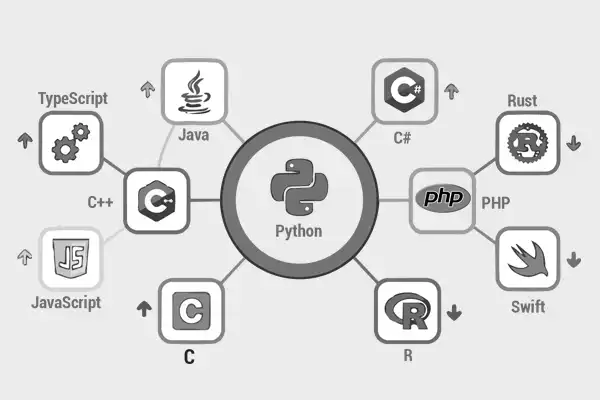

As always, this ranking of the Top 10 popular open source programming languages is based on four other rankings. A new entrant this year is Rust.
Over the past decade, I have contributed three articles to Open Source For You (OSFY) focusing on the ranking of popular programming languages. The first article on this subject, titled ‘10 Most Popular Programming Languages’, was published in 2017. It is a difficult as well as controversial task to rank programming languages for popularity or usefulness. So, rather than depending on a single ranking, I considered the four most popular rankings of programming languages: the RedMonk programming language ranking, the PYPL (PopularitY of Programming Language Index) ranking, the IEEE Spectrum ranking of programming languages, and the TIOBE index. The article is available online on the OSFY portal at https://www.opensourceforu.com/2017/03/most-popular-programming-languages/. My top 10 list of programming languages that year was C, C#, C++, Go, Java, JavaScript, PHP, Python, Ruby, and Swift (in alphabetical order, not in the order of popularity).
After a gap of exactly two years, in February 2019, I wrote another article titled ‘Yet Another Top Ten List of Popular Programming Languages’, available at https://www.opensourceforu.com/2019/03/yet-another-top-ten-list-of-popular-programming-languages/. I used the same criteria as in 2017 to compile the Top 10 list, and the programming languages picked this time were C, C#, C++, Java, JavaScript, Objective-C, PHP, Python, R, and Swift. Objective-C and R entered the Top 10 list, replacing Go and Ruby. The languages that looked especially promising in 2019 were Python and JavaScript, while Ruby and Perl showed a noticeable decline in popularity.
The article concluded with a section on new and emerging programming languages that had been first released within the previous decade (2009 or later). This list included seven languages: Swift, Go, Rust, Kotlin, Julia, TypeScript, and Dart.
The last article in this series was published in February 2021. The article, titled ‘The Latest Trends in the Programming World’, is available at https://www.opensourceforu.com/2021/03/the-latest-trends-in-the-programming-world/. The same criteria were used to compile the Top 10 list, and the programming languages were: C, C#, C++, Java, JavaScript, PHP, Python, R, Swift, and TypeScript. In this edition, Objective-C was replaced by TypeScript. Notably, eight languages consistently appeared in the Top 10 across all three of my rankings from 2017 onwards: C, C#, C++, Java, JavaScript, PHP, Python, and Swift. This article also identified the promising programming languages. In addition to Python and JavaScript, which were highlighted in 2019, R and TypeScript showed strong promise for rapid adoption in the programming world. Like the earlier edition, a list of languages in decline was compiled, featuring Perl (also present in the 2019 list) and Objective-C, whereas Ruby showed improvement and was removed from the list.
The list of promising young programming languages in 2021 remained largely the same as in 2019, with the addition of an eighth language, Solidity, which is used for blockchain-based applications. The final list therefore included Swift, TypeScript, Go, Rust, Kotlin, Dart, Julia, and Solidity.
Now that five years have passed since the last article with this theme was published, it is time to analyse the latest trends in the programming world. Our analysis will be based on the same four rankings used in the previous three articles mentioned earlier. This article is particularly relevant in light of two major developments since the last edition of the Top 10 programming languages: the emergence of ChatGPT, Gemini, and other large language models (LLMs), and significant research breakthroughs in quantum computing. It is high time to analyse how these impactful technologies have affected the world of programming.
The Top 10 list
We now examine how recent developments in computer science have shaped trends in the programming world. As a starting point, we present a Top 10 list of programming languages. The ranking in this article is obtained by aggregating the latest results from the four rankings introduced earlier. Drawing on multiple indices helps mitigate the biases inherent in any single ranking and offers a more balanced assessment. Six languages—Python, Java, JavaScript, C, C++, and C#—appear consistently across all four ranking schemes. These languages were also permanent fixtures in our previous rankings and continue to retain their positions in 2026, underscoring their enduring relevance and influence in modern computing.
The next two languages included in our Top 10 list are PHP and R. Each has recorded two Top 10 finishes and four Top 20 finishes across the rankings we considered. PHP had consistently appeared in the Top 10 in our previous three editions; however, its current positions—12th in the IEEE Spectrum programming languages ranking and 15th in the TIOBE index—suggest a decline in its usage over the past five years. R, by contrast, ranks 12th in the RedMonk ranking and 11th in the IEEE Spectrum ranking, placing it slightly ahead of PHP in overall popularity.
However, the final two spots in the Top 10 list are closely contested among TypeScript (2 Top 10 finishes and 3 Top 20 finishes), Rust (1 Top 10 finish and 4 Top 20 finishes), Swift (1 Top 10 finish and 3 Top 20 finishes), Go (1 Top 10 finish and 3 Top 20 finishes), and Kotlin (4 Top 20 finishes). To resolve this tie, I selected the two languages with the best average ranking across the four rankings considered: RedMonk, PYPL, IEEE Spectrum, and the TIOBE index. Rust is ranked 19, 7, 14, and 13 respectively, yielding the strongest average among the candidates at 13.25. Swift follows with rankings of 11, 6, 16, and 22, resulting in an average of 13.75. The remaining contenders trail slightly behind: TypeScript averages 14.25 (6, 12, 7, 32), Go averages 14.75 (12, 21, 10, 16), and Kotlin averages 16 (14, 17, 13, 20). Based on these aggregate rankings across independent measures, Rust and Swift emerge as the most consistent performers and therefore complete the final two positions in the Top 10 list.
In the previous three rankings, we only considered whether a language appeared in the top 10 or not, without assigning a numeric order within that group. In this article, however, we apply the same averaging method used earlier to break ties and produce a relative popularity ranking of the ten selected languages, arranging them from most to least popular. Thus, the final ranking based on average positions across the four indices is as follows:
1. Python
2. Java
3. C++
4. JavaScript
5. C
6. C#
7. R
8. PHP
9. Rust
10. Swift
Before drawing conclusions from the inclusions and omissions in the list, it is useful to compare the four ranking schemes and the biases inherent in each. We begin with the RedMonk ranking, which reports only the top 20 programming languages. Its methodology relies on two parameters: GitHub activity and Stack Overflow discussions. As a result, this ranking serves as a strong indicator of developer engagement and community activity. However, it tends to favour programming languages with vibrant open source ecosystems while under-representing programming languages used primarily in closed enterprise environments. Notably, this is the only ranking in which Python is placed second, narrowly trailing JavaScript.
The PYPL ranking, which reports only the top 30 programming languages, is based on how frequently programming language tutorials are searched on Google. It therefore reflects learning demand rather than direct industry usage. This approach naturally favours beginner-friendly languages and those widely taught in academic institutions. The relatively high position of C illustrates this tendency.
The IEEE Spectrum ranking is the most comprehensive among the schemes considered, incorporating a wide range of indicators such as Google search trends, GitHub activity, Stack Overflow data, job postings, academic publications, and social media signals. By combining these diverse metrics, it attempts to balance perspectives from academia, industry, and the developer community. As a result, the IEEE Spectrum ranking is less biased towards any single measure and serves as a strong indicator of overall ecosystem relevance. Among the four ranking schemes, it is also the most closely aligned with industry demand. The relatively high ranking of Kotlin illustrates this tendency.
Finally, we consider the TIOBE index. Although it lists the largest number of programming languages, its rankings can sometimes be confusing and potentially misleading. The TIOBE index is based on measures of visibility, including search engine hits, indexed web pages, books, tutorials, courses, vendor materials, and job mentions. Its primary limitation is that it reflects online presence rather than actual industry usage. Therefore, older programming languages often appear much higher in the rankings than languages currently favoured in modern software development. For example, Perl is ranked 11th, Fortran 12th, and Ada 18th. I have seen a lot of things in my life, but I have yet to see a professional Ada programmer in person. Programming languages like Fortran and Ada have significant historical importance and remain relevant in specialised domains, but their high rankings do not necessarily reflect mainstream industry adoption.
We now turn to the trends emerging from our ranking. The most noticeable shift is the relatively weaker performance of PHP. In all previous editions, PHP consistently appeared in the top 10 across all four rankings considered. This time, however, it is placed in the top 10 in only two of them. At present, it is too early to draw firm conclusions about PHP’s future. This may represent a short-term fluctuation, or it could signal a gradual decline in the language’s popularity.
Another surprising finding is the absence of TypeScript from the Top 10 list. This outcome is largely driven by its low ranking—32nd—in the TIOBE index. In contrast, the IEEE Spectrum ranking places TypeScript in 7th position, just below JavaScript, highlighting its strong relevance in modern software development. The comparatively weak showing in the TIOBE index may be partly explained by TypeScript’s relative youth (its first version was released in 2012) and by the likelihood that many TypeScript-related searches are counted under JavaScript.
Rust’s first entry into the Top 10 list is another important trend. Given that it was released only in 2012, this represents a significant achievement for the language. Figure 1 shows the logo of Rust.
Winners, losers, and the under-17 contenders in the programming language race
Now let us identify the languages that are gaining momentum. As in our previous rankings, the clear winner is Python. Its continued dominance is not surprising, even amid the rapid expansion of AI and quantum computing. In fact, these very trends reinforce Python’s position. Python remains the primary language for AI development, and leading quantum computing toolkits such as Qiskit are built around it. Rather than slowing Python’s progress, the explosive growth of AI applications and quantum simulations has accelerated its momentum and strengthened its leadership.
Another important trend is that, unlike 2019 or 2021, there are no clear losers. Back in 2019 I thought that Ruby and Perl might be doomed. But in just two years I had to retract my words about Ruby. My 2021 list had Perl and Objective-C as languages destined for oblivion. However, after five years I am retracting my prediction about Perl. Not only is Perl still around, it is also surviving even after Perl 6 was officially renamed Raku and is considered a programming language independent of Perl (Perl 5). Similarly, Objective-C has 1 Top 10 finish, 3 Top 20 finishes, and ranks 29th in the TIOBE index — not the signs of a language in decline. So, I have an empty list of languages that are losing the battle for dominance in the programming world.
Finally, we turn to the under-17 contenders in the race for the programming language championship. The original 2019 edition focused on languages first released in 2009 or later. Today, these languages have matured, yet even the oldest among them is no more than 17 years old. The list compiled in 2019 included Swift, TypeScript, Go, Rust, Kotlin, Dart, and Julia. With the addition of Solidity in 2021, it expanded to eight promising programming languages.
What trends can we infer for 2026 from the performance of these languages? Swift, TypeScript, Go, Rust, Kotlin, and Dart each record at least three Top 20 finishes, indicating strong and sustained visibility across rankings. This consistency suggests that they have secured firm positions in both industry and academia. Based on the available data, it is reasonable to expect that some of these languages will remain permanent fixtures in the Top 10, while the others are likely to hold stable positions within the Top 20.
Julia presents a less straightforward case. It appears only once in the Top 20, and that too at the 20th position in the PYPL ranking. It does not appear in the RedMonk Top 20 list, ranks 31st in the IEEE Spectrum ranking, and 28th in the TIOBE index. Despite this modest showing, Julia is still a relatively young language, with its first release in 2012. Given its strengths in scientific and high-performance computing, there remains reason for optimism, and it deserves to be retained among the promising programming languages to watch in 2026.
Solidity, the programming language I added in 2021 to the 2019 list of seven promising languages, entered the discussion at a time when blockchain technology was at the peak of its popularity. Designed for implementing smart contracts on blockchain platforms, Solidity was widely viewed as a potential breakout language. However, its recent performance suggests that it may not become the next major force in the programming world after all. As blockchain technology has moved beyond its hype phase into a more mature phase, expectations surrounding Solidity have also become more grounded. With a 25th rank in the IEEE Spectrum ranking and a 41st rank in the TIOBE index, Solidity no longer appears to be an imminent breakout star, particularly given its domain-specific nature. Reluctantly, I therefore retract my earlier prediction and remove Solidity from the list of promising programming languages.
But should we include any new language in our list of promising contenders? I must admit I hesitated, especially after having to retract my earlier optimism about Solidity. However, after careful research, I have decided to add one more language to the list: Zig, a systems programming language designed as a modern, general-purpose improvement over C. Zig is free and open source software released under the MIT License. Since it was first released in 2016, it is still very much in its formative years.
How does Zig perform in the rankings we have considered? It is currently placed at the 24th position in the PYPL ranking and appears within the top 100 of the TIOBE index. While these positions do not yet signal dominance, they indicate steady visibility and growing interest. That alone is encouraging enough to justify watching Zig closely. I plan to revise this list in a couple of years, and it will be interesting to see how far Zig has progressed by then. Figure 2 shows the logo of Zig.
With Zig’s inclusion, the final list of promising programming languages now consists of Swift, TypeScript, Go, Rust, Kotlin, Dart, Julia, and Zig.
What the Stack Overflow 2025 Developer Survey says
Now let us look at some insights from the Stack Overflow 2025 Developer Survey, one of the most comprehensive global surveys on programming and developer trends. After the United States and Germany, India ranks third in the number of respondents, highlighting the country’s growing technology adoption and expanding developer community.
Some results from the survey help explain Rust’s first-time entry into the Top 10 list. The survey distinguishes between desired and admired languages, and Rust ranks as the most admired programming language at 72%. Now consider Cargo, Rust’s build system and package manager — according to the survey, Cargo is the most admired cloud development and infrastructure tool in 2025. The survey also highlights the popularity of uv, an extremely fast Python package and project manager written in Rust, further reflecting Rust’s growing influence in modern programming.
The survey also supports my decision to include Zig in the list of promising programming languages. Zig records a strong admiration score of 64%, making it the fourth most admired programming language. Perhaps this time the prediction will hold more firmly than my earlier optimism about Solidity. The survey also reinforces Python’s global dominance.
I hope this analysis proves useful to students of computer science as well as working professionals, since understanding programming language rankings can help you evaluate whether your current area of expertise remains relevant and which languages may be worth learning next. At the same time, we must ask a deeper question: will programming look the same a decade from now, given the rapid rise of advanced AI tools? Could we enter a phase where many traditional programming roles are replaced by prompt engineering? It is a possibility — but it is equally certain that programming itself will not disappear. The tools may evolve, but skilled programmers will continue to shape how technology is built and used.
With that thought, I bid you farewell until we meet again to discuss the next wave of trends in the programming world in a few years’ time.