





















































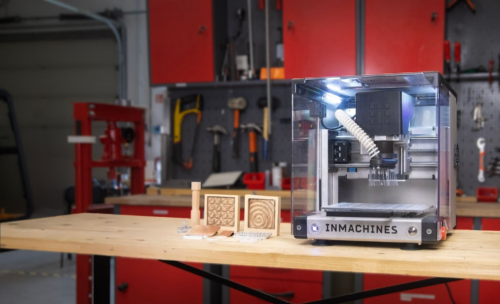

InMachines’ Piccola, a CE-certified desktop CNC mill, brings industrial-grade machining and regulatory compliance to local fabrication environments.
InMachines introduced Piccola, an open-source desktop Computer Numerical Control (CNC) milling machine built for research, school labs, makerspaces, and small production shops. Designed under the technical guidance of Daniele Ingrassia, the device uses principles built over ten years of open-hardware work across the global Fab Lab network. The platform joins earlier digital tools from the team, including the LaserDuo dual-source laser cutter and the BigFDM large-scale 3D printer.
The unit was shown in public on 27 July 2026 at the Regional Fab26 event in Bottrop, Germany, with build plans published on 30 July 2026. The firm uses a dual distribution plan, where all build files, parts lists, and assembly guides are shared under open-hardware licenses, while fully built kits will be sold through an upcoming crowdfunding campaign.
The physical build uses a solid steel frame, linear guide rails, precision ball screws, and stepper motors to offer the stiffness needed to cut soft metals, hard plastics, composite boards, and solid woods. High-speed motor options give variable speeds for basic cutting, fine carving, and surface smoothing.
To help it fit into professional settings, Piccola was built to meet European Union safety rules for CE approval, adding full outer covers, fast kill switches, and wire insulation needed for official use in commercial shops and school classrooms.
All design files, including 3D model files, circuit board plans, and main controller code, are shared by InMachine with no private locks. The controller uses standard G-code commands, running easily with free and commercial toolpath creation software. Its modular setup allows part swaps, while the build acts as a clear teaching guide for schools studying digital machine tools.