




























































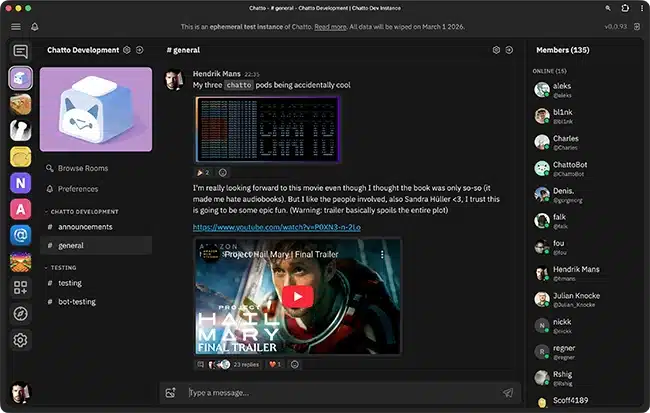

The messaging platform provides encrypted conversations, self-hosted deployment, and built-in voice and video calling while allowing organisations to retain control of their communication data.
Chatto has been released as an open-source team messaging platform, allowing organisations to deploy their own communication servers. Chatto was designed as an alternative to commercial team messaging services, giving people control over their messages and account data. It comes as a single executable package for Linux, Windows, and macOS, along with other options such as Docker Compose and Kubernetes support.
The platform encrypts message text and selected account fields using per-user encryption keys. Each user’s encrypted data can only be decrypted using that user’s encryption keys. When an account is deleted, all encryption keys are permanently shredded using crypto-shredding, thus rendering the encrypted data unreadable even when backups of that data exist.
Not all data is encrypted. Though messages and particular account fields are encrypted, some metadata and assets stay in plaintext format. The platform identifies which information is encrypted and which remains in plaintext, allowing administrators to evaluate the scope of protection.
Every deployment functions as an isolated community without any federation of data on multiple servers. Users connect straight to the server that hosts their community, while organisations that have several communities can install separate server instances. The platform includes built-in voice and video calling with screen sharing that uses end-to-end encryption for securing media data during calls. Call limits depend on hardware resources of the server.
A managed hosting service, Chatto Cloud, is expected to enter public beta soon. While initially being hosted on European-owned infrastructure, it will still remain compatible with self-hosted deployments allowing administrators to move data between hosted and self-hosted deployments if required. The project is freely available through GitHub.