























































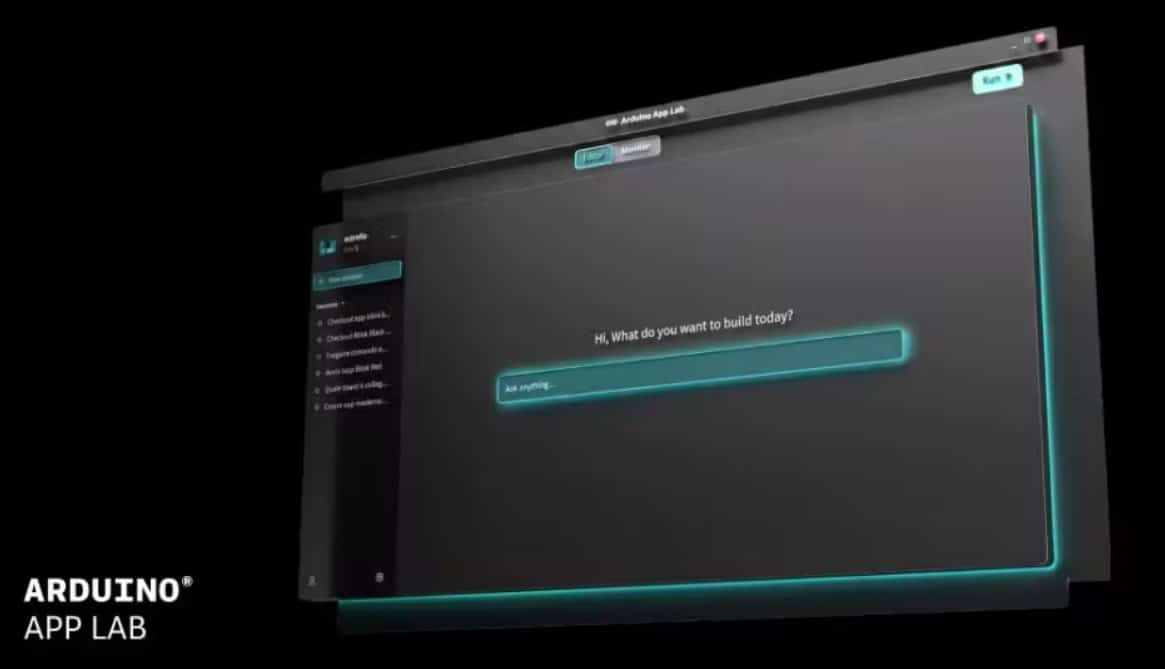

Arduino App Lab 0.10.0 adds an AI coding agent that can inspect projects, modify files, run applications, debug errors, and streamline embedded development.
Arduino has added an artificial intelligence (AI) coding agent to App Lab, turning the open source electronics development environment into a more automated workspace for building applications on its hardware platforms. The feature arrives with App Lab 0.10.0 as Agentic Mode, which can write, modify, test, and debug project code rather than simply suggesting snippets.
The key difference from a conventional AI chatbot is that the agent can interact with the project itself. Built around the model context protocol (MCP) and integrated with Arduino’s App command line interpreter (CLI), Agentic Mode can inspect the workspace, create and edit files, run applications, stop processes, and examine errors generated during execution. This allows a developer to describe a feature and have the agent work through the project changes instead of manually moving AI-generated code into the development environment.
The agent is also aware of App Lab’s Apps, Bricks, and Sketches, giving it context about Arduino’s development framework. When an implementation fails during execution, it can inspect the resulting error and attempt a correction. This moves AI assistance closer to an iterative development workflow, where code generation, execution, and debugging happen within the same environment.
Agentic Mode currently follows a bring-your-own-key model. Developers authenticate through their own AI-provider accounts and remain responsible for application programming interface (API) usage. Claude is the first supported provider, with Arduino indicating that additional providers are planned.
App Lab 0.10.0 also strengthens conventional development tools. Its new language server support adds autocomplete, automatic formatting, hover documentation, go-to-definition, and reference finding across Arduino sketches as well as Python, HTML, CSS, and JavaScript. The update also lets users provision an UNO Q for Arduino Cloud directly from App Lab’s Settings page, reducing setup steps for connected-device projects.
For electronics developers, the broader significance is the shift from AI as a code-generation utility toward an agent that can interact with the embedded software project, test changes, and respond to failures. That could shorten the path from a hardware idea to a working prototype, particularly for Arduino-based experimentation and development.