An open source desktop robot combines a four-servo drive system, 3D-printable parts, and programmable software to enable omnidirectional movement in a compact design.
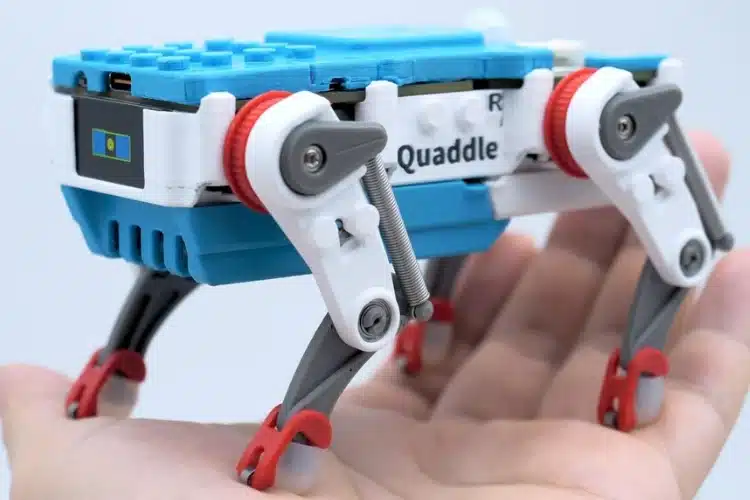
Petoi has unveiled Quaddle, an open source desktop robot designed to achieve omnidirectional movement using only four servo motors. Built on the OpenCat robotics platform, the compact quadruped is intended for robotics education, programming, artificial intelligence experiments, and desktop interaction while keeping the mechanical design simple and affordable.
Compared to traditional quadruped robots, which usually use several servos on each leg, Quaddle incorporates one servo on each leg along with a unique mechanical system for moving forwards, backwards, sideways, diagonally, and rotating on the spot. Although there are fewer actuators in the robot, it is still possible for it to carry out various actions like balancing itself and performing various expressions and actions that have been programmed into it.
Quaddle supports block-based programming, Python, MicroPython, and C++ depending on the user’s experience and the application they want to build. More advanced models include options like teaching motion by physically manipulating the legs, voice control, and integration with robotic frameworks for additional development.
The development of this project is a continuation of the development of the OpenCat robotics ecosystem, which was used for various educational and scientific projects in robotics, as well as for personal experiments. The software is distributed under an open source license, allowing developers to modify and expand the system as needed.
Through a simple four-servo drive, open-source software, and customisable hardware, Quaddle demonstrates how compact desktop robots can achieve omnidirectional movement.