A compact development board combines dual-core processing, FPGA fabric, and native Lua programming to simplify embedded system development and rapid hardware prototyping.
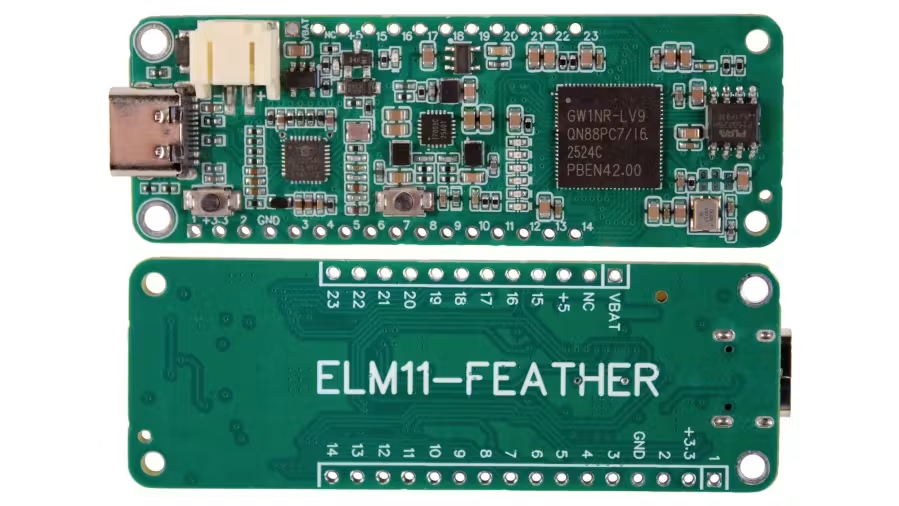
BrisbaneSilicon has introduced the ELM11 Feather, a compact development board that combines a dual-core microcontroller with a field programmable gate array (FPGA) on a Feather-compatible platform. Launched through a crowdfunding campaign, the board is designed to simplify embedded development by allowing users to program hardware using the Lua scripting language instead of conventional hardware description languages.
The board features a dual-core processing architecture combined with programmable logic, allowing software execution and hardware acceleration on the same platform. Built-in Lua scripting enables users to program the peripherals, control logic, and experiment with applications through a convenient scripting language that reduces the time spent learning how to program an FPGA.
Designed in the Feather form factor, the platform can be used together with a variety of expansion boards. This means that the developers can incorporate different peripherals like sensors, communication devices, and screens to the system without having to design them. This makes it useful for control, robotics, internet of things (IoT), and educational purposes.
The platform includes firmware, software libraries and documentation allowing users to inspect, modify, and extend the system. The developers state that the purpose of the board is to make FPGA more accessible by combining programmable logic with high-level software development.
Through the combination of FPGA technology, dual-core processing, Lua programming, and Feather support, the ELM11 Feather is an interesting development platform. The project shows how high-level programming languages can be used to make programmable hardware more accessible.