




























































An open source robotic guide dog combines autonomous navigation, onboard artificial intelligence, and low-cost hardware to help blind and visually impaired people move safely through unfamiliar indoor and outdoor environments.
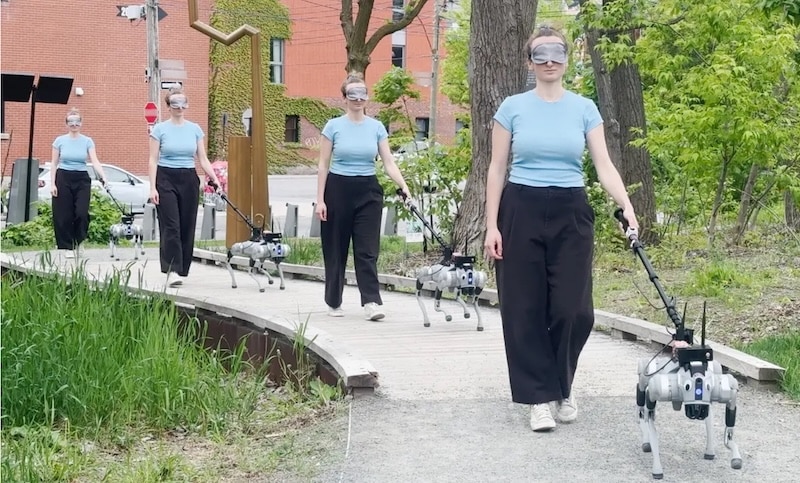
Researchers have introduced Milo, an open source robotic guide dog designed to assist blind and visually impaired people with independent navigation. Developed as a lower-cost alternative to traditional guide dogs, the robot uses onboard artificial intelligence to guide users through unfamiliar environments without relying on cloud services or pre-mapped locations.
In contrast to numerous other autonomous navigation systems that rely on pre-rendered maps for navigation, Milo operates in real time and does not rely on previously available maps. The robot detects passable paths, evades people and obstacles and constantly creates a map of its surroundings to recognise objects which become temporarily invisible to it.
The system was trained to navigate through a simulated environment setting via reinforcement learning, where different obstacles were created for it. The robot interprets its surroundings using a bird’s-eye view; it can perceive the environment consistently in different lighting conditions and other aspects of the environment. The sensors placed on the telescopic handle recognise the position of the user.
They have made all hardware designs, simulation software, and pre-trained AI models open source, which can help researchers and developers analyse, customise, and develop this platform further for assistive robotics research. They have also tested the system on indoor and outdoor obstacle courses in order to test the navigation accuracy, speed of travel, and obstacle avoidance.
This project is a great example of how an open source robotics technology can help make assistive mobility technologies more accessible to visually impaired people.