



















































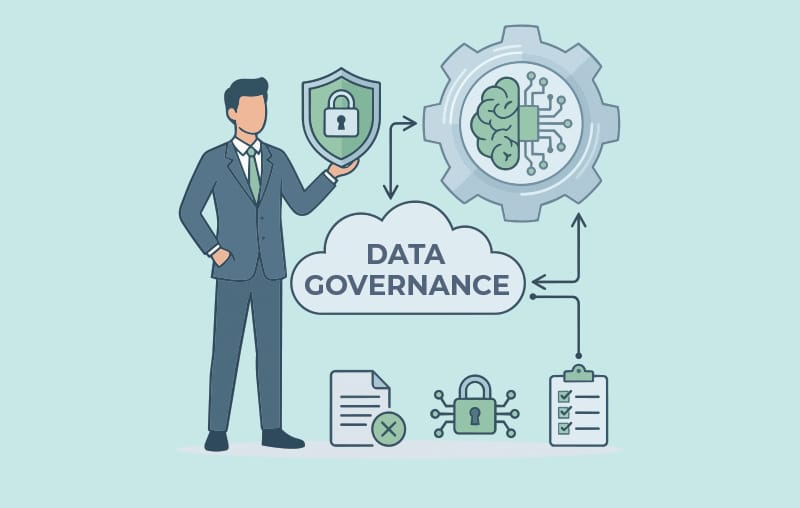

Data governance helps to streamline operations, minimise data risks, maximise data usage, and improve business efficiency, among other things. It is mandatory in the AI era.
The modern enterprise generates and consumes unprecedented volumes of data across operational systems, customer interactions, cloud applications, IoT devices, and AI platforms. At the same time, AI systems are becoming major consumers of enterprise data, making decisions, generating content, recommending actions, and automating workflows.
Traditional data governance programs were primarily designed to support business intelligence and regulatory compliance. However, the AI era introduces new requirements around model governance, explainability, lineage, ethical AI, data observability, and autonomous decision-making. Organisations must therefore evolve towards a unified data and AI governance model that ensures data can be trusted not only by humans but also by machines.
Poor data governance can result in hallucinating AI systems, biased model outcomes, regulatory violations, security breaches, increased operational costs, customer trust erosion and incorrect business decisions.
Data governance has therefore evolved from a compliance function into a strategic business capability. Organisations that establish trusted, governed, and accessible data foundations will be better positioned to scale AI initiatives, accelerate innovation, and create sustainable competitive advantages.
The basic objectives of data governance are:
- Enhance the agility of data-informed business decisions.
- Facilitate seamless knowledge sharing across the enterprise.
- Eliminate ambiguity and foster trust in data assets.
- Increased data trust, better decision-making and faster innovation cycles.
- Improved compliance posture, reduced data duplication and greater business agility.
Challenges in data governance
As enterprises expand into multi-cloud environments and increasingly adopt generative AI, governance challenges continue to multiply. Common data governance challenges faced by enterprises today are:
Data explosion
Data exists in multiple diverse systems; it comprises structured data, semi-structured data, unstructured content, streaming data, IoT telemetry, computer vision assets, AI generated outputs, etc. Traditional governance frameworks often lack the scalability and automation required to manage such diversity.
Data in silos
Data is segmented across various platforms, channels, tools, and business units, making it challenging to access it across the enterprise. It resides in ERP systems, CRM platforms, legacy applications, cloud-native platforms, data warehouses, data lakes, and SaaS applications. This leads to inefficiency, data duplication and data inconsistency.
Data accuracy
Completeness and timeliness of data is an issue.
Data quality
Lack of oversight of the quality of data coming into an enterprise as well as its usage throughout the organisation leads to poor data quality. Common quality challenges include missing values, duplicate records, outdated information, inconsistent definitions, incomplete lineage and data drift.
Regulatory complexity
Managing regulatory compliance, and establishing data security and data privacy are challenges. Enterprises must comply with GDPR, HIPAA, CCPA, PCI-DSS, and the EU AI Act along with industry-specific regulations.
Data management
A poor data management strategy may lead to an enormous amount of data in a completely unmanageable format.
Data leakage
Leaks of sensitive business information or customer data can lead to data breaches.
AI-specific risks
New AI-era governance concerns include algorithmic bias, explainability requirements, training data provenance, prompt governance, LLM hallucinations and autonomous agent controls.
Governance alone does not create value. Enterprises need data capabilities that make governance operational while enabling innovation and AI adoption. Modern data ecosystems require intelligent platforms capable of discovering, understanding, protecting, and serving data on a scale.
Modern data architecture for AI
Modern data architecture provides the capabilities necessary for analytics, machine learning, generative AI, and autonomous systems. It enables enterprises to manage data as a strategic asset while ensuring governance, security, and scalability. It is a unified, governed, AI-ready data foundation that enables trusted insights, intelligent automation, and autonomous decision-making through reusable data products, continuous observability, and embedded governance controls.
The architecture is organised into two structural categories (Figure 1). The first five layers form the primary pipeline — the path data travels from the moment it is created in a source system to the moment it produces a business outcome.
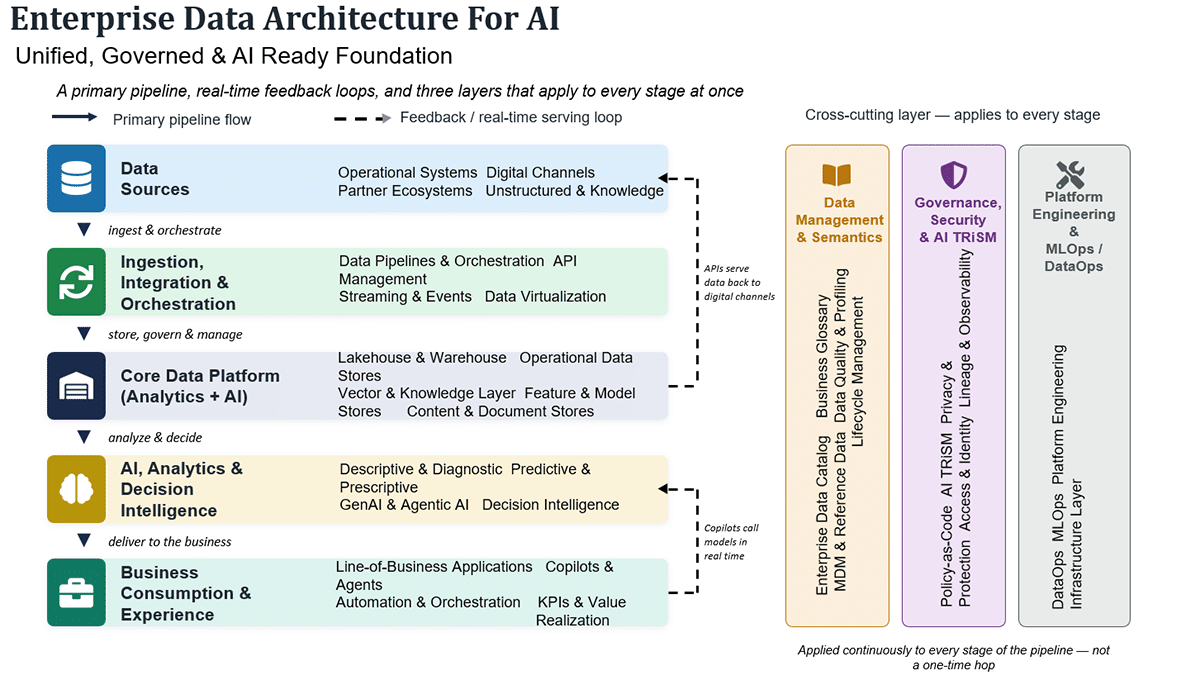
The remaining three layers are cross-cutting disciplines which are applied continuously, at every stage, from ingestion through consumption. A modern AI-ready data architecture provides the infrastructure necessary for analytics, machine learning, generative AI, and autonomous systems. It enables organisations to manage data as a strategic asset while ensuring governance, security, and scalability.
Data sources
This layer represents the full surface area of enterprise data — every system, channel, partner relationship, and unstructured artifact that generates information the organisation can use. It groups the ecosystem into four major categories:
- Operational systems: These are the systems that run the day-to-day business: ERP, CRM, domain platforms, billing, HR, etc. These remain the backbone of structured, transactional data.
- Digital channels: The web, mobile, API, and customer-portal through which customers and employees interact directly with the enterprise are included in this category. These channels are not purely a source; they also receive personalised or real-time data back through APIs.
- Partner ecosystems: These are the B2B integrations, data exchanges, and marketplaces that bring external, third-party data into the enterprise’s view.
- Unstructured and knowledge data: This category includes documents, emails, videos, knowledge bases, and ontologies. It has grown in strategic importance because it is precisely the content that large language models and retrieval-augmented generation (RAG) pipelines depend on.
Ingestion, integration and orchestration
This layer helps to move data from source into the platform reliably, securely, and in the right cadence like batch, streaming, or on-demand.
- Data pipelines and orchestration: Comprises engines that sequence and monitor data movement, paired with pipeline observability so failures and delays are visible before they become business problems.
- API management: Includes gateways, throttling, versioning, and security policy enforcement for every API-based integration, ensuring that data movement through APIs is controlled rather than ad hoc.
- Streaming and events: These are event hubs and pub/sub infrastructure (e.g., Kafka-style platforms) that support event-driven integration where near-real-time movement is required.
- Data virtualisation: This lets consumers query across multiple heterogeneous stores without first physically consolidating the data, reducing duplication and latency for enterprise usage.
Core data platform (analytics + AI)
This is the heart of the architecture that acts as an AI-ready layer. This unified storage and serving layer is the place where data lives and is made available for both traditional analytics and AI workloads from a single, governed foundation.
- Lakehouse and warehouse: This category combines the flexibility of a data lake with the performance and semantic structure of a warehouse, including reusable semantic models that give consistent business meaning to raw tables.
- Operational data stores (ODS): Supports near-real-time reporting for use cases that cannot wait for a batch cycle.
- Vector and knowledge layer: Vector databases and ontologies that power agentic AI and semantic search are foundational to genAI.
- Feature and model stores: Reusable features, a model registry, and model artifact storage enable machine learning models to be built, versioned, and reused consistently rather than recreated per project.
- Content and document stores: A repository that supports genAI applications operating directly over enterprise content (contracts, policies, knowledge articles).
AI, analytics and decision intelligence
In this layer, the governed data is converted into insight, prediction, and increasingly autonomous action.
- Descriptive and diagnostic: Comprises BI (business intelligence), dashboards, and self-service analytics.
- Predictive and prescriptive: Includes machine learning models, optimisation, and simulation.
- GenAI and agentic AI: Copilots, task-oriented agents, and RAG pipelines generate content to take bounded actions on the enterprise’s own data.
- Decision intelligence: Composite decision flows that blend rules engines, analytics, and AI models into a single decision path.
Business consumption and experience
The components and agents in this layer inform the AI/analytics layer in real-time what gets built upstream.
The business layer brings together line-of-business applications, AI copilots and agents, automation, and performance tracking to drive outcomes. Business applications support daily operations and customer interactions, while embedded copilots and agents enhance productivity. Automation through BPM, RPA, and event-driven workflows reduces manual effort, and KPIs with outcome tracking ensure the solution delivers measurable business value.
Data management and semantics layer
This layer makes data trustworthy, findable, and consistently defined. It is applied continuously across every stage of the pipeline rather than as a single processing step.
Governance, security and AI TRiSM
This layer ensures privacy, identity, and full traceability of data and models.
Top open source data security tools that are widely used include Metasploit, OSSEC, OpenVAS, Snort, KeePass, and ClamAV. These tools can be integrated into various security strategies to protect a wide range of cyber threats.
Platform engineering and MLOps/DataOps
Modern data platforms combine DataOps, MLOps, platform engineering, and scalable infrastructure. DataOps automates testing and deployment of data pipelines, while MLOps manages model deployment, monitoring, and retraining. Platform engineering provides self-service tools and governance for faster, consistent deployments. Together with serverless computing, storage optimization, and cost management, these capabilities create efficient, scalable, and reliable data platforms.
Popular open source tools for data storage are Hadoop, LakeFS, Cassandra, and Neo4J. These provide scalability, robustness and performance in managing large data and analysing large datasets in various applications.
| Industry trends |
|
Benefits of data governance
Enterprises with mature governance capabilities experience higher AI model accuracy, increased data trust, better decision-making, faster innovation cycles, improved compliance posture, reduced data duplication, and greater business agility.
Effective data governance ensures consistent, accurate, and trustworthy data across the enterprise, enabling better decision-making and stronger business outcomes. It establishes clear standards for data quality, governance, and workflow management while improving agility, scalability, and productivity through streamlined processes and data reuse. Centralised governance reduces duplication, lowers data management costs, optimises storage, minimises security risks, and builds confidence in data accuracy and documentation. It also helps organisations comply with regulatory requirements such as GDPR, CCPA, HIPAA, and PCI-DSS.
Today, data governance is not optional but mandatory. Effective data governance is a collection of processes, people, policies, standards, and metrics that ensure the effective and efficient use of data in enabling an enterprise to achieve its goals.
Disclaimer: The views expressed in this article are those of the authors. Tricon Solutions LLC and Gspann Technologies, Inc., do not subscribe to the substance, veracity or truthfulness of the said opinion.