
























































The reBot-DevArm combines detailed mechanical documentation with an open software stack for robotics development, simulation and AI experiments.
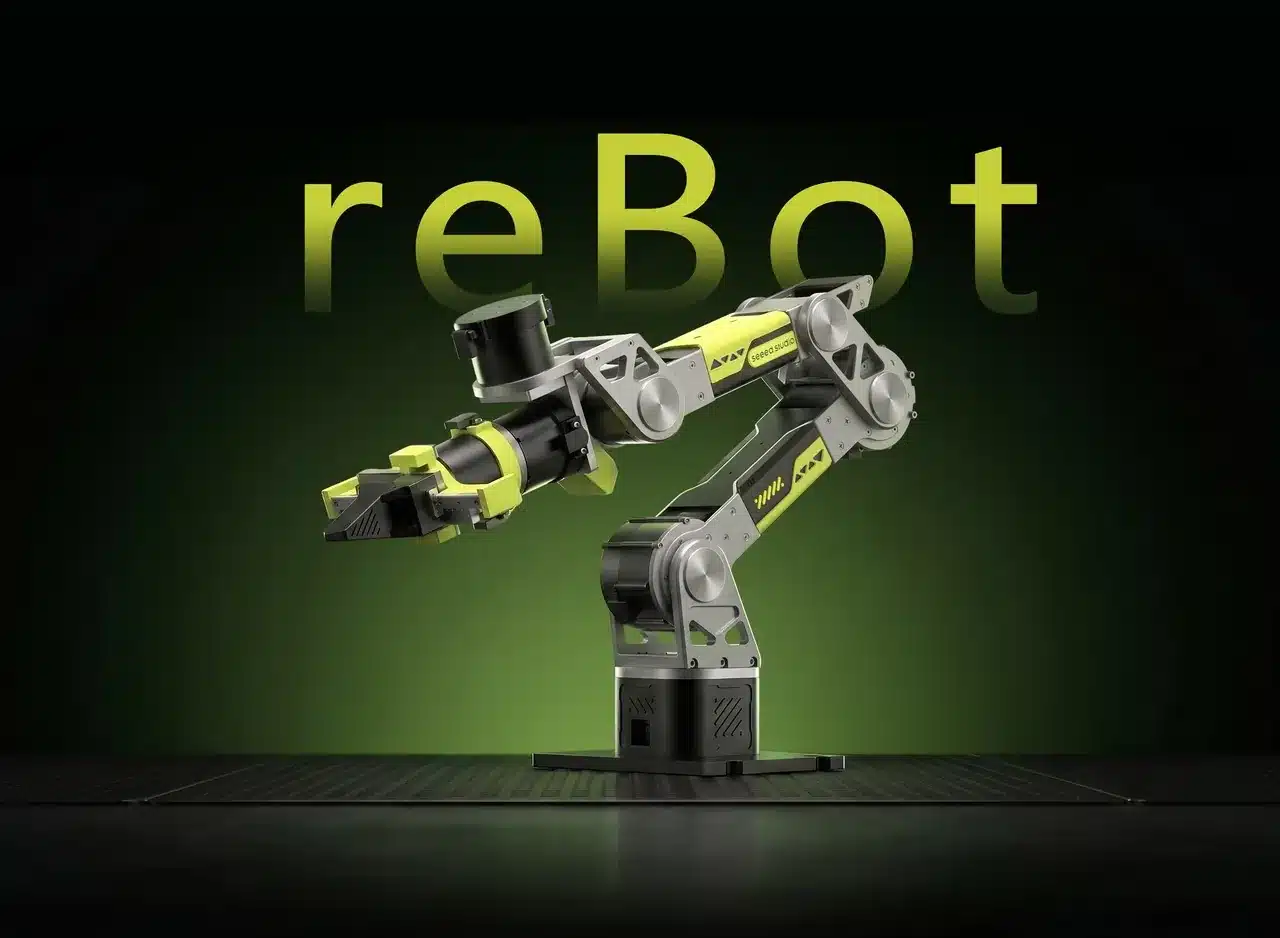
Seeed Studio’s reBot-DevArm is an open-source six-axis robotic arm designed as a desktop platform for robotics development and experimentation. The arm has six revolute joints plus a seventh motor for its parallel gripper, with the repository providing mechanical CAD files, software, documentation and a bill of materials for building the system.
The project is available in two hardware variants: the B601-DM and B601-RS. The DM version uses Damiao actuators with a 24V power system, reaches up to 767 mm and has a recommended payload of 1.5 kg. The RS version uses RobStride actuators, operates from 48V, reaches 754 mm and has a recommended payload of 2.5 kg. Both versions have a declared repeat positioning accuracy of below 0.2 mm.
A major part of the project’s open-source approach is the amount of hardware information released. The repository includes STEP and STP CAD files, STL meshes, URDF descriptions, assembly documentation and component-level BOM information. The documentation also records hardware revisions, including changes to motor selection, cable restraints, reinforcement parts and harness clips based on physical testing and assembly feedback.
The arm is also integrated with several robotics software frameworks. Its ecosystem includes ROS and ROS 2, MoveIt, Pinocchio, MuJoCo and NVIDIA Isaac Sim, while the hardware can be used with Hugging Face LeRobot and GR00T N1.7 for robot-learning workflows. This enables developers to collect demonstrations, simulate robot behaviour and experiment with vision-language-action models before deploying them on physical hardware.
The project also publishes performance and thermal-testing information rather than relying only on nominal specifications. Tests on the DM version showed that sustained high-load operation can trigger motor thermal protection, particularly at greater reach and during static loads. The hardware is now licensed under CERN-OHL-W-2.0, while the software uses Apache-2.0, allowing developers to inspect, modify and build upon the platform under the respective licence conditions.