























































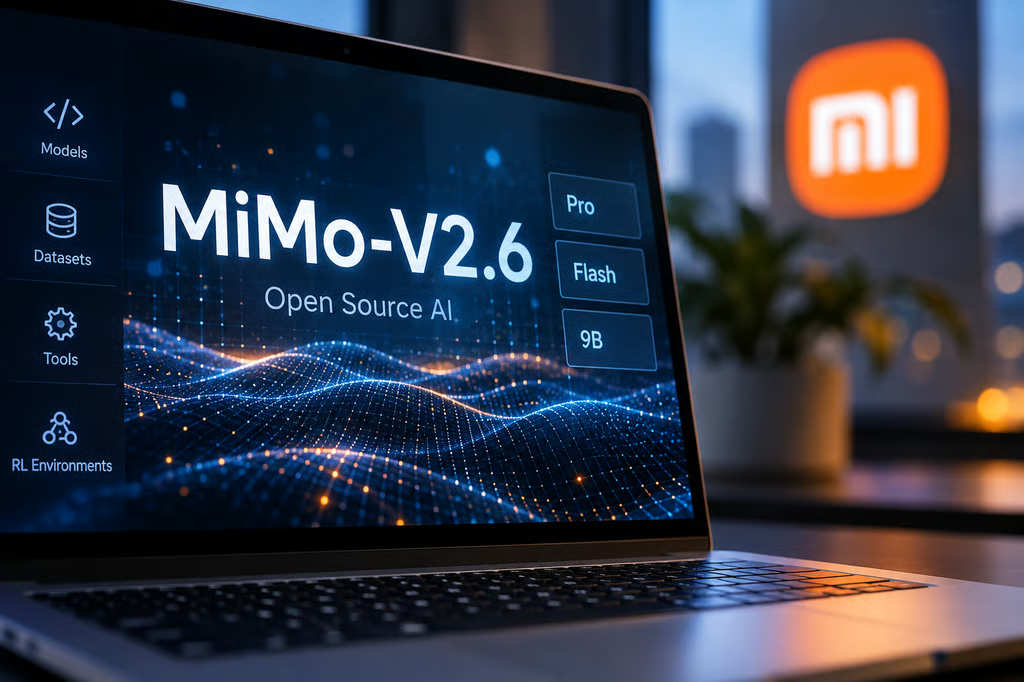

The release combines open-weight multimodal models with reinforcement-learning environments and training tools for agentic AI research.
Xiaomi has released MiMo-V2.6, an open-weight AI model family that includes MiMo-V2.6-Pro-RL, MiMo-V2.6-Flash-RL, and MiMo-V2.6-Distill-Qwen-9B. Alongside the model weights, Xiaomi has published more than 7,000 reinforcement-learning environments and an end-to-end framework covering environment interaction, trajectory collection, reward evaluation, and policy optimisation. The Pro, Flash, and 9B model repositories list the MIT licence.
The Pro model is positioned as the flagship multimodal model and supports text, image, video, and audio inputs, with a context window of up to 1 million tokens. Flash targets a more efficiency-focused configuration. The 9B model serves a different purpose: Xiaomi describes MiMo-V2.6-Distill-Qwen-9B as a supervised fine-tuned checkpoint based on Qwen3.5-9B and intended as a starting point for reinforcement-learning research.
The open-source release also exposes components of Xiaomi’s reinforcement-learning workflow. The more than 7,000 environments cover areas including software engineering, vulnerability reproduction, knowledge-intensive tasks, and web development. The company says its larger training runs used 1,568 prompts and 16 rollouts per training step, generating billions of tokens per update. Xiaomi reports RL training costs of about $2.62 million for Pro and $850,000 for Flash, excluding pretraining and other development work.
The release provides developers with three distinct assets rather than simply different sizes of the same model. Pro and Flash are large RL-trained models intended for direct use, while the 9B checkpoint is aimed at further experimentation with agentic reinforcement learning. Public Hugging Face repositories make the model weights available, while the accompanying environments and training framework provide additional material for researchers investigating how reinforcement learning can be applied to AI agents.
MiMo-V2.6 is therefore notable not only for making model weights available, but also for publishing parts of the infrastructure used to train and evaluate agentic systems. Xiaomi’s reported performance improvements remain company-reported results, while independent testing has evaluated the released Pro model separately. This distinction is relevant when reproducing the reported results or assessing how much of the training approach can be replicated using the released resources.