
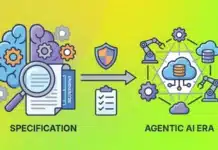

















































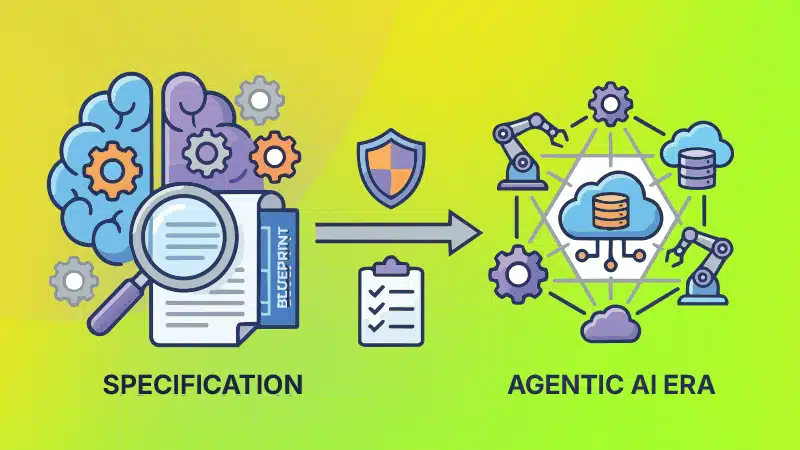

Spec-driven development is a critical discipline for the age of agentic software engineering. Organisations that define the right intent and turn specifications into durable engineering assets will do well in this age.
Software development is entering a phase where the most valuable engineering artifact is no longer only the codebase. In AI-assisted and agentic development, the real source of leverage is the clarity of intent that guides humans, tools, and autonomous coding agents. Spec-driven development, often shortened as SDD, responds to this shift by treating the specification as a living contract that defines what must be built, why it matters, how success will be verified, and where the boundaries of acceptable implementation lie. This approach is becoming important because AI coding agents can produce code faster than most teams can review, but speed without shared intent can quickly turn into confusion, rework, technical debt, and governance exposure.
Understanding spec-driven development
Spec-driven development is a disciplined software engineering approach in which development begins with a clear, versioned, reviewable specification rather than with an informal prompt or a half-formed implementation idea. The specification describes the problem, user value, functional behaviour, non-functional expectations, constraints, assumptions, interfaces, acceptance criteria, and verification strategy. In conventional projects, specifications often became static documents that were written early and forgotten later. In SDD, the specification remains active throughout the lifecycle. It informs design, drives task decomposition, guides AI-generated code, anchors testing, supports review, and provides traceability for operational and compliance needs.
The rise of coding agents has made this practice more than a documentation preference. When an AI agent receives an ambiguous instruction, it must still make implementation choices. It may select a design pattern, create a data model, call a library, introduce an API behaviour, or add assumptions that were never discussed. A well-written specification reduces these silent decisions. It gives the agent a bounded problem space and gives human reviewers a stable reference against which the output can be judged. In that sense, SDD is not anti-agility. It is a way of making agility safer when software is produced by a combination of human judgment and machine execution.
Trends in spec-driven development in the agentic development lifecycle
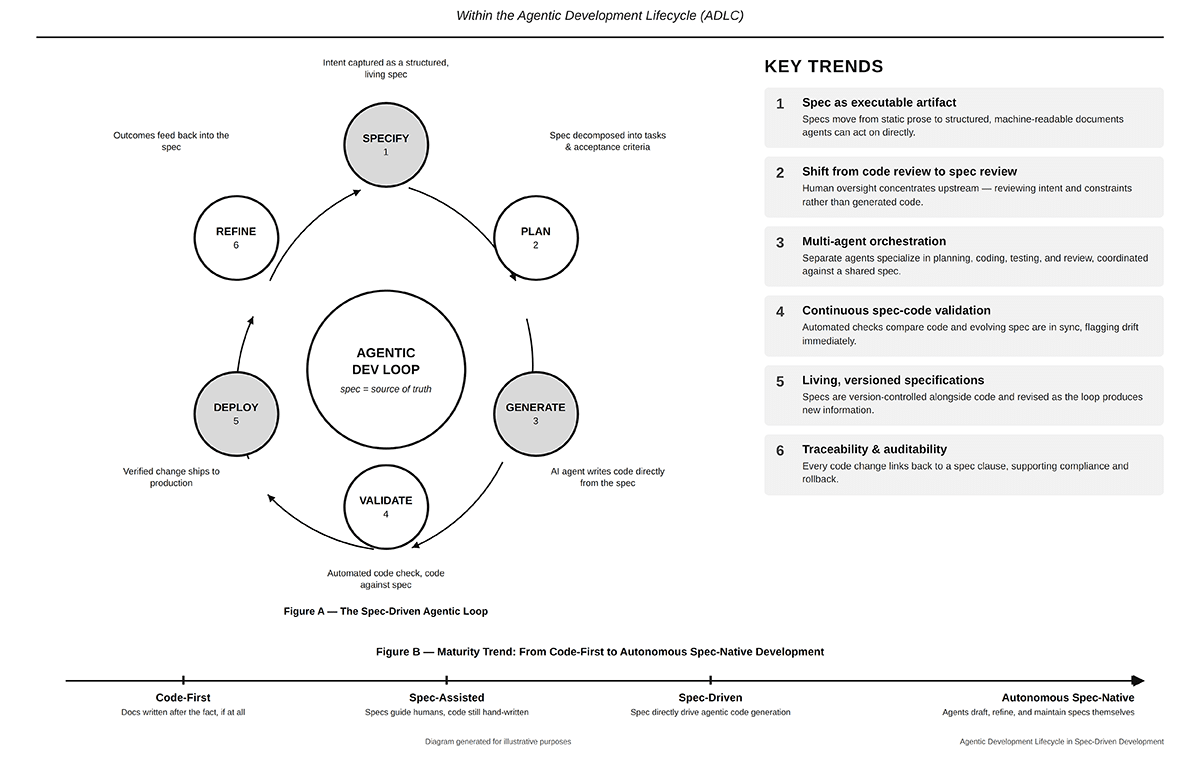
The agentic development lifecycle is changing the centre of gravity in software engineering. Earlier generations of AI tools helped developers complete lines of code or generate small functions. Newer agentic systems can analyse requirements, inspect repositories, propose designs, generate tests, modify several files, run builds, explain failures, and prepare pull requests. Industry reports describe this as a movement from isolated coding assistance towards coordinated agent teams, long-running workflows, and human oversight at scale. As agents take on larger portions of execution, the need for a durable expression of intent becomes stronger. Spec-driven development is therefore emerging as a coordination layer between product thinking, architecture, engineering, testing, security, and operations.
One visible trend is the movement from chat-led development to artifact-led execution. Instead of relying on long conversational histories, teams are creating structured specifications, implementation plans, task lists, acceptance criteria, invariants, and testable contracts. These artifacts can be stored in version control, reviewed like code, and reused by multiple agents or developers. This matters especially in brownfield modernisation, where agents must respect existing architecture, hidden dependencies, security controls, and enterprise integration standards.
A second trend is the growth of multi-agent SDLC patterns. Requirement agents can transform business inputs into stories and acceptance criteria. Design agents can propose architecture alternatives. Build agents can implement bounded tasks. Test agents can generate unit, integration, regression, and security tests. Review agents can check coding standards, vulnerabilities, dependency risks, and architectural alignment. Release agents can assemble evidence for deployment readiness. In this model, the specification becomes the shared operating contract that aligns these agents and prevents each one from interpreting the goal differently.
A third trend is the rise of governed autonomy. Enterprises are beginning to distinguish between assisted coding, automated task execution, bounded agentic workflows, and trusted autonomous delivery. Spec-driven development supports this maturity journey because it makes intent, scope, assumptions, approval gates, and verification evidence explicit. It also allows work to be decomposed into smaller, auditable tasks, which is essential when agents are allowed to act across repositories, pipelines, test environments, issue trackers, and cloud platforms.
| Dimension | Vibe coding | Spec-driven development |
| Primary intent | Rapid exploration and quick generation | Controlled implementation from defined intent |
| Source of truth | Prompt, chat history, and developer memory | Versioned specification, plan, tests, and acceptance criteria |
| Best fit | Prototype, demo, learning exercise, internal experiment | Production system, regulated workload, multi-team delivery, long-lived product |
| Risk profile | Higher risk of drift, hidden assumptions, technical debt, and weak traceability | Lower risk through explicit constraints, reviews, validation, and auditability |
| Human role | Prompt, observe, correct, and iterate | Define intent, review specification, govern decisions, verify outputs |
Spec-driven development versus vibe coding
Vibe coding and spec-driven development are not merely two tool preferences; they represent two different philosophies of working with AI. Vibe coding is exploratory, conversational, and fast. A developer describes what they want, receives generated code, tests or observes the outcome, adjusts the prompt, and iterates. It is useful when the goal is discovery, prototyping, learning a new framework, creating a throwaway proof of concept, or testing whether an idea has value. It lowers the entry barrier and gives teams a quick way to move from thought to working sample.
Vibe coding appears weak when the work must survive beyond the prototype. Chat history is not a reliable architecture record. Generated code may work locally but miss edge cases, non-functional requirements, security controls, naming conventions, observability requirements, or integration contracts. Different prompts can produce different implementations for the same feature, and later contributors may not understand why specific choices were made. As the system grows, the early speed of vibe coding can be offset by rework, duplicated logic, inconsistent patterns, and fragile maintenance.
Spec-driven development takes a different route. It begins by making intent explicit before implementation begins. It asks teams to define the expected behaviour, constraints, data ownership, quality requirements, non-goals, compliance expectations, and verification approach. AI agents still accelerate implementation, but they operate inside a more carefully described boundary. The trade-off is clear: SDD requires more upfront thinking, but it improves maintainability, traceability, quality, and enterprise confidence. A practical enterprise strategy is not to reject vibe coding entirely. Teams can use vibe coding for early exploration, then convert the learning into a living specification before production-grade development begins.
Advantages of spec-driven development
The first advantage of SDD is clarity. A specification removes much of the guesswork that typically sits between a business idea and implementation. It defines the expected result in a way that product owners, architects, developers, testers, security teams, and AI agents can all interpret. This shared clarity reduces repeated clarification cycles and helps teams avoid building features that are technically impressive but misaligned with business intent.
The second advantage is traceability. In enterprise environments, teams must often prove why a change was made, which requirement it satisfies, what tests validate it, and who approved the release. SDD creates a natural chain from requirement to design, from design to task, from task to code, and from code to evidence. This is valuable not only for audits, but also for daily engineering discipline. When a defect appears, the team can examine whether the specification was incomplete, the implementation violated the specification, or the tests failed to cover the intended behaviour.
The third advantage is better governance of AI-generated code. AI coding agents are powerful but not inherently accountable. They can produce plausible code that compiles while still violating security principles, architectural standards, licensing expectations, privacy rules, or performance constraints. A strong specification acts as a guardrail. It states what the AI system may assume, what it must not change, what approval is required, what data may be accessed, and what evidence is needed before the output is accepted.
The fourth advantage is maintainability. A codebase generated from vague prompts may function in the short term, but future teams will struggle to understand its assumptions. SDD keeps the rationale visible. It supports onboarding, refactoring, modernisation, and impact analysis because the design intent is available alongside the implementation. This is especially useful when enterprises use AI to modernise legacy platforms, upgrade libraries, migrate cloud services, or refactor monolithic systems.
Developing skills for SDD
Spec-driven development requires a different skill profile from traditional coding or casual AI prompting. Developers need engineering depth, but they also need the ability to express intent precisely. Product owners must learn to write acceptance criteria that are testable rather than aspirational. Architects must translate quality attributes into constraints that agents can respect. Testers must think in terms of executable evidence. Security specialists must define misuse cases, policy checks, and restricted actions early enough to influence implementation rather than waiting for end-stage review. Here is an example skill code snippet to understand this better:–
--

name: spec-driven-development

description: >

Use this skill whenever a user asks to build, add, or change a feature

in a codebase. Enforces a spec-first workflow: write and confirm a

structured spec before generating any code, then validate generated

code against that spec. Trigger on requests like "build a feature",

"implement X", "add support for Y", or "refactor Z" in a code project.

---

# Spec-Driven Development

## Workflow

1. **Specify** — Before writing code, draft a spec at

`specs/<feature-slug>.md` with these sections:

- `## Intent` — one paragraph, the "why"

- `## Requirements` — numbered, testable statements

- `## Non-goals` — explicitly out of scope

- `## Acceptance Criteria` — checklist, each mapped to a test

2. **Confirm** — Show the spec to the user. Do not generate code until

they approve it or explicitly say to proceed.

3. **Plan** — Break the spec into an ordered task list. Each task must

cite the requirement number(s) it satisfies.

4. **Generate** — Write code task-by-task. Reference the spec file

in comments where non-obvious (`# satisfies REQ-3`).

5. **Validate** — After generating code, re-read the spec and check

each Acceptance Criterion explicitly. Report PASS/FAIL per item —

do not just say "looks good."

6. **Refine** — If a criterion fails or the user requests a change,

update the spec FIRST, then regenerate the affected code. Never

let code and spec drift silently.

## Rules

- Never skip straight to code generation for non-trivial features.

- Never mark an acceptance criterion as passed without checking it.

- Keep the spec file updated — it should always describe current

intended behavior, not just the original request.
A useful SDD skill path begins with requirement articulation. Practitioners should learn to separate business goals, user journeys, functional behaviour, constraints, and assumptions. They should also become comfortable writing non-goals, because stating what the system will not do prevents agents from adding unnecessary features. The next skill is decomposition. A good specification must be broken into small, bounded tasks that can be implemented, reviewed, and tested independently. This reduces the risk of large AI-generated changes that are difficult to inspect.
Another important skill is evaluation design. Teams must define how they will know that the implementation is correct. This includes unit tests, integration tests, contract tests, performance checks, accessibility checks, security scans, policy validations, and manual review criteria. In agentic development, evaluation is not a final stage; it is the steering mechanism that keeps the agent aligned. Finally, practitioners need AI collaboration literacy: how to provide context, how to bound tasks, how to inspect generated diffs, how to challenge assumptions, how to preserve institutional knowledge, and how to decide when human engineering judgment must override AI output.
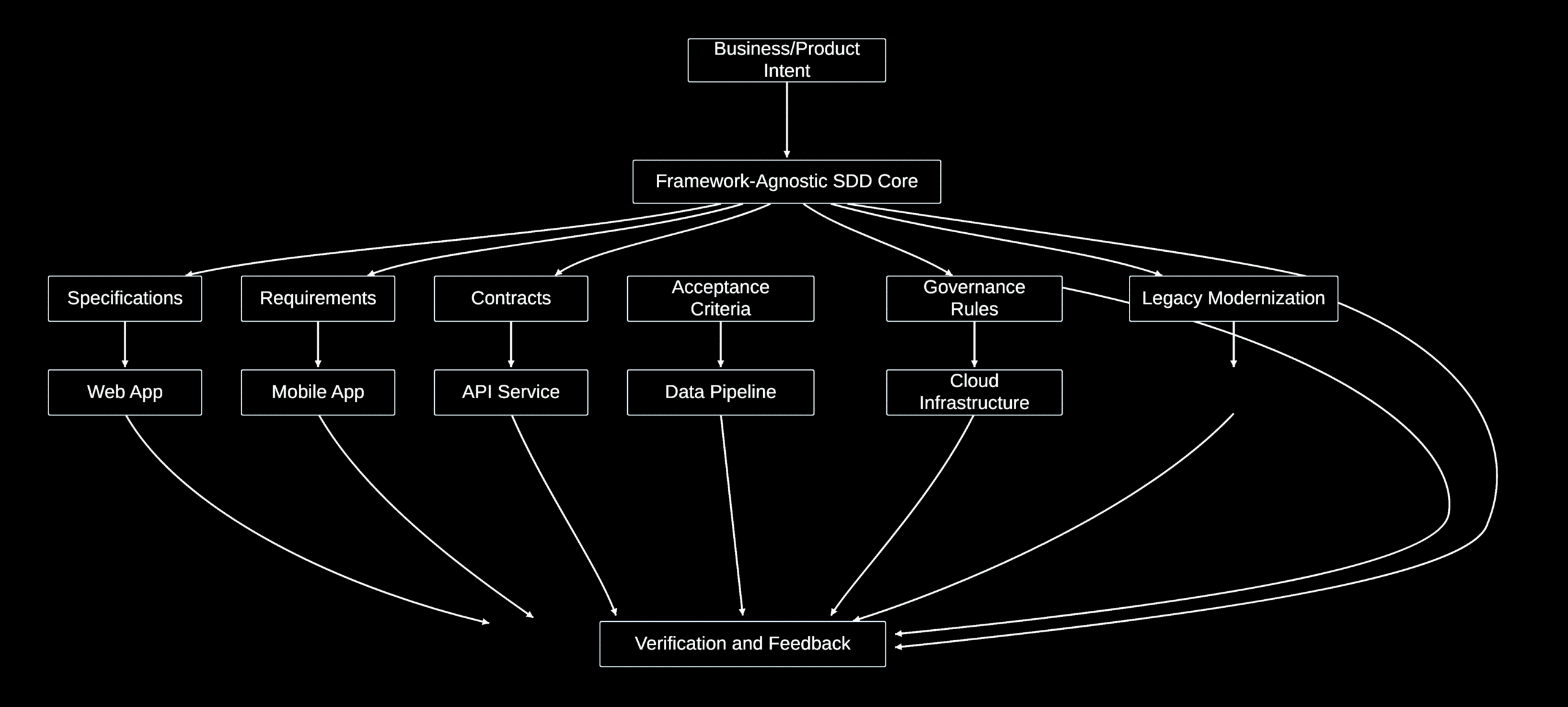
Governance model in spec-driven development
Governance in SDD should not be designed as a bureaucratic checkpoint that slows every team. It should function as a lightweight control system that makes safe delivery easier. A practical governance model begins with specification ownership. Every specification should have named business, architecture, engineering, quality, and security owners depending on the risk level of the work. Their role is not to write every detail, but to ensure that the specification is complete enough for reliable implementation and review.
The second governance layer is risk classification. Not every feature needs the same level of formality. A temporary prototype may need a short intent brief. A customer-facing financial transaction, healthcare workflow, identity service, or production infrastructure change requires a stronger specification with security, privacy, audit, rollback, and approval expectations. Risk classification allows teams to scale governance according to consequence rather than treating all work identically.
The third layer is human-in-the-loop approval. AI agents may generate implementation plans, code, tests, and documentation, but high-impact decisions should remain under accountable human review. Approval gates may be required for architecture changes, data access, external API calls, security-sensitive code, deployment scripts, infrastructure changes, and irreversible business actions. The fourth layer is observability. Teams should retain evidence of specification versions, prompts or agent instructions, generated plans, test runs, tool calls, approvals, exceptions, and deployment outcomes. This evidence is essential for debugging, compliance, incident response, and continuous improvement.
Best practices for enterprise adoption
Enterprises should start with a pragmatic adoption model rather than a grand methodology rollout. The first step is to select use cases where specifications naturally create value: API development, platform modernisation, regulatory workflows, data pipeline changes, security remediation, test automation, release readiness, and multi-team integration. These scenarios benefit from clarity, traceability, and reusable patterns. Teams should avoid forcing SDD onto short-lived experiments where the cost of specification is greater than the value of the output.
Another best practice is to create reusable specification templates. Templates should include sections for problem statement, users, scope, non-goals, functional requirements, non-functional requirements, data considerations, security constraints, accessibility expectations, observability requirements, acceptance criteria, test strategy, rollout plan, and rollback approach. Templates prevent blank-page anxiety and help teams converge on a common language. They also make it easier for AI agents to consume specifications consistently.
A third best practice is to integrate SDD into existing DevSecOps workflows. Specifications should be stored with the code or linked to the work item system. Pull requests should reference the relevant specification and tests should map back to acceptance criteria. Security and compliance checks should be automated wherever possible. This keeps SDD close to delivery instead of turning it into a separate documentation exercise.
A fourth best practice is to use a hybrid operating pattern: vibe-explore, spec-produce, agent-implement, human-verify, and continuously-learn. Teams can use AI freely during discovery to understand options and prototype ideas. Once the direction is clear, they convert the learning into a living specification. Agents then implement bounded tasks, while humans review outputs and maintain accountability. After deployment, feedback from users, defects, incidents, cost data, and operational logs should update the specification so it remains a living artifact rather than a forgotten document.
Reusability and extensibility in SDD
Reusability is one of the most important enterprise advantages of spec-driven development. When specifications are treated as living engineering assets rather than one-time documents, they can become reusable patterns that improve consistency across products, teams, and AI-assisted delivery workflows. In a large organisation, many requirements repeat in different forms: authentication, authorisation, audit logging, error handling, API versioning, accessibility, observability, privacy controls, deployment approvals, and rollback expectations. SDD allows these recurring expectations to be captured once as reusable specification fragments, templates, checklists, policies, and test contracts that can be applied across multiple initiatives.
A mature SDD practice can maintain a specification library similar to a code library. This library may include reusable API specification templates, standard non-functional requirement patterns, domain-specific acceptance criteria, security requirement blocks, data classification rules, observability expectations, and release readiness checklists. For example, every customer-facing API may reuse a standard OpenAPI template that defines request validation, error response formats, authentication requirements, rate-limiting expectations, logging rules, and backward compatibility constraints. Similarly, all user interface features may reuse accessibility acceptance criteria aligned with WCAG expectations, while all production services may inherit common requirements for tracing, metrics, alerts, and incident response evidence.
Reusability becomes even more valuable in agentic AI development because agents need consistent instructions and boundaries. If every team writes requirements differently, AI coding agents may interpret similar problems in inconsistent ways. Reusable specifications reduce ambiguity by giving agents repeatable structures, standard vocabulary, known constraints, and validated examples. Requirement patterns, policy-as-code rules, test-as-contract definitions, and reference architectures help agents generate outputs that align with enterprise engineering standards. A reusable agent workflow may define how a build agent decomposes tasks, how a test agent maps acceptance criteria to test cases, how a review agent checks architectural compliance, and how a release agent assembles deployment evidence.
Extensibility is the companion principle to reusability. A reusable specification must not be rigid. It should evolve as products grow, regulations change, architectures modernise, and AI tools become more capable. Extensible SDD depends on modular specifications, version control, traceability, and structured change impact analysis. A modular specification separates stable intent from variable implementation details. For example, a payment workflow specification may keep the core business rules stable while allowing extensions for new payment providers, fraud checks, reporting obligations, or regional compliance requirements.
Versioning is essential for this evolution. Teams should know which version of a specification produced which implementation, which acceptance criteria were valid at the time of release, and what changed when a new requirement was introduced. Traceability links requirements to design decisions, code changes, tests, approvals, and operational evidence. This makes it possible to assess the impact of change before agents modify code.
Reusable and extensible SDD reduces duplication, improves governance, accelerates delivery, and helps enterprises scale AI-assisted software development without losing control over quality or intent.
Developing framework-agnostic SDD
Framework-agnostic SDD means designing specifications so that the expression of intent is independent of a specific programming language, software framework, cloud provider, AI coding assistant, issue tracker, or DevOps platform. The central idea is to separate what the system must achieve from how a particular team chooses to implement it. This distinction is critical in modern enterprises because the same business capability may be implemented across different technology stacks such as Java and Spring Boot, .NET, Python, Node.js, React, native mobile applications, microservices, data pipelines, Kubernetes workloads, serverless functions, or legacy platforms. If the specification is tightly coupled to one framework, it loses value when the implementation environment changes.
A framework-agnostic SDD approach begins with stable engineering artifacts. These include intent, scope, requirements, non-goals, assumptions, constraints, interfaces, data contracts, quality attributes, acceptance criteria, verification strategy, and governance gates. These elements should remain understandable even if the implementation moves from a monolith to microservices, from on-premises infrastructure to cloud-native deployment, or from one AI coding platform to another. For example, a requirement such as “the system must validate customer identity before initiating a funds transfer” is framework-agnostic. The implementation may differ across Java, .NET, or Python, but the business rule, verification expectation, audit requirement, and security constraint remain the same.
Modern technical standards make framework-agnostic SDD more practical. OpenAPI can describe REST interfaces independently of implementation language. AsyncAPI can define event-driven contracts across messaging systems. JSON Schema can formalise data structures. C4 model diagrams can describe architecture at different levels of abstraction. Architecture Decision Records can capture important design choices without embedding them only in code. Policy-as-code tools can express security, compliance, and infrastructure rules in a repeatable way. Test contracts can define expected behaviour that must pass regardless of the underlying stack. CI/CD evidence can then prove that the implementation satisfies the specification in a specific environment.
This approach is also important for agentic AI development. Different teams may use different coding assistants or autonomous engineering agents, but those agents should consume the same intent. A framework-agnostic specification provides model-context-friendly documentation that can be passed to requirement agents, design agents, build agents, test agents, and review agents without locking the organisation into one vendor or toolchain. It also reduces the risk that an AI agent will overfit the solution to a preferred framework rather than the real business requirement.
Framework-agnostic SDD improves long-term maintainability and modernisation. When specifications are independent of implementation choices, teams can migrate systems, replace frameworks, refactor services, or modernise legacy platforms with better confidence. The specification remains the stable contract, while the implementation can evolve. This is especially valuable for regulated workloads and multi-team delivery because compliance obligations, acceptance criteria, and approval gates remain traceable even when the technology landscape changes. In the agentic AI era, framework-agnostic SDD helps organisations preserve intent, enable portability, and maintain governance across diverse and continuously evolving engineering ecosystems.
Spec-driven development does not remove creativity, speed, or experimentation from development. Instead, it channels them through a clearer expression of intent. Vibe coding will continue to be valuable for discovery and rapid prototyping, but enterprise delivery needs more than an impressive first draft. It needs shared understanding, reviewable decisions, testable outcomes, secure implementation, and accountable governance. SDD provides that foundation.