





























































A simple dining analogy reveals the inner workings of SONiC, a modern open source network OS.
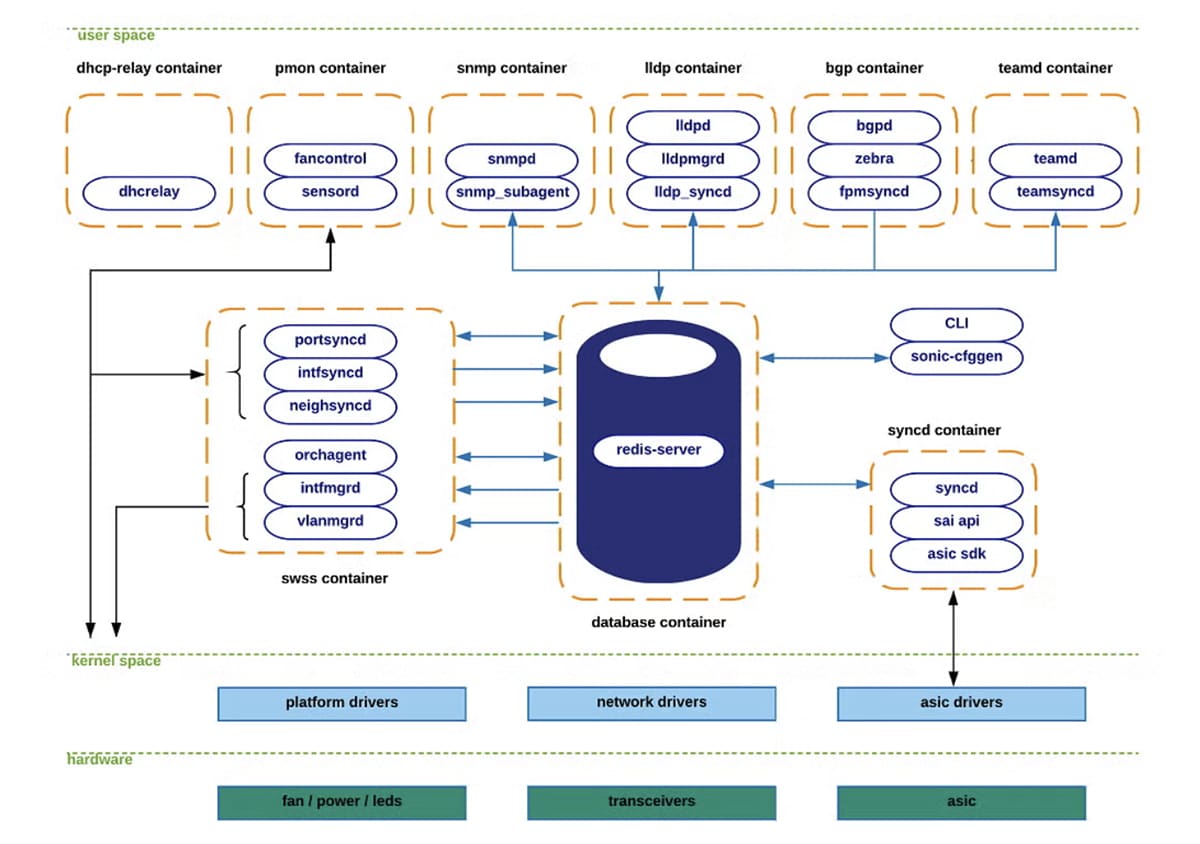
SONiC (Software for Open Networking in the Cloud) is an open source, Linux-based network operating system used by hyperscalers and large data centres. It is designed to run on a diverse range of switching hardware from multiple vendors. Its architecture is characterised by a high degree of modularity and containerisation, which are key to its flexibility, reliability, and extensibility.
The core of SONiC’s architecture involves a separation of the networking control plane logic from the underlying switch application-specific integrated circuit (ASIC). Key components include:
Configuration plane
Operator and automation inputs (via CLI, config files, or APIs) define the network’s desired state, such as routes, VLANs, and telemetry settings, without dictating the hardware implementation details.
Orchestration agents (OrchAgent)
This is the central control plane process responsible for reading the desired state from a shared database. It translates the high-level operational intent into low-level, concrete configuration tasks for the hardware layer.
Switch Abstraction Interface (SAI)
SAI is a standardised, vendor-agnostic API. It provides a common interface for programming switch ASICs by defining functions for managing forwarding tables, access control lists (ACLs), and queues. Hardware vendors supply their own SAI implementation to interface with their specific chip.
Data plane
This is the physical forwarding layer where the switch ASIC processes and forwards packets based on the state programmed via SAI.
The modular design allows each major function to run as an independent process within its own container. This enables components to be upgraded or restarted in isolation, significantly improving the system’s overall reliability and allowing for faster innovation and greater hardware flexibility.
When you walk into a well-run restaurant, you rarely think about what happens behind the scenes. Orders move smoothly from the table to the kitchen, chefs coordinate without shouting, and dishes arrive hot and on time.
Modern data centre switches aim for the same experience. SONiC—the open source network operating system used by hyperscalers—was designed so that dozens of independent software components can cooperate quietly in the background. To make that architecture easier to grasp, let’s borrow the restaurant analogy and see how SONiC keeps packets flowing as reliably as meals in a busy dining hall.
How orders enter the system
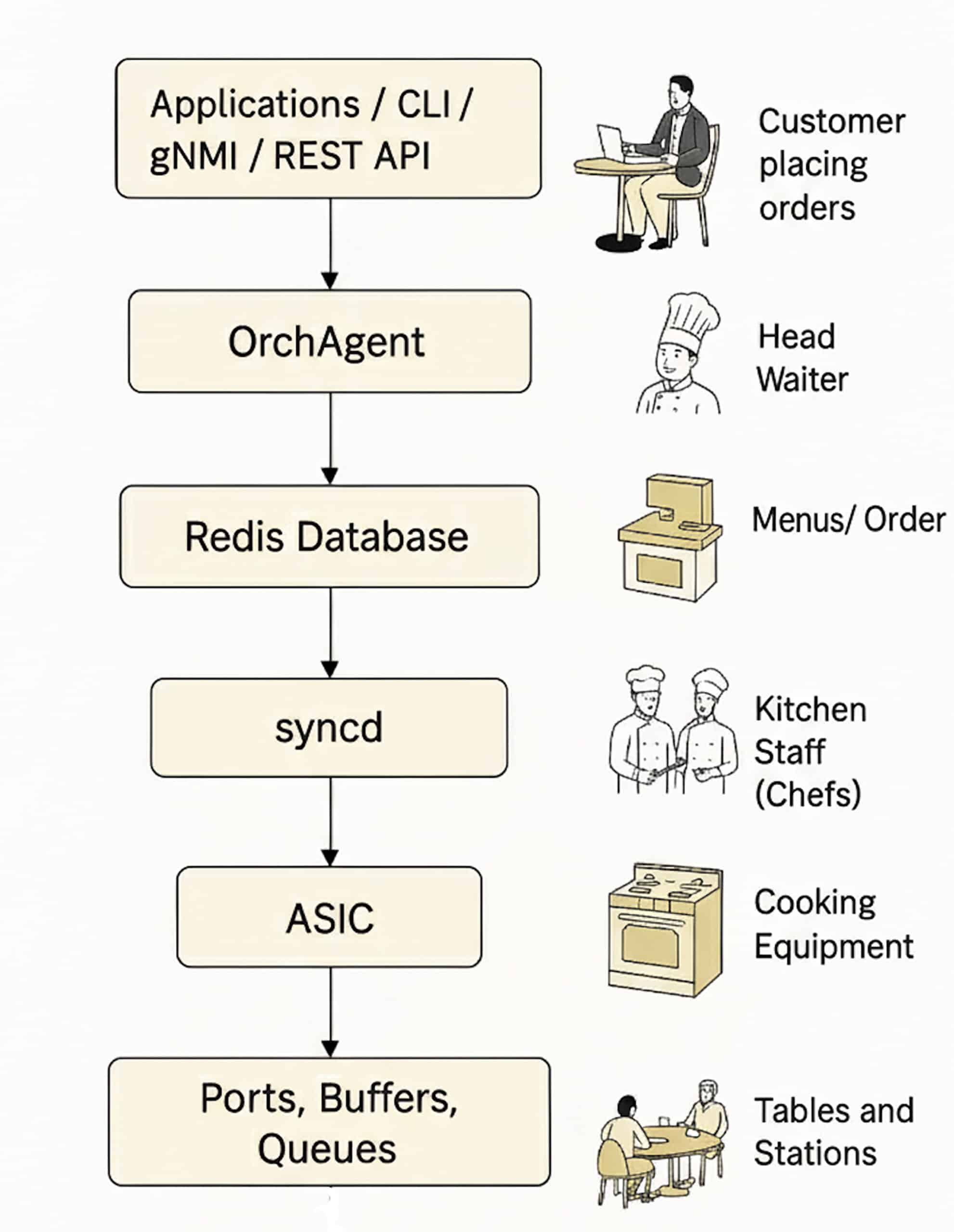
Every restaurant begins with customers placing requests. In SONiC, those ‘orders’ come from operators and automation systems through the command-line interface, configuration files, or management APIs.
These inputs describe what the switch should do—add a route, create a VLAN, enable telemetry—without dictating how the hardware must implement them.
The head waiter of SONiC
In a restaurant, a head waiter collects orders and ensures they reach the right kitchen station. SONiC assigns that role to its orchestration agents, often referred to collectively as OrchAgent. They read the intended state from a shared database and translate it into concrete tasks for lower layers.
This separation allows high-level intent to remain stable even if hardware platforms or vendor drivers change underneath.
What happens in the kitchen
Behind the swinging doors sits the kitchen manager. In SONiC, that job belongs to the process that talks to the switch silicon through the Switch Abstraction Interface, or SAI.
SAI acts like a standard recipe book. It defines how to program forwarding tables, access-control lists, counters, and queues, regardless of who built the chip. The hardware vendor supplies a SAI implementation; SONiC supplies the logic that calls it.
The result is portability. The same SONiC control plane can run on many different switching platforms, just as a chef can cook the same dish in multiple kitchens.
Serving packets at scale
Once the kitchen finishes preparing a dish, servers carry it to the table.
In networking terms, that is the data plane doing its job. Packets flow out of physical ports according to the state programmed earlier—routes selected, filters applied, quality-of-service enforced.
What makes SONiC distinctive is that the people taking orders, the kitchen manager, and the servers are all separate processes. Each runs in its own container and can be restarted or upgraded without shutting down the entire restaurant.
Why modular design matters
This architectural style delivers three major advantages.
First, it improves reliability. If one component misbehaves, it can often be restarted independently. Second, it encourages innovation. Developers can extend or replace modules without rewriting the whole system. Third, it keeps hardware choices flexible. Operators avoid being locked into a single vendor because the abstraction layer shields the upper software from chip-specific details.
Seeing SONiC in a new light
Analogies cannot replace technical documentation, but they help build intuition. Thinking of SONiC as a restaurant highlights its most important trait: cooperation between specialised workers through clear interfaces.
When orders flow smoothly from diners to chefs to servers, nobody notices the complexity underneath. That same invisibility is what operators want from their network operating systems—predictable behaviour, interchangeable components, and room to grow.
As SONiC adoption expands across the open source ecosystem, this modular approach is likely to remain its defining ingredient.
What to take away next
Understanding SONiC through an analogy is only the first step. If you are curious to dig deeper, explore how its databases coordinate state, how routing protocols plug in, and how vendors implement SAI for their chips.
Once you do, you may find that running a large data centre switch has more in common with running a fine restaurant than you ever expected.