



























































The integration of DevOps in radio and wireless applications can help automate infrastructure deployments in sensitive domains like the military.
Software Defined Radio (SDR) refers to the advanced radio communication technology in which radio and wireless infrastructure are managed, controlled, allocated and monitored by software libraries for real-time high performance applications. In traditional radio engineering applications, hard-wired infrastructure (including circuits, resistors, capacitors, antenna and similar components) is used and managed manually. SDR integrates the mechanisms to control the entire radio, wireless and telecom environment by software applications locally or remotely.
For high performance and security-based applications for air defence, military, weather satellites and public safety, SDR-based digital environments use field programmable gate arrays (FPGAs) for accurate results without unpredictable delays.
| Application area | Key benefit | Traditional manual approach | Primary tools | DevOps automated approach |
| RF verification | Immediate feedback on signal quality | Manual bench testing with hardware analysers | GNU Radio, PyTest, NumPy | Automated signal capture and mathematical validation in pipeline |
| Testbed management | Consistent, reproducible test conditions | Manual cable swapping and hardware config | Ansible, Terraform, Labgrid | Programmable, version-controlled lab environment (IaC) |
| Field updates | Rapid,
low-cost scaling to remote nodes |
On-site manual firmware flashing | Yocto, Buildroot, Ansible | Remote OTA (over-the-air) automated deployment |
| RF simulation | Fail early: catch bad designs before physical build | Ad-hoc simulation and design validation | OpenEMS, Ansys API, Python | ‘Shift-Left’ integration: auto-testing designs before fabrication |
| Compliance | Reduced risk of regulatory non-compliance | Final certification at end of dev cycle. | Custom test scripts, regulatory libs | ‘Compliance-as-Code’: auto-checking bounds at every commit |
Key applications of SDR are:
- Military and defence
- Telecom and spectrum analytics
- Satellites and navigation systems
- Industrial monitoring/SCADA
- Wireless environment testing and measurements
- Global navigation satellite systems (GNSS)
- Cybersecurity and signals intelligence
- Aviation and maritime tracking
- Industrial IoT and smart grid
- Wireless protocol research
- Wireless protocol reverse engineering
- Emergency and public safety
DevOps in SDR
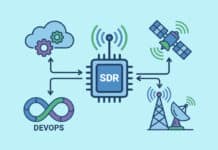
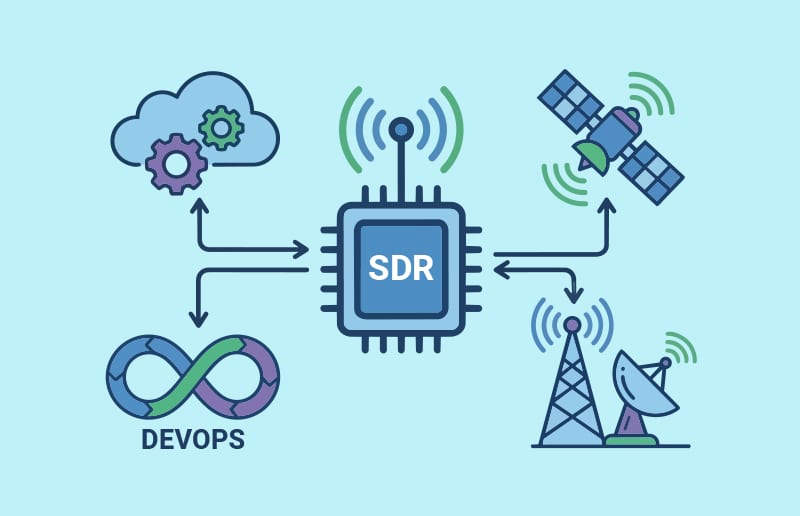
DevOps can be used in multiple domains including civil and construction engineering, radio frequency and telecom, wireless spectrum analysis and dynamic allocations, electronic components assembly, mechanical engineering, etc (Figure 1).
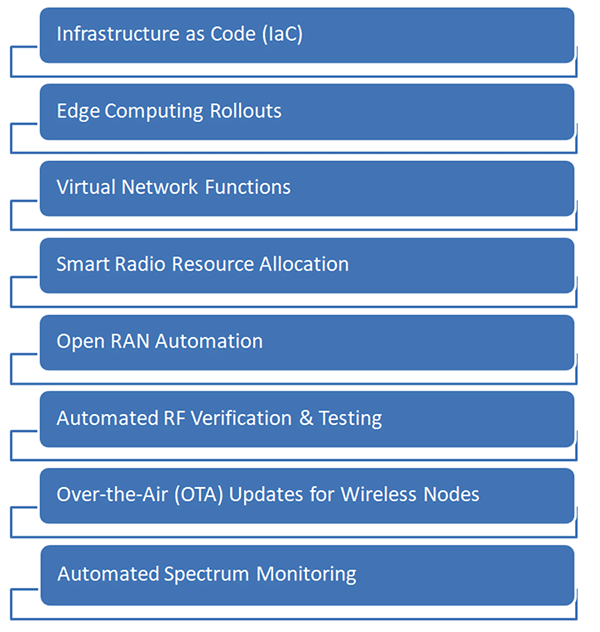
Telecom and wireless technologies can use DevOps for taking specific and error-free actions on air waves or radio signals, which can be managed, controlled and monitored using SDR. The integration of SDR with DevOps makes the overall radio and telecom environment secure and privacy-aware.
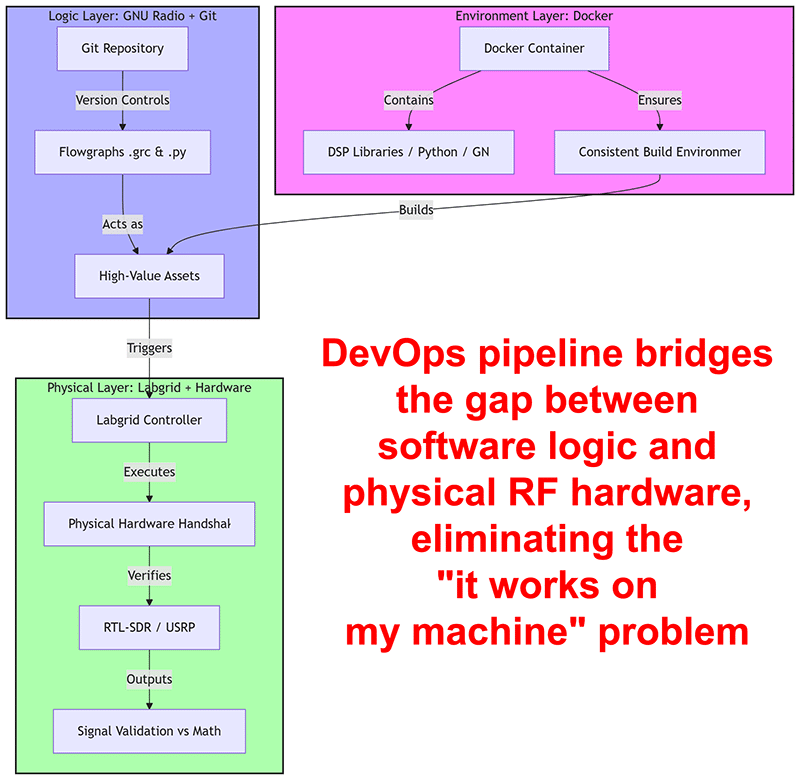
Here’s the pipeline/workflow of RF and DevOps:
Commit -> Build -> Simulate -> Test (HIL) -> Deploy
The manual work is forwarded to Hardware in the Loop (HIL) for effective and high-performance pipelines. In addition, AI-based platforms are integrated for dynamic intelligence and decision making.
Table 2: Popular open source toolkits for DevOps in RF and SDR
| Tool/Library | URL | SDR/RF application | Use case |
| GNU Radio | gnuradio.org | Core engine for defining radio waveforms and modulation | Radio frequency intelligence, Digital signal processing (DSP), Wireless analytics |
| GitLab CI/CD | gitlab.com | Managing multi-stage builds and triggering remote tests | Orchestration and Pipelines |
| Labgrid | labgrid.org | Automating interaction with physical SDR hardware | Hardware-in-the-Loop (HIL) |
| Docker | docker.com | Standardising DSP build environments (UHD, libraries) | Containerisation |
| GPS-SDR-SIM | github.com/osqzss/gps-sdr-sim | Creating synthetic GNSS signals for receiver testing | Signal simulation |
| Buildroot | buildroot.org | Creating lean, reproducible images for embedded SDRs | Firmware deployment |
| Ansible | ansible.com | Automating remote SDR node updates and configuration | Configuration management |
In a DevOps-based pipeline, the following phases are integrated for high performance and minimal error rate:
Validation: To analyse whether the new radio and wireless frequency is within the standards and prescribed limits.
Simulation: Execution of virtual Software Defined Radio (GNU Radio or similar open source platforms) to analyse the radio and telecom behaviour.
Deployment: Hardware deployment only if the simulation is working fine and as per the requirements without or with minimal error.
Verification: Analysis of the signal matching, outputs and confirmation with the target.
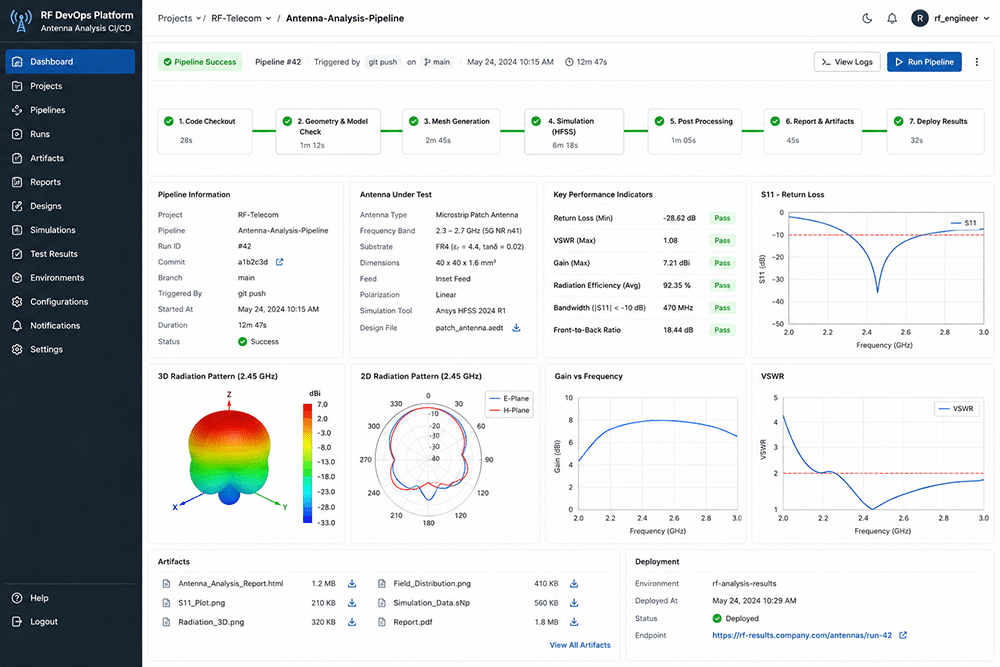
DevOps on AI-based platforms ensures quality and minimal errors in infrastructure deployment. In defence and military applications, the auto-detection of suspicious or unknown flying objects can lead to swift decision making. Researchers can make use of GNU Radio, Python libraries and other similar platforms for real-time air signal analysis, predictions, and decision making.