























































Open source tools have not replaced enterprise IT platforms; they have become the connective layer that makes modern operations possible.
Historically, enterprise IT infrastructure operations were characterised by predictability. Servers were provisioned, applications were deployed, and most monitoring consisted of ensuring that systems were ‘up’. The tools used to perform these activities tended to be proprietary, tightly coupled with specific platform environments and engineered for static environments that rarely changed.
Now, this model has changed dramatically.
The operations supporting modern IT infrastructures can be highly decentralised systems, hybrid and multi-cloud deployments/platforms, containerised applications, and continual delivery pipelines. Visibility, reliability, and adaptability are no longer an option but, rather, core components of IT operations. Quietly but surely, open source technologies are providing the foundations to enable enterprises to meet these demands well.
This evolution/process did not occur overnight; it was born out of the real-world need to operate environments that included a combination of Windows and other OSes, where traditional tools were incapable of addressing the increasing complexity of operations.
In its early years, open source was used mainly to assist IT staff with basic system monitoring and diagnostics. Open source tools were useful because they addressed specific issues such as improving system health, automating tasks, or collecting logs. However, these tools typically did not help to define the strategy to support these IT needs.
Most of the time, IT data came from proprietary vendors. IT departments relied on IT monitoring tools to monitor individual servers, and alerts from those tools were primarily based on pre-defined performance thresholds. Investigating and diagnosing the root cause was primarily performed manually by the IT staff members, who knew how the system’s components worked together.
As systems became more complex through virtualisation and centralisation, and applications began to spread across different locations, it became increasingly difficult to correctly diagnose any outage or failure on any component of an IT system. Instead of being able to verify if the server was ‘on’, IT staff were now required to determine ‘why’ the service was not functioning correctly.
Addressing operational complexity with open source
Cloud architecture, microservices, and distributed workloads created increased operational complexity, which caused companies to move away from using static dashboards in conjunction with siloed applications. Due to the ability of companies to update and change their infrastructure on a minute-by-minute basis, static dashboards and siloed applications were no longer sufficient in supporting the type of rapid-response environment created by cloud computing.
Traditional monitoring approaches struggled to keep pace for several reasons:
- They were built around fixed infrastructure assumptions.
- They lacked flexibility to model dynamic dependencies.
- They provided limited context across systems and teams.
The open source ecosystem started to fill these gaps by providing flexible, extensible, and standards-based alternatives that could evolve along with the infrastructure. It was also the beginning of a larger shift away from defining monitoring systems, towards behavioural observation of functionality.
Observability: The new baseline
Observability introduced a fundamentally different way of thinking about operations. Teams no longer asked pre-defined questions via static metrics; instead, they used their systems to discover failure types not yet known using real-time instrumentation and logging of data.
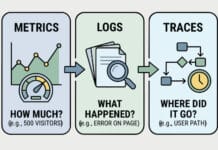
To support this new approach, three types of data became the basis of the observability model:
- Metrics for understanding performance patterns or trends related to service continuity.
- Logs for recording detailed information on events or actions that have occurred within the system.
- Traces for monitoring transaction processing across multiple components that exist across various environments or throughout networks.
The role of the open source community in the successful operationalisation of the observability model is very important for many reasons, including the widespread usage of Prometheus, Grafana, and OpenTelemetry tools. Not only did these tools succeed in being widely adopted as open source projects, but they also successfully filled gaps within many processes by providing visibility into operational problems and allowing for a shared standard of collecting telemetry across all platforms, environments, or programming languages.
As newer technology became available and companies continued to include visibility into their systems as a standard, observability also became popular as the new standard among modern IT operators.
Kubernetes: Creating a new control layer for managing resources and applications
When discussing modern-day operations, one cannot avoid discussing Kubernetes. Initially launched as a way of controlling the provisioning and orchestration of containers, Kubernetes has evolved to become an operational control layer for both applications and infrastructure.
Kubernetes simplified some areas of deployment and scaling; however, it created additional challenges through:
- Workloads being highly ephemeral.
- Service topologies changing quickly.
- Increased abstraction away from the core infrastructure.
Traditional methods of monitoring were rendered ineffective due to these dynamics; so open source tools were developed again to fill this void. With these Kubernetes-based observability, logging, and automation tools, organisations could gain visibility into their clusters, workloads, and the interactions between services.
Open source is now integral to operations related to Kubernetes. Most organisations find that usage of non-open source tools is not feasible for managing container-based environments.
Automation moves from convenience to a necessity
Automation has now matured to become a central function of how we operate our businesses. It started as a convenience, helping teams save time on routine tasks and minimising their manual effort in doing so, but when implemented on a larger scale, automation becomes critical for providing reliability.
Open source non-development automation made possible:
- Declarative provisioning of infrastructure.
- Consistency among systems environments using configuration management tools.
- Automated remediation of known failure scenarios.
Utilising IaC mitigated the potential for drift in the production environment and improved the repeatability of what is created in each cycle, while automation solutions enabled the automation of policies and standards without requiring ongoing human supervision.
The most effective operational models tightly integrated automation with observability — metrics and logs can trigger automated responses for incidents.
Adoption of open source in Windows and mixed OS enterprises
The increased usage of open source solutions within historically Windows-centric companies is one of the largest trends and shifts in this decade. Open source solutions were once seen as either incompatible with or peripheral to Windows environment operations but, today, open source components are embedded in almost every aspect of business activity conducted daily.
The trend towards using open source solutions in what were historically Windows-centric companies has occurred for several reasons including:
- A heterogeneous environment comprised of a mixture of both Windows and non-Windows operating systems (such as Linux) and cloud computing platforms.
- The demand for consistent observability across all operating systems.
- Integration issues that proprietary software/solutions were unable to provide solutions for.
IT teams began utilising open source projects as these gave them the level of flexibility and functional capability needed to solve and support the issues that were challenging proprietary solutions.
The development and deployment of telemetry standards, cross-platform agents, and API-based architectures allowed IT organisations to unify their visibility across multiple systems along with their automated processes.
Lessons learnt from operating open source at scale
There are many benefits of using open source tools but there are also a few lessons learned from implementing these tools in large enterprises.
Complexity when integrating tools
Toolchains can be complex to manage; therefore, it is essential to carefully manage the toolchain components, including data flows, dependencies, and interoperability.
Team readiness
The key to successful implementation of open source tools is not just having the right tools, but also having teams that fully understand how to use them and are able to support, grow, and evolve these tools into something that is effective.
Governance and security
Open source tools provide you with an increased access to information through transparency; however, they also require you to have clear policies and procedures related to patching, version management, and compliance.
Above all, organisations must recognise that flexibility and standardisation should be balanced. If organisations customise their open source tools excessively, they will jeopardise their ability to maintain and sustain these tools, whereas enterprises that implement open source tools in a rigid manner will ultimately lose the ability to adapt to future demands in their business.
The cultural shift behind technical change
Technology alone does not transform operations. The move towards open source-driven observability and automation is closely tied to organisational and cultural change.
Teams must increasingly collaborate across traditional boundaries. Developers, operations engineers, and SREs share the responsibility for reliability. Incident response becomes a learning rather than a blame exercise.
Knowledge sharing extends beyond the organisation. Open source communities provide not just software, but operational patterns, troubleshooting insights, and collective experience.
In this model, maturity is measured not by the number of tools deployed, but by how effectively teams use them to learn and improve.
What IT leaders should evaluate next
For enterprises continuing this journey, several considerations stand out:
| Evaluation focus | What it means in practice | Why it matters |
| Maturity over adoption | Assess whether tools align with defined operational goals rather than adding new technologies for coverage alone | Prevents tool sprawl and ensures observability investments translate into actionable outcomes |
| Standards over silos | Favour open telemetry standards and interoperable data models instead of isolated, proprietary formats | Reduces long-term integration friction and preserves architectural flexibility |
| Scale from the start | Design observability and automation with growth, data volume, and complexity in mind | Avoids re-architecture as environments expand across platforms and clouds |
| Outcomes over trends | Measure success through reliability, performance, and operational resilience — not market hype | Keeps focus on business and service-level objectives rather than tooling popularity |
These evaluations help organisations avoid common pitfalls while extracting meaningful value from open ecosystems.
To sum up, open source has transitioned from providing support to serving as a foundational component of the IT workspace. As infrastructure evolves towards greater levels of distribution, automation, and the use of multiple platforms, tools or integrations built using open standards will facilitate observable and automated functionality to ensure reliability at scale.