





















































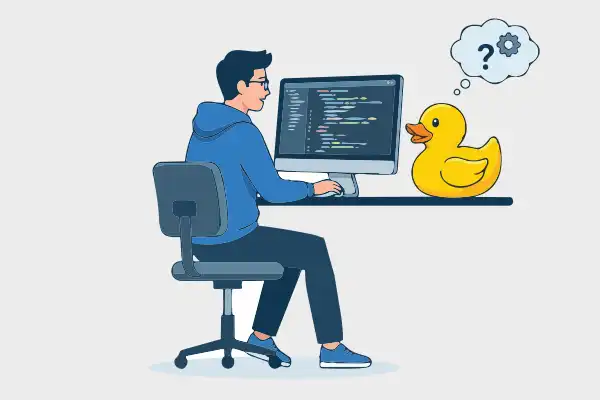

Discover why rubber duck debugging is a powerful process today. There’s also a step-by-step guide on how to use it in the age of artificial intelligence.
In an era of sophisticated AI coding assistants, the humble practice of rubber duck debugging is gaining new relevance. While an AI can instantly generate code or identify syntax errors, it often lacks the nuanced context of the programmer’s original intent. Thus, the ‘duck’ evolves from a simple passive listener into an active, querying partner; the core magic lies not in receiving an answer, but in the act of formulating the question with such clarity that the solution often reveals itself in the process.
Every engineer has experienced this moment.
You are stuck on a problem for hours. The logs look fine. The logic seems correct. You run the program again and again. Still nothing changes. Finally, you turn to a colleague and begin explaining:
“See, first this function validates the input. Then it calls the API. After that—”
And suddenly you pause.
“Wait… that API call can fail before validation completes.”
The bug was not hiding in the code. It was hiding in your thinking. This phenomenon has a name: rubber duck debugging.
In today’s world of AI-powered tools, this simple technique has become even more powerful — but only when used correctly.
Where did rubber duck debugging come from?
The term became popular after the 1999 book ‘The Pragmatic Programmer’ by Andrew Hunt and David Thomas. In the book, the authors describe a programmer who keeps a rubber duck on his desk. Whenever he gets stuck, he explains his code line by line to the duck. Quite often, the solution appears during the explanation itself.
But this behaviour existed long before the book. Developers would figure out the problem or the bug while:
- Writing a detailed email about a production issue — and solving it while writing;
- Explaining logic on a whiteboard — and spotting the flaw mid-sentence;
- Discussing a bug during a stand-up meeting — and realising the mistake while speaking.
The duck is only symbolic. The real idea is simple: When you explain clearly, you think clearly.
Why does this technique work?
Software development is not just typing code. It is structured thinking. Rubber duck debugging works because it improves that thinking.
It forces sequential thinking
Inside our mind, logic feels complete. But when we explain it, we must go step by step:
- What is the input?
- What happens next?
- Why is this condition needed?
- What happens if it fails?
Many developers mentally skip transitions. While explaining, those hidden gaps become visible.
It exposes assumptions
Many real-world bugs are based on assumptions:
- This value will never be null.
- The API always returns valid JSON.
- Users will never enter negative values.
When you say these statements out loud, they suddenly sound risky. Explanation makes hidden assumptions visible.
It improves problem understanding
Sometimes the issue is not in the code — it is in misunderstanding the requirement.
By clearly explaining expected behaviour, you may discover:
- The requirement was incomplete.
- Edge cases were not considered.
- Failure scenarios were ignored.
Clarity in understanding significantly reduces debugging time.
From rubber duck to AI
A physical rubber duck listens silently. AI, however, can:
- Ask clarifying questions.
- Reflect your logic back to you.
- Point out missing scenarios.
- Simulate edge cases.
But there is an important difference. If you use AI only to generate solutions, you reduce your own growth. If you use AI to test and refine your thinking, you become stronger. The goal is not faster answers. The goal is clearer reasoning.
How to use AI as a rubber duck
Here is a structured approach suitable for students, working engineers, and system architects.
Step 1: Define the role clearly
Before sharing code, guide the AI.
Prompt example: Act as a rubber duck debugger. Do not immediately give me a solution. Listen to my explanation and point out unclear logic, missing steps, or wrong assumptions.
This keeps the focus on reasoning rather than quick fixes.
Step 2: Explain the intended behaviour (not the code)
Start with what the system should do.
Prompt example: I am writing a function to calculate discounts.
> Premium users get 20%.
> Regular users get 10% if purchase is above `5000.
> Others get no discount.
Immediately, important questions arise:
- What if the purchase is exactly `5000?
- What if the amount is negative?
- Can a user be both premium and regular?
- What if the user type is missing?
Clarity begins before the first line of code is written.
Step 3: Walk through the logic sequentially
Now explain your implementation step by step.
Prompt example: Here is my step-by-step logic:
1. Check if the user is premium.
2. If yes, apply 20%.
3. Else check if purchase > 5000.
4. Apply 10%.
5. Return final amount.
Please restate this and tell me if any case is not handled.
AI may highlight:
- Missing boundary condition (exactly 5000).
- Lack of validation for negative input.
- Overlapping conditions.
This improves completeness and robustness.
Step 4: Identify assumptions
This is the most critical stage.
Prompt example: What assumptions am I making here? Under what real-world situations can this logic fail?
Step 5: Explore edge cases
Most production failures occur in rare situations.
Prompt example: List possible edge cases for this logic.
This step prepares your system for real-world unpredictability.
Step 6: Request improvement
This is the final step once there is clarity and reasoning is clear.
Prompt example: Based on our discussion, suggest a clean and safe implementation.
In this discussion AI supports your thinking instead of just replacing it.
Technology keeps evolving. AI tools are becoming more powerful every year. But one thing remains constant — software quality depends on clarity of thought.
Whether you use a physical duck, a colleague, a whiteboard, or an AI tool — the principle remains the same. Clear explanation leads to clear thinking. Clear thinking leads to better engineering.