























































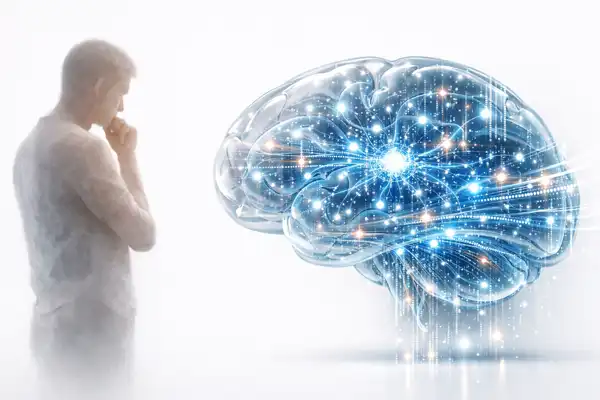

The danger lies not in machines getting more intelligent with time…but in humans finding it convenient to depend on that intelligence.
Not so long ago, learning was something only humans could do. Children learnt through textbooks, and professionals took decades to master their skills — the road to expertise was long and filled with mistakes and mentorships. Today, however, a machine can completely master in mere minutes what a human would take years to learn. A generative AI model can write code that it was never explicitly taught, diagnose diseases from scans better than trained specialists, and create marketing strategies without attending business school.
Artificial intelligence is not arriving with a big bang or in the form of dystopian robot armies. It is coming in a subtle way—through recommendation engines, chatbots, automated hiring systems, predictive analytics, and decision-making algorithms that are deeply embedded in everyday systems. And while AI is not ‘killing’ humans in a literal sense, it may be taking away what makes human contribution economically and cognitively relevant. Are we witnessing progress—or the slow outsourcing of human thinking?
From tools to thinkers: How AI crossed the line
For decades, technology acted as an amplifier of human capability. Calculators enhanced arithmetic. Computers accelerated computation. Software automated repetitive tasks. Humans remained firmly ‘in the loop’.
Today, AI systems have not only come close to the level of human intelligence but have also surpassed it in many ways. Besides carrying out commands, they now analyse, foresee, and improve their performance. Large language models can reason in different fields. Vision machines can sense patterns that are not visible even to the human eye. Reinforcement learners are becoming better with the help of the loops of feedback in a very short time—far quicker than any human could ever be.
In 2023, researchers noticed that AI models were able to do tasks better than humans in:
- Diagnostics of medical images
- Reviewing legal documents
- Detecting financial fraud
- Discovering software vulnerabilities
Machines are not taking over the work of humans but, rather, thinking ahead of them. The harsh reality is that having the ability to learn quickly has become the competitive edge for machines, and humans are the ones losing this race.
Everyday AI we ignore—but depend on
The most treacherous aspect of AI is not its exceptional power but rather the fact that it goes unnoticed.
The first thing that you see in the morning is a news feed that has been selected by an algorithm. Predictive models of traffic lead your journey to work. An online job application is first screened by automated software. The preferences of machines trained by customers are the ones that decide your entertainment, shopping, and even dating choices.
Most people think that they use AI from time to time. On the contrary, AI is constantly using them—learning from their behaviour, controlling their choices, and directing their attention.
Consider this:
- Netflix credits over 80% of watched content to AI recommendations.
- Google processes billions of AI-assisted searches daily, many never reaching a human-curated result.
- Social media platforms optimise engagement using reinforcement learning—often amplifying outrage because it retains attention better than calm reasoning.
Notably, AI is not just taking over the functions of humans, but it is also quietly taking the place of the layer of society that influences decisions.
Productivity boom or human skill bust?
Advocates of AI tell us that there are already considerable gains in productivity—and they do not lie. Consultancy companies like McKinsey and PwC predict that AI will be a US$ 15 trillion addition to the world economy by 2030. Programmers who rely on AI coding assistants claim that their output has increased by 20-40%. The elimination of human involvement in customer service reduces problem resolution times to a matter of seconds. However, this is not without a downside.
The upswing in productivity is not equally shared, and the development of skilled workers is no longer a gradual process. The moment AI does a task quicker and with higher quality, the human is very likely to stop doing that task.
The introduction of spell-checker caused people to rely less on their spelling ability. The same happened with satellite navigation systems and people’s capacity to find their way around. Now that generative AI has made headway in writing, coding, design, and analysis, it might extinguish the very skills that are categorised as ‘knowledge work’. The important question: If machines are thinking, what is the job of humans in the training process?
Every technological era comes with the promise of reskilling. This is supported by history—newly created positions took the place of old ones during the industrial revolution. But AI comes with a fundamental change. What’s being phased out is brains rather than brawn. The not-so-white-collar professions that were regarded safe—accounting, journalism, law, software engineering—are being reshaped. Entry-level positions that have traditionally been used for developing expertise are disappearing the fastest.
Once a junior analyst learned via reports. Now, AI takes that over. A junior developer learned through debugging. Now, AI repairs the code before the human comprehends the mistake. How do you develop new skills when the learning ladder is taken away? This is not the same as just losing a job—it is losing the ability to gather experience.
Why startups love AI
For entrepreneurs, AI is difficult to resist. A startup today can run with just a small part of the workforce that was required ten years ago. AI manages the customer service, creates marketing copy, does analytics, coding, and even comes up with new product ideas.
From a business perspective, this is logical: AI does not ask for salaries, leaves, or benefits. It can be scaled up instantly, and improves with data, not with experience.
However, this also triggers a situation where humans are considered expensive bottlenecks. The startup ecosystem is, in fact, addressing the all-important question: How much human presence is needed in an enterprise?
Large enterprises: Opting for efficiency over empathy
For large companies, AI heralds the era of efficiency and cost-cutting. Boards are authorising AI adoption since shareholders demand dividends. However, automated decision systems are denying loans, rejecting candidates, or optimising layoffs. Who holds the responsibility? Is it the algorithm, the vendor, or the executive who signed the contract?
AI is being deployed by most large enterprises quicker than they can comprehend it. Ethical reviews are carried out only after the deployment of the product. Governance practices have not caught up with the pace of innovation. The focus is on efficiency at the expense of empathy, and society may suffer the consequences in the long run.
When algorithms decide what you see, buy, and believe
Cognitive shaping is one of the most underestimated impacts of AI. The algorithms determine:
- What trends in the news
- Which voices are louder
- Which opinions are more common
Gradually, this results in the creation of algorithmic reality tunnels that are fortifying beliefs and polarising societies. AI is not trying to deceive; however, it optimises for engagement and not for truth. The more advanced machines become, the less humans will think critically and just trust the outputs without questioning the assumptions made. Curiosity will slowly be replaced by convenience.
Are we outsourcing thinking itself?
This is probably the most perilous trend of all. AI is already performing tasks like email drafting, document summarisation, and essay writing. The role of humans is continually becoming that of reviewers and not of thinkers. Mental muscles do weaken over time due to lack of usage. In the cognitive world, outsourcing leads to intellectual dependence. The issue is not whether AI is thinking but whether humans are choosing not to.
The economics of AI: Fewer jobs, higher profits, wider gaps
In the world of AI, people whose skills are automated risk being displaced or experiencing stagnation. The workforce is hollowed out as mid-level skill jobs disappear first. This is already apparent.
AI might change who is able to prosper. Technology advances more quickly than legislation. AI is no different. Systems are firmly established by the time regulations are drafted. Governments find it difficult to strike a balance between control and innovation. In a technology that shapes opportunity, power, and cognition, ethics cannot be an afterthought.
What society gains—and quietly loses
AI offers undeniable benefits: efficiency, accessibility, medical breakthroughs, scientific discovery.
- But society risks losing:
- Deep focus
- Apprenticeship-based learning
- Human-centred judgement
- Intellectual independence
Progress is not free. Every convenience extracts a subtle cost.
Humans cannot compete with machines on speed, scale, or memory. But competition may be the wrong lens. The future belongs not to those who outcompete machines—but to those who complement them. Creativity, ethics, leadership, emotional intelligence, and purpose remain uniquely human—if cultivated intentionally.
As AI accelerates, the central question is not technological—but philosophical: Are we building machines to serve humanity or reshaping humanity to serve machines? The answer will define the next century. AI is neither a saviour nor the villain. It is a mirror—reflecting human priorities, incentives, and values. Machines may learn faster than humans. But whether humans become obsolete is not a technological inevitability—it is a collective choice. Progress should make humans more human—not less. The clock is not ticking loudly. It is ticking quietly. And that is what makes this moment so dangerous—and so important.