





















































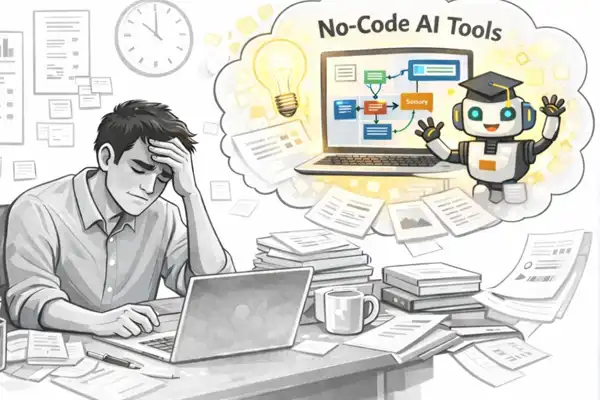

AI is accelerating its role in software development, but its true strength appears when paired with human judgment.
A decade ago, while it was still emerging, AI’s role in software development was experimental. It was essentially a sidekick for automating small tasks.
Today, it is literally transforming how you conceptualise, build, and improve software. Driven by open, collaborative designs like Zoho’s ZIA and Anthropic’s Model Context Protocol (MCP), AI has become a creative partner rather than a coding shortcut.
I set out to explore this shift, how AI has evolved from a coding companion into an intelligent assistant, why open protocols like MCP matter, and what it all means for developers and the future of software.
The big question: Will AI replace developers?
Let’s face it, you cannot move beyond this one major question when it comes to artificial intelligence: Will AI replace developers?. The short answer is no.
AI can automate repetitive work and speed up your learning process, but software development needs more than basic code generation. It demands understanding context and perspective for different situations, and interpreting problems before you can design a solution that solves them.
In my experience, AI performs best when you treat it like an intelligent assistant. It can draft, suggest or even refine your problem statements or corresponding solutions. But it still needs human direction. AI cannot yet replace creativity, design intuition, and domain understanding.
Three categories of AI development tools
When I began preparing, I wanted to cut through the noise. New tools appear daily, and listing them all would be endless. Instead, I grouped AI development tools into three broad categories:
- Chat-based assistants (ChatGPT, Claude, DeepSeek)
- AI inside your IDE (GitHub Copilot, Codium, Cursor AI)
- AI-powered development platforms (Replit, Bolt, Lovable)
I tested all three categories on the same simple problem statement: building a website that accepts user inputs (name, email, mobile number) and generates a QR code. Also, I used the same programming language and prompt for all these tools.
Category one: Chat-based assistants
My first stop was ChatGPT. It is arguably the tool that popularised AI-assisted development. Chat-based systems excel in brainstorming, debugging, and explaining concepts. However, using them involves a certain amount of friction: coding in an IDE while prompting in a browser requires constant context switching.
During the QR code project, ChatGPT generated reliable snippets and accurate library suggestions, but each correction required manual application. The workflow felt more like tutoring than co-building.
Use cases for this category are clear—brainstorming, concept clarification, code generation, and debugging. Yet, as the demo shows, it remains a cycle of prompt, paste, fix, and repeat.
Category two: AI inside the IDE
The real transformation begins when AI moves inside your workspace. Tools like Codium, Copilot, and Cursor AI integrate directly into Visual Studio Code, allowing instant refactoring, auto-suggestions, and in-editor chat.
I found Codium’s chat sidebar particularly intuitive. Highlighting a code block and asking for an optimisation produced clean, contextual edits within seconds. By switching between models like OpenAI and DeepSeek, the tool adapts to the nature of each project, an advantage for professional users.
To make the test fair, I assume the developer knows nothing about the underlying errors. I let the AI handle them entirely. During the same web app test, Codium autonomously corrected most syntax and dependency issues. I barely left the IDE, and the flow remained uninterrupted.Another advantage is flexibility—Codium allows switching between large language models like OpenAI and DeepSeek, depending on project requirements.
This category represents integrated AI that keeps the developer in the flow, reducing context switches while still requiring human oversight for final accuracy.
Category three: AI-powered development platforms
Platforms like Replit, Bolt, and Lovable take automation to its logical extreme. Here, you can generate and deploy entire applications from a single prompt.
Using Replit’s AI agent, I created the same project in one go. I get a few errors when I attempt to go live with the project, but Replit resolves them autonomously without me having to introduce any additional context.
Once the prototype is ready, I have two deployment options. I can either export the code and run it offline or host it instantly on Replit’s own domain. This way, I can easily share the live version for client review or approval.
For rapid prototyping and client demonstrations, this approach is unbeatable. Yet, I would caution against overreliance. Production-level applications still require human oversight for scalability, security, and maintainability.
Comparing all three (plus traditional coding)
To visualise the difference, I compared all three categories against traditional coding:
- Time to understand requirements remained constant across all methods.
- Time to write, debug, and test code reduced dramatically as AI was introduced, with full platforms offering the fastest prototyping.
Yet there is a caveat. While prototyping accelerates, production-grade deployment remains challenging. AI-generated code is not always flawless; you need a developer’s professional expertise to deal with random errors and edge cases. Today, I estimate that roughly half of all AI-generated code is reliable. Within a few years, this may increase to 90%. The rest needs review, especially for error handling, validation, and performance. With every new model release, though, these gaps are narrowing.
How AI has evolved into an intelligent assistant
The next phase in AI’s evolution is definitely the transition from static models to AI agents. Frameworks like LangChain and CrewAI enable large language models to take actions such as calling APIs, retrieving live data, or managing workflows.
I see this as the start of true software collaboration. AI agents can now perform multi-step reasoning, not just code completion. They operate in controlled, sandboxed environments which are secure, traceable, and auditable.
This structured autonomy transforms the developer’s role. Instead of micromanaging syntax, we orchestrate systems that reason and execute within defined boundaries.
Why open protocols like MCP matter
Before Anthropic introduced the model context protocol (MCP), each AI tool needed custom connectors or APIs to communicate with others. It was as fragmented as the pre-USB era of device compatibility. In those days, every device needed its own unique driver or cable. Nothing just worked together right out of the box.
AI tools were kind of facing the same problem. Every system, whether models like GPT, Claude, or Gemini, used its own interface to exchange data or perform other actions. Developers had to manually build connectors or rely on proprietary tools to enable the platforms to communicate with each other.
MCP changes that by acting as a universal connector for AI systems. It defines how models share data and actions securely, creating an open, standardised interface for multi-agent systems. In essence, MCP does for AI collaboration what open standards did for the internet: it levels the field.
For developers like me, that means reduced integration complexity, easier orchestration of tools, and more transparent interoperability across platforms. Competing protocols will likely emerge, but MCP has already positioned itself as a credible open model standard.
The broader picture: Hardware and emerging trends
AI’s progress is more than just software-related. Hardware advances like Microsoft’s Majorana 1 are a milestone in qubit stabilisation. They can theoretically store information much more stably than traditional qubits. So, in basic terms, they could reduce the error rates that prevent quantum processors from handling large-scale AI workloads. Meanwhile, NVIDIA’s Dynamo runtime is pushing the efficiency of classical computation to new levels. It enables AI models to run more efficiently by automatically optimising the way code executes across CPUs and GPUs.
As these technologies come together, we can expect in the future, AI workflows might run securely on local or edge systems rather than cloud-based environments.
Such distributed AI could offer better data privacy and independence from proprietary APIs, in short, we can step closer to sustainable open source ecosystems.
| AI history highlights (1950–2022) |
|
Risks and responsibilities
AI’s potential is fraught with real risks. Geoffrey Hinton, often called the “Godfather of Deep Learning”, has spoken about AI models learning unintended behaviours. Elon Musk and other tech leaders have warned about the overuse of automation and its ethical implications.
From a developer’s perspective, the most immediate responsibilities towards AI include protecting proprietary code, managing data leakage, and ensuring compliance when integrating third-party APIs.
Most thought leaders have advocated awareness and standardised governance as the way to control the evolution of AI while reducing risk. We must encourage a culture of responsibility, particularly for the developer community, which must consider the ethical deployment of AI as important as its innovation.
The verdict: Partnership, not replacement
With regards to software development, AI speeds up design, testing, and deployment, but it relies on human intent and creativity.
For me, AI is neither a competitor nor a threat, but a collaborative tool.
We must find the balance to utilise AI’s power more responsibly, maintain creative control, and champion open and transparent ecosystems, ensuring that technology serves humanity, not the other way around.
So, I believe, the true promise of AI in software development is partnership, not replacement.
This article is based on insights from the AI DevCon session ‘From Code To Intelligence’ By Shaikh Faisal, software developer and project manager at Wingrat IT Solutions. The discussion was transcribed and curated by Apurba Sen, Senior Journalist, EFY.