






















































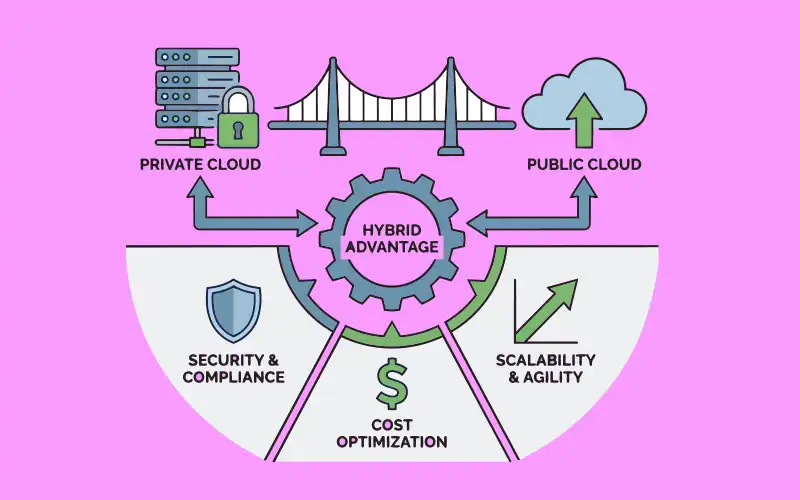

A hybrid cloud is not just about saving costs — it is about the enterprise becoming more agile, efficient and productive.
Enterprises are expanding their usage of clouds to maintain their competitive edge, accelerate innovation and transform interactions with customers, employees and partners. Cloud solutions provide the much-needed flexibility to develop the capabilities necessary to innovate and seize new business opportunities.
A hybrid cloud comprises two or more models (on-premises, private cloud, and public cloud), which help enterprises to distribute their applications and manage workloads across multiple environments, enabling availability, resiliency and flexibility. This involves choosing a model for a given application where the most business benefits are realised.
CIOs across industries are busy working with multiple cloud providers, essentially to retain what works and find out what to improve across the enterprise cloud estate. A fundamental decision they need to make is how to balance the on-site, remote, public and private elements of a cloud model and to adopt emerging technologies. They need to consider the following before promoting a hybrid cloud model:
- Does the enterprise have the right business culture to embrace rapid change?
- What value does the hybrid cloud bring to their business?
- Will it help them to lower costs, improve processes and better manage security?
- The capability to address change management when moving to a hybrid cloud while maintaining business continuity must be looked into.
- Does the enterprise have proper use cases for hybrid cloud adoption?
- What is the volume of cloud service requirement for new application development on existing architectures, and for the development of next-generation applications?
A hybrid cloud offers flexibility, scalability, security, data sovereignty, compliance, and cost-effectiveness based on individual business objectives. Some of the top companies offering hybrid cloud platforms are Amazon Web Services, Google, IBM, Microsoft, Oracle, Salesforce, SAP, Teradata, Alibaba, and Tencent.
According to an Allied Market Research report, the global hybrid cloud market was valued at $96.7 billion in 2023, and is estimated to reach $414.1 billion by 2032, growing at a CAGR of 17.2% from 2024 to 2032.
Research conducted by Foundry shows that 98% of IT leaders have adopted or plan to adopt a hybrid model specifically to balance AI performance. The report highlights that generative AI applications in co-location centres rose from 42% to 45% year-over-year as organisations prioritised low latency and data control over cloud-native convenience.
A recent report from Gartner stated that sovereign cloud infrastructure spending will leap 35.6% year-over-year to $80 billion in 2026. They estimate that 20% of cloud infrastructure workloads will shift from global hyperscales to local/regional providers this year to meet digital independence goals.
What enterprises should consider before opting for the hybrid cloud
A hybrid cloud plays a key role in increasing the speed of delivery of IT resources to end users, improves disaster recovery capabilities, and enables better resource utilisation. However, organisations should consider a few things before going for a hybrid cloud.
Visibility of current state: The current application landscape and infrastructure across the enterprise must be assessed. A complete application portfolio analysis of the enterprise should be performed to decide on the cloud adoption.
Rate of cloud adoption: A big bang approach will not work. The timelines of cloud adoption should be based on the criticality of the applications. The factors that decide the rate of cloud adoption include complexity of the applications, data requirements, regulatory and compliance needs, modernisation prerequisites, cost implications, and real-time requirements.
Portfolio rationalisation: The business functions and the applications that are catering to them need to be identified and re-engineered based on industry trends and mergers/acquisitions. Redundant functionalities across applications must be rationalised before moving to the hybrid cloud.
Application migration: Applications can be migrated to and from the data centre and cloud using the hybrid cloud model. The applications that need to remain on-premises or move to a private or public cloud must be identified. This migration can be temporary or permanent depending on the strategy of migration.
Nature of applications: Applications that change frequently must be moved to the cloud to leverage automated deployment through DevOps. Applications that handle sensitive data are best retained on-premises. Applications with very high scalability requirements because of varied user load are ideal to be hosted on the public/private cloud.
Selection of environments: Public cloud environments may not provide specialised hardware. Choose the best environment for the application to run to deliver the functionality at the most optimal cost and effort.
Integration strategy: There is a need to connect the applications back to the historical data that resides on the on-premises servers even after the cloud migration. Enterprises must develop an integration strategy to be followed by the hybrid cloud.
Regulatory requirements: Applications requiring regulatory and compliance requirements demand some of the applications and data to reside on-premises. This requires due diligence to select the right candidates for the hybrid cloud.
Containerisation: Containerisation helps make the application cloud-agnostic and move across public, private, and on-premises clouds.
Cloud interoperability: Integration between several cloud offerings across multiple cloud service providers and cloud types is a key consideration for the success of hybrid cloud adoption.
Hybrid cloud management model
The hybrid cloud adoption management model is depicted in Figure 1. The key layers of this model are:
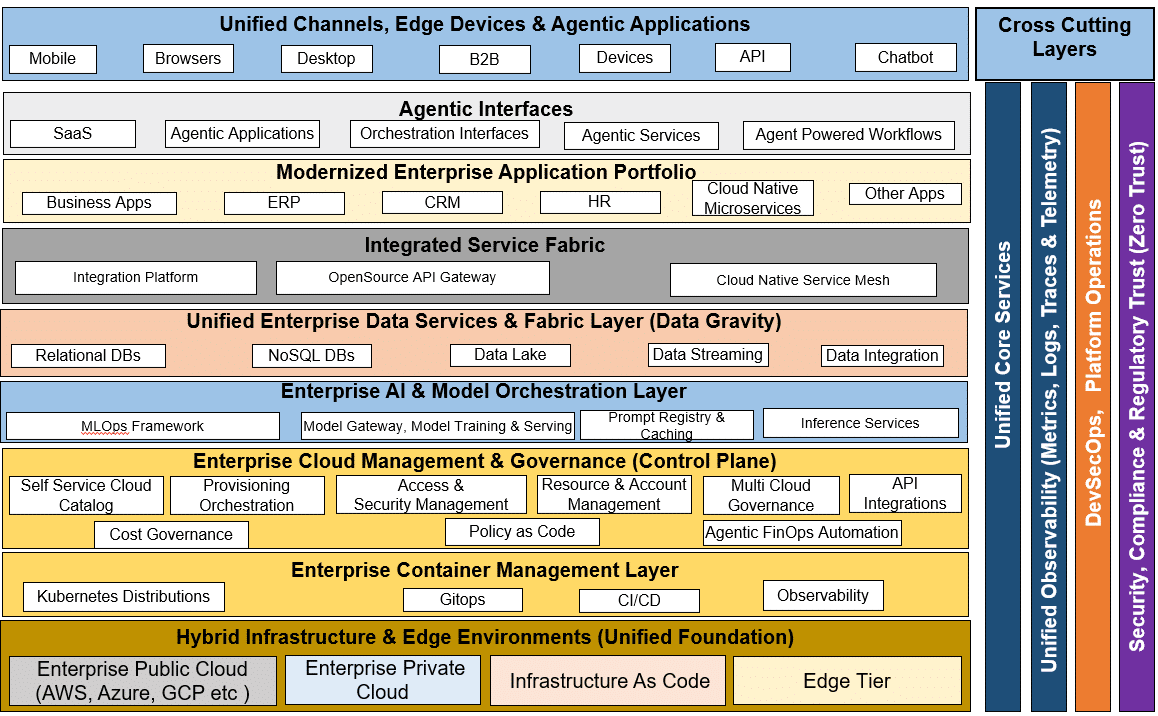
Unified channels and edge devices: This is the user interface and access layer through which users interact with the cloud system, such as the web, mobile, and IoT devices.
Agentic interfaces: These serve as the interface for autonomous AI agents that can now interact with users like a human collaborator.
Modernised enterprise application portfolio: This layer categorises the applications that run on the hybrid cloud into microservices (modern), monoliths (traditional), and legacy (old systems).
Cloud-native microservices: These are applications designed as small, independent services for easier updates and scaling.
Agentic services: These autonomous workflows (using frameworks like LangGraph) can execute complex multi-step tasks across different business apps.
Integrated service fabric: This layer enables different components of the platform to communicate with each other effectively and securely. It includes:
- Open-source API gateway (e.g., Kong, Envoy): Centralises API management, security, and traffic control. Used to route requests to the correct model or microservice.
- Cloud-native service mesh (e.g. Istio, Linkerd): Manages service-to-service communication, providing advanced features like intelligent routing, encryption (mTLS), and observability within the container ecosystem.
- Integration platform (e.g., Apache Camel): Provides lightweight, enterprise integration patterns to connect diverse systems to fetch historical data.
Unified enterprise data services and fabric layer: This layer addresses data gravity and provides a standardised approach to data management across the hybrid landscape. It ensures that data can be discovered, accessed, and governed regardless of where it is stored. Various data services are:
- Relational database; e.g., PostgreSQL
- NoSQL database; e.g., Cassandra, Redis
- Data lake for storing and managing large volumes of unstructured data; e.g., MinIO, Apache Hive
- Data streaming for real-time, event-driven architecture; e.g., Apache Kafka
- Data integration for change data capture; e.g., Debezium
Enterprise AI and model orchestration layer: This layer provides the standard tools needed to train, serve, and govern models. Key components include:
- MLOps framework: To orchestrate the end-to-end machine learning lifecycle; e.g., Kubeflow, MLflow.
- Model gateway: Intelligently routes requests to the most efficient model using local models for routine tasks and public LLMs for complex reasoning.
- Model training and serving: Develops and exposes models as scalable services; e.g., TensorFlow, Seldon Core.
- Prompt registry and caching: Caches AI responses, significantly reducing API costs and latency; e.g., Valkey.
- Inference services: Runs AI models on private hardware for maximum data security; e.g., vLLM, KServe.
Enterprise cloud management and governance: This enables the provisioning of infrastructure components, platform services components, security and access management, and multi-cloud governance. This platform provides a self-service catalogue for users that helps them manage their services. It manages costs (FinOps) and handles Policy-as-Code (ensuring no one creates an insecure public database).
This is the single-pane-of-glass that orchestrates operations, controls costs, and enforces policies across the entire hybrid cloud.
- Policy-as-Code: Provides a unified way to enforce security policies and regulatory compliance; e.g., Open Policy Agent (OPA), Kyverno.
- Cost governance: This addresses cloud cost optimisation automation, and provides real-time visibility into Kubernetes spending; e.g., OpenCost.
- Self-service catalogue: Allows developers to provision resources without manual intervention from IT admins.
Enterprise container management layer: Containerising the solution makes the services cloud-agnostic and platform-agnostic. Containers provide a platform to run services that are easily portable, elastically scalable, multi-region deployable and resilient, based on Kubernetes.
Examples include Kubernetes distributions (e.g., OKD, RKE2), specialised GitOps and CI/CD pipelines (e.g., ArgoCD, Jenkins), and an observability stack (e.g., Prometheus, Grafana).
Hybrid infrastructure and edge environments: This is a foundation layer that has physical or virtualised hardware on which everything runs. By utilising open source technologies like KVM-based hypervisors for private clouds and edge computing solutions, this layer creates a consistent abstraction across public clouds, private clouds, on-premises data centres, SaaS and the network edge. Examples are KubeEdge and OpenYurt.
- Edge tier: Localised nodes for <10ms latency processing.
- Private sovereign cloud: Secure, on-premises data centres that keep sensitive information within national or corporate borders.
- Public cloud (Hyperscalers): Used for massive scaling, burst compute, and heavy AI model training.
- Infrastructure as Code (OpenTofu): Ensures the entire foundation is scripted and reproducible.
Unified core services: This layer comprises the standards and processes that must be applied consistently across every single level. It prevents vendors locking in and provides a ‘common language’ for the entire platform. By using open standards (like Terraform for infrastructure or Prometheus for monitoring), it ensures that we can move a service from public cloud to an on-premises private cloud without having to rewrite the deployment scripts or change how the app is monitored.
Unified observability: This provides real-time metrics, logs, and traces from the hardware right up to the user; e.g., Open Telemetry.
Security, compliance and regulatory trust: This layer acts as automated guardrails. It ensures that data sovereignty, zero-trust identity (Keycloak), and regulatory requirements are met at every layer.
DevSecOps and platform operations: This layer automates the security and maintenance of the platform throughout the software lifecycle.
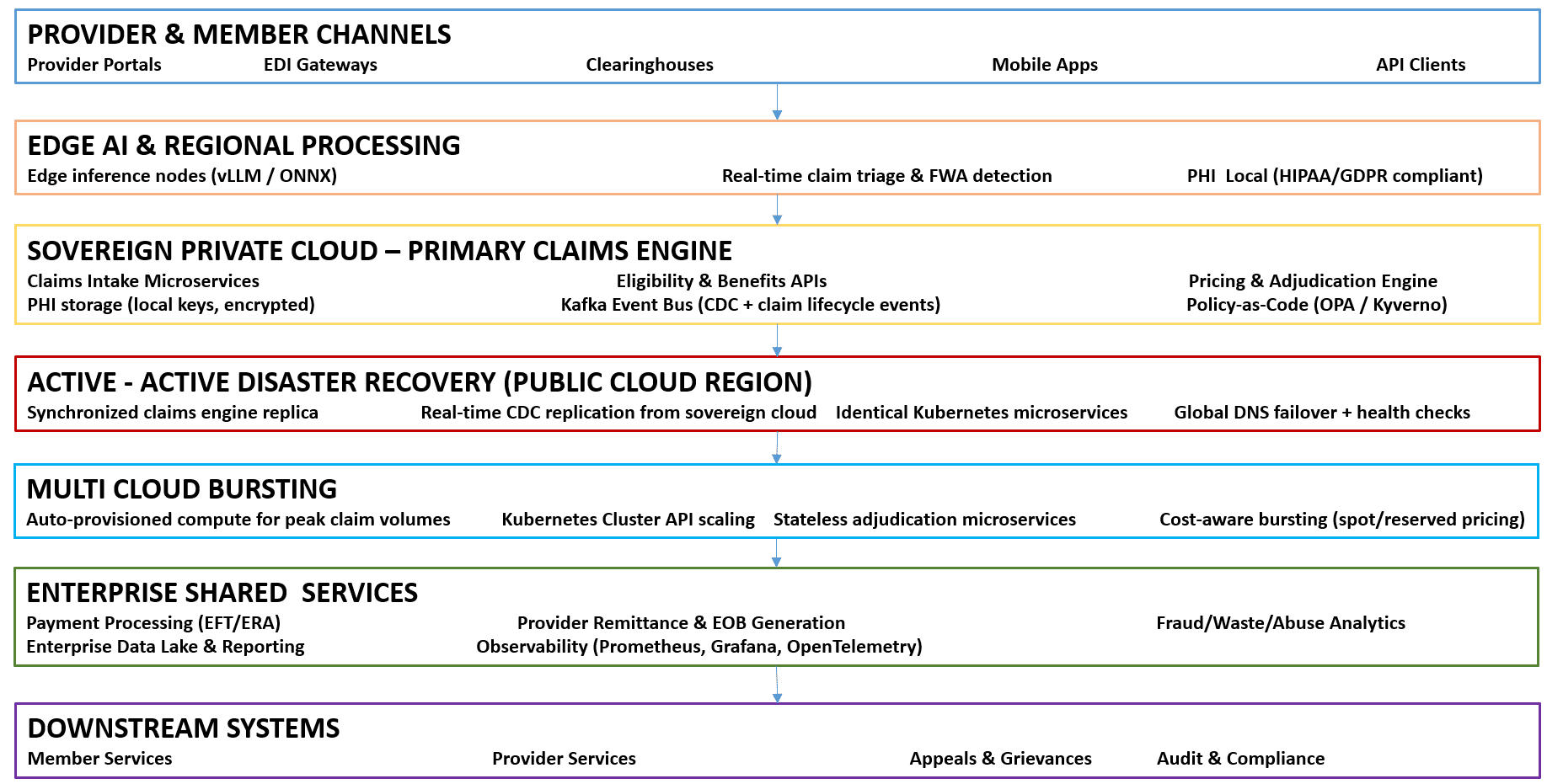
A health insurance claims management platform moving to a hybrid cloud model: An example
Let’s consider a health insurance company modernising its claims management platform using hybrid cloud architecture to improve adjudication speed, regulatory compliance, and operational resilience.
The platform processes millions of claims daily. The solution is based on a hybrid cloud model that is centered around AI and addresses the following:
Edge computing: The solution adopts AI-powered claims triage models at the network edge close to the provider network to accelerate claims processing. This hybrid AI approach reduces cloud GPU costs and improves first‑pass claim resolution rates.
Multi‑cloud bursting: This helps to handle peak claims volumes. It provides elastic scalability, ensuring claims are processed within regulatory timelines even during peak times.
Sovereign cloud controls: This solution for a claims platform adopts the sovereign hybrid cloud model, which helps to protect PHI and national data. As the company operates across multiple countries, it must comply to data sovereignty laws as well as cloud and AI development acts in the EU.
Disaster recovery: Claims adjudication is mission‑critical, and downtime directly impacts providers, members, and regulatory SLAs. The model needs to adopt an active‑active hybrid DR model. This ensures zero downtime, uninterrupted provider payments, and compliance with CMS timelines.
The hybrid cloud claims management architecture helps in achieving:
- Zero downtime claims processing
- Faster adjudication through edge-based AI
- Elastic scalability during peak claim periods
- Full compliance with national and international data sovereignty laws
- Lower operational costs
Benefits of hybrid cloud adoption
A hybrid cloud helps enterprises increase flexibility to deliver IT resources, improve disaster recovery capabilities, and lower IT capital expenses. The other benefits are:
Business acceleration: Helps speed up business processes, supports collaboration, and provides cost-effective solutions to free up IT budgets for innovative, revenue-generating projects.
Cost reduction: Helps in reducing operating and capital costs, and improves performance, productivity and business agility via a flexible, scalable solution. Enterprises can choose the applications to move across the clouds and on-premises based on their enterprise requirements.
Flexibility: Enterprises can choose the optimal environment for each workload based on performance, security, and cost. They can easily migrate their workloads to or from their infrastructure and a public cloud whenever necessary.
Cost optimisation: A hybrid cloud model allows users to choose from the environment where they want to run their workloads most cost-effectively. By running AI inference on local hardware (CPUs/NPU), enterprises can save up to 40% compared to renting high-end GPU instances in the public cloud.
Reliability: In this model, if one cloud goes down, some functionality will still be available to users from the other deployed clouds. Generally, one public cloud can be used as backup for another cloud.
Resilience: In a hybrid model, an enterprise can run applications redundantly in both environments, i.e., public and private clouds. Thus, components of a single workload can interoperate and run in both environments. It enables an active-active setup where workloads run simultaneously across environments, ensuring zero downtime during hyperscaler outages.
Risk management: A hybrid cloud helps to mitigate risks with a single, unified, cybersecurity solution.
Managing legacy systems: A hybrid cloud can bridge the gap between legacy and new systems, leading to major cost savings.
Scalability: Applications can scale infinitely by adopting a hybrid cloud strategy while keeping the core business data secure through on-premises hosting. When an enterprise’s demand exceeds the capacity of the physical data centre, it can transfer the data to the public cloud to access extra capacity and scale.
Disaster recovery and business continuity: Hybrid clouds enable enterprises to create robust disaster recovery plans by replicating data and applications across multiple environments.
Hybrid cloud is now a popular IT strategy, enabling enterprises to migrate workloads, speed up application development, adopt containers and microservices, and ensure portability across platforms. Enterprises of any size can adopt it to ensure cost-efficient business delivery with zero downtime.
Disclaimer: The views expressed in this article are those of the authors. Tricon Solutions LLC and Gspann Technologies, Inc., do not subscribe to the substance, veracity or truthfulness of the said opinion.