





























































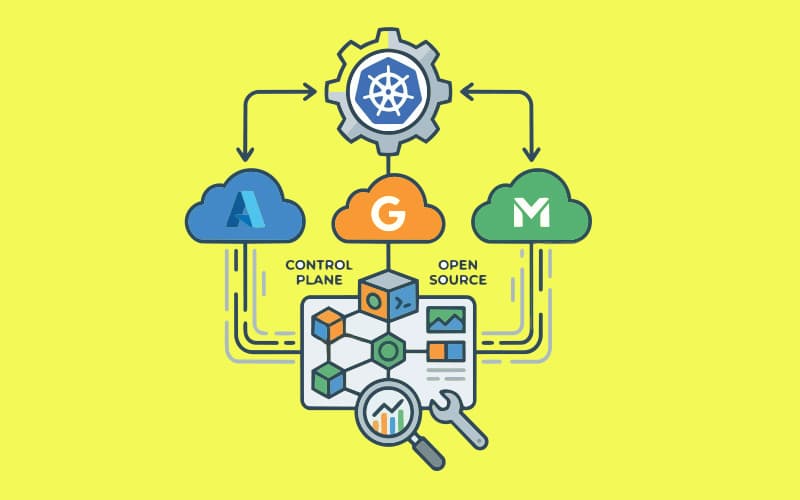

Kubernetes and open source control planes make multi-cloud operations easier and help organisations build scalable and cloud-agnostic infrastructure platforms.
The development and deployment of applications have changed dramatically with cloud computing. Over the last decade, cloud-based solutions have grown rapidly, providing businesses with a scalable, flexible, and fast way to innovate. Many enterprises today are increasingly adopting multi-cloud architectures, where applications and infrastructure are deployed across multiple cloud platforms. According to the Flexera State of the Cloud Report, 89% of organisations now operate in a multi-cloud environment, reflecting the growing demand for flexibility and resilience in cloud deployments. By distributing workloads across different cloud providers, enterprises can reduce vendor lock-in, improve disaster recovery strategies, and meet regulatory or data-residency requirements. As cloud-native technologies continue to mature, multi-cloud infrastructure is becoming a key component of modern enterprise IT strategies.
Kubernetes and current open source control plane technologies are essential in this area of technology. They provide an orchestrated layer for containerised applications, enabling them to be portable from one cloud to another. When you use Kubernetes together with an open source control plane such as Crossplane, Cluster API, or GitOps, it becomes the basis to unify multi-cloud infrastructure management.
Understanding multi-cloud infrastructure
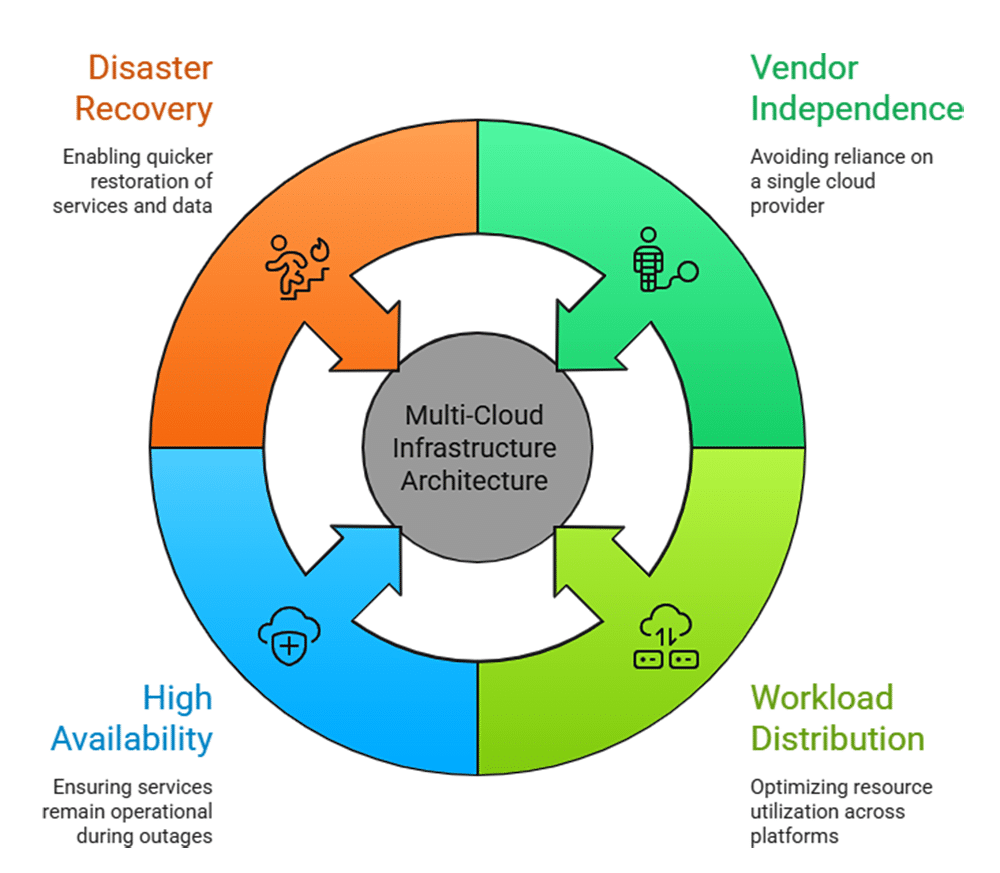
Using different cloud services from different companies for part or all your infrastructure is referred to as having a multi-cloud strategy. These infrastructures can consist of either public clouds, private clouds, or edge locations.
The benefits that come from having a multi-cloud infrastructure are numerous. These include the ability to:
- Minimise your risk of becoming tied down to one vendor (vendor lock-in);
- Improve your system’s resiliency (the ability of your systems to bounce back) and recover from a disaster;
- Comply with government regulations around data residency;
- Utilise the location of workloads to provide better performance;
- Reduce infrastructure costs through better flexibility with providers.
Why Kubernetes became the foundation of multi-cloud platforms
Kubernetes was developed by Google to manage the deployment of workloads that are packaged as containers. Because of its wide acceptance, it has become the standard for the orchestration of cloud-native infrastructure resources.
One of the strongest features of Kubernetes is its ability to abstract everything that goes into deploying an application on behalf of the user and provide a common API for using the underlying infrastructure. The following key capabilities of Kubernetes facilitate multi-cloud application orchestration:
Deploy once, run anywhere: The flexibility of Kubernetes to deploy applications packaged inside containers allows them to be loaded in both public clouds, private clouds, and any combination of those two environments. The use of one technology provides an identical user experience throughout.
Declarative infrastructure: Kubernetes uses declarative configuration files to define the desired state of an application and its underlying infrastructure, and allows for the automated deployment of both the application and its required infrastructure to achieve this state.
Self-healing: Kubernetes can automatically scale an application. For instance, if you were to lose a container because it died, Kubernetes would automatically create a new replica of that container, providing a more reliable means for a distributed application.
Extensible: Extensibility means the custom resource definitions (CRDs) that come with Kubernetes (as part of the Kubernetes standard distribution) add the new features related to monitoring/managing an application’s use of Kubernetes that cannot be achieved using Kubernetes.
While we refer to Kubernetes today as the most popular cloud native orchestrator for multi-cloud, it primarily manages only container workloads (i.e., containers running). To provide for multi-cloud deployment of workloads, additional tools need to be used for controlling (managing) all the resources required for deploying workloads from multiple clouds (i.e., firewalls, load balancers, compute platforms, etc).
The role of open source control planes
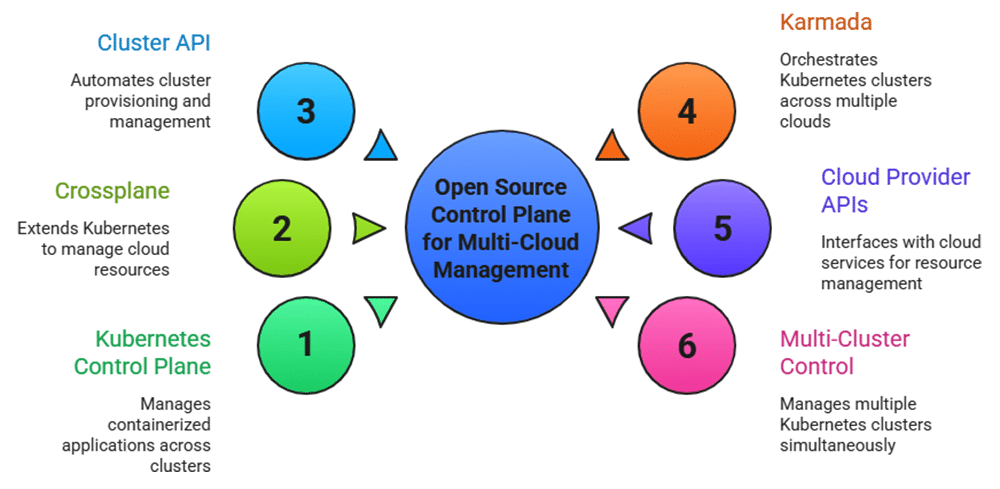
A control plane is an essential component for managing infrastructure resources and for guaranteeing a state of the system that is as its intended design. A traditional cloud control plane is designed to work with one service provider and manages compute, network, and storage independently. As an example, Amazon, Google Cloud, and Microsoft Azure use different control planes for virtually all their services.
Open source control planes are designed to serve as a unified layer of infrastructure management across multiple service providers.
The most popular open source control plane solutions available are:
Crossplane: Crossplane builds on top of Kubernetes to allow you to manage cloud resource infrastructure directly from within Kubernetes through the Kubernetes API.
Cluster API: This allows users to declaratively manage their Kubernetes clusters throughout many different infrastructure providers using declarative configuration syntax.
Karmada: Karmada offers central administration of multiple Kubernetes clusters and enables the operation of multiple clusters among service providers.
With these solutions, you can define and manage your infrastructure resources, such as databases, networks, virtual machines, and similar items, as Kubernetes objects.
As a result of this, Kubernetes has evolved from merely being a container orchestration tool into a universal infrastructure control plane.
Crossplane: Kubernetes-native infrastructure management
Among the many popular open source solutions currently available for multi-cloud infrastructure management, Crossplane is widely thought of as one of the best. It enhances the features of Kubernetes by providing an expanded definition of infrastructure to include Kubernetes-resourced Infrastructure as Code.
By utilising Crossplane, organisations can provision a multitude of infrastructure elements like cloud storage buckets, databases, and virtual networks using Kubernetes manifests. In practice, a developer can define a database instance on AWS or Google Cloud using the YAML configuration within Kubernetes.
The many advantages of Crossplane include:
- One API to manage a unified infrastructure across multiple cloud providers.
- Version control of all infrastructure definitions using Infrastructure as Code.
- Standardised infrastructure templates created by platform teams and used by developers in the application development process.
Centralised platform engineering teams are creating shared foundation components (Infrastructure as Code) for providing developers with reusable infrastructure.
GitOps for multi-cloud infrastructure
It’s critical for every organisation to manage its infrastructure across different environments — automating and making its processes reproducible is essential.
The GitOps model provides tremendous value here.
GitOps is a DevOps practice that uses Git repositories to store infrastructure code for configuration, which is automatically propagated to systems via a continuous delivery pipeline. Three of the most common open source GitOps solutions are:
- Argo CD
- Flux CD
- JenkinsX
By leveraging these tools, organisations can automatically provision and upgrade resources contained within their Git repositories via CI/CD pipelines across multiple Kubernetes clusters or in different clouds.
The primary benefits of GitOps include:
- A version-controlled infrastructure that provides historical tracking of all changes to your infrastructure.
- Docs for the deployment of infrastructure can be automated; so the infrastructure is deployed using automated CI/CD pipelines.
- Increased reliability — if there is a difference between the desired and the actual state of a given system, GitOps tools reconcile between the two states, restoring the configuration to what it was previously.
By combining GitOps with Kubernetes control planes, organisations can create an organisation-wide multi-cloud infrastructure management system that is entirely automated.
Observability and networking across multi-cloud clusters
For monitoring several workloads in different clouds, a singular observable stack is of great importance. There are many open source tools available for monitoring in Kubernetes-based environments, but the most common include:
- Prometheus
- Grafana
- Loki
- OpenTelemetry
With these tools, developers can utilise a combination of logs, metrics, and traces retrieved from multiple container systems to effectively monitor the health of the applications running in these different clusters.
Networking is another issue that needs to be addressed when working in multi-cloud environments. All workloads that are deployed across various cloud providers need to communicate with each other in a secure and efficient manner.
Service mesh technologies, such as Istio and Linkerd, help implement secure service-to-service communications and traffic management, as well as provide a means of performing distributed tracing and service discovery. By leveraging service meshes, organisations can apply networking policies uniformly across their various Kubernetes clusters.
Reference architecture for multi-cloud Kubernetes platforms
A multi-cloud Kubernetes environment generally has many levels or layers.
Kubernetes clusters: Kubernetes clusters can be managed using tools like Crossplane, Cluster API, etc. These help to automate the entire lifecycle of cloud infrastructure and cluster management.
Pipeline: Infrastructure and application configurations are stored in Git repositories so that they can be continually developed and managed through an automated process.
Service mesh layer: This allows secure service-to-service communication between clusters, like Istio and Linkerd.
Observability stack: Prometheus and Grafana provide observability/monitoring of workloads across multiple clusters.
With this architecture, an organisation can deploy workloads to multiple public clouds in a unified way, with a single point of control, management, and governance.
Real-world use cases of multi-cloud Kubernetes
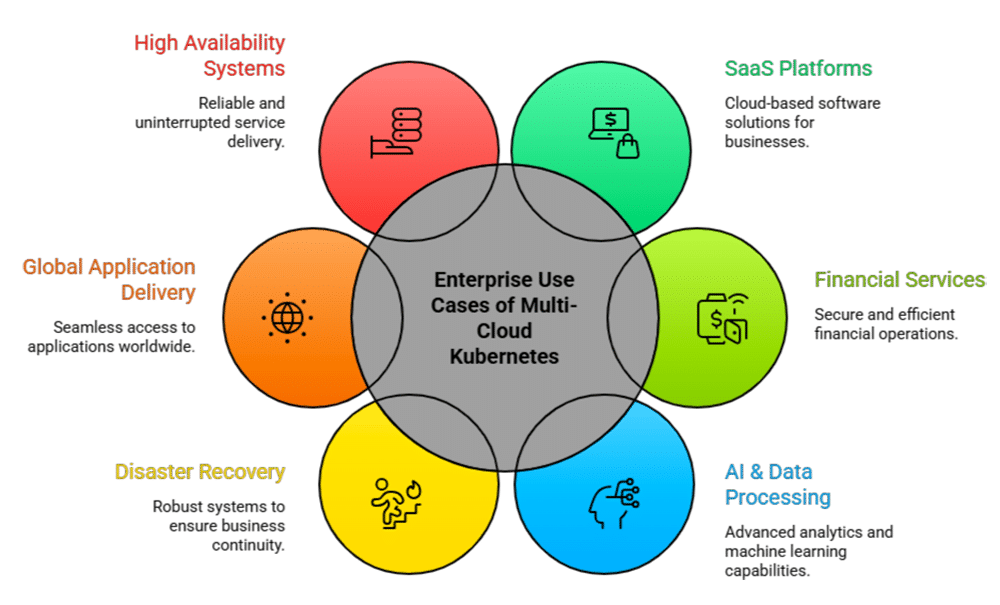
Multi-cloud designs based on Kubernetes are being used by most businesses.
Software as a Service (SaaS): Global SaaS companies are using multi-cloud to deliver their products more reliably. These architectures are often implemented by experienced .NET development companies that design scalable microservices and container-based applications running on Kubernetes clusters.
Financial services: Companies in finance use multiple cloud suppliers to meet the expectations of their regulators, so that they don’t become too dependent on one vendor.
AI and data platform: Large data processing jobs run across multiple clouds to ensure that compute resources are always available for data processing.
Disaster recovery: Organisations create replicas of their production environments in a different cloud so that they can carry on with their business even when the primary service provider fails to provide the compute resources needed.
Building multi-cloud designs typically calls for considerable experience with DevOps best practices, as well as automating infrastructure. Therefore, most companies partner with experienced cloud or Kubernetes consultants to help design and create dynamic multi-cloud platforms.
Companies that offer Kubernetes consulting services (e.g., developing Kubernetes solutions), DevOps services (e.g., automating DevOps), and the development of cloud-native applications help businesses build production-ready environments and structured pipelines between their multi-cloud providers.
Challenges in managing multi-cloud Kubernetes
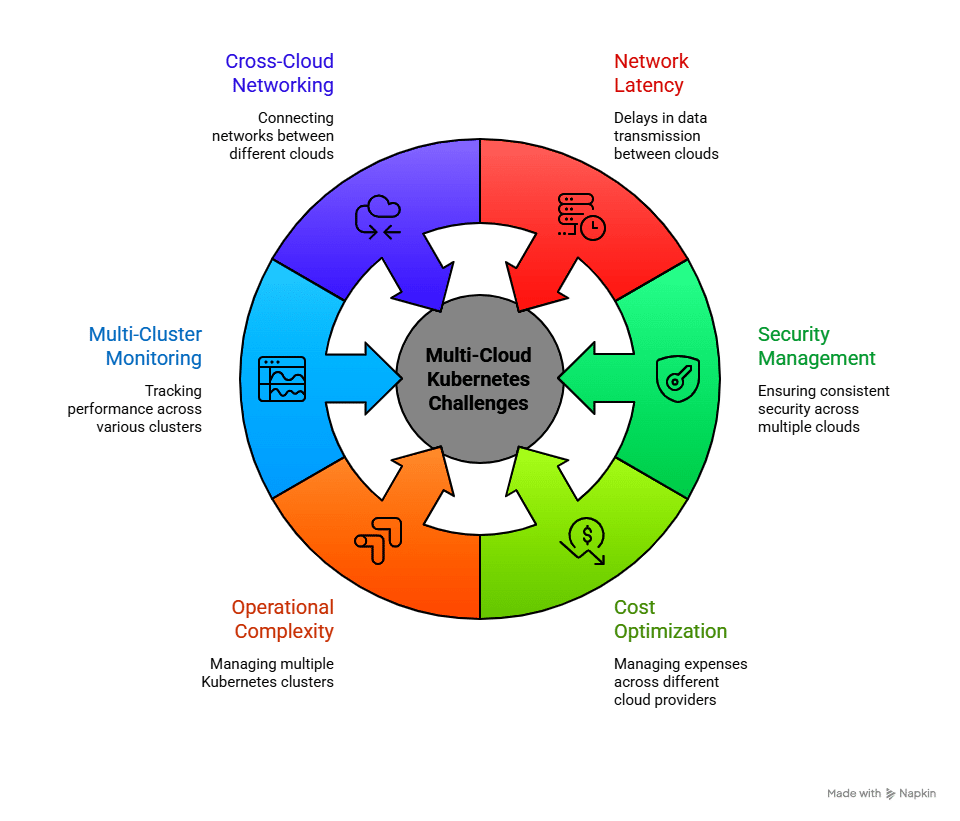
Although there are many advantages of using a multi-cloud Kubernetes management system, there are still a lot of challenges involved in managing one.
Network latency: Different cloud providers can result in additional delay when communicating between different workloads.
Security management: The identity and access control policies need to be the same across every cluster.
Cost management: Poor optimisation can increase the operational costs of running different infrastructures in different clouds.
Operational complexity: Effective automation and monitoring systems are required for each cluster to avoid operational issues.
Organisations that utilise multi-cloud architectures must establish strong governance frameworks and standardised infrastructure templates for all their clusters.
The future of multi-cloud infrastructure
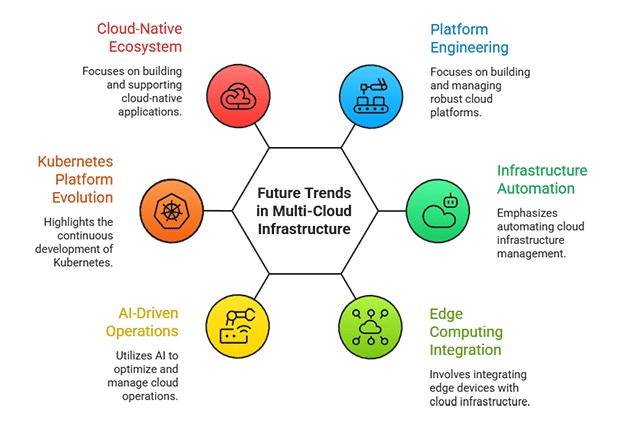
The following trends will impact the future of multi-cloud infrastructure.
Platform engineering: Enterprise internal developer platforms are becoming more commonplace.
Infrastructure automation: Tools that provide automatic lifecycle management of clusters are rapidly advancing and will likely become standard.
Integration of edge computing: Use of Kubernetes for managing workloads across edge facilities is becoming more common.
AI-driven infrastructure operations: Infrastructure optimisation and anomaly detection can now be achieved using machine learning algorithms.
The application of Kubernetes as a base platform has led to it being the cornerstone for managing container workloads that are distributed across many different cloud providers. By combining Kubernetes with other open source control plane technologies like GitOps, Cluster API, and CrossPlane, Kubernetes can provide more than just the orchestration of applications. It can also serve as an integrated platform for managing all aspects of an organisation’s infrastructure.
As the ecosystem matures, Kubernetes and open source control planes will most likely play key roles in driving the evolution of cloud native infrastructure platforms.