
























































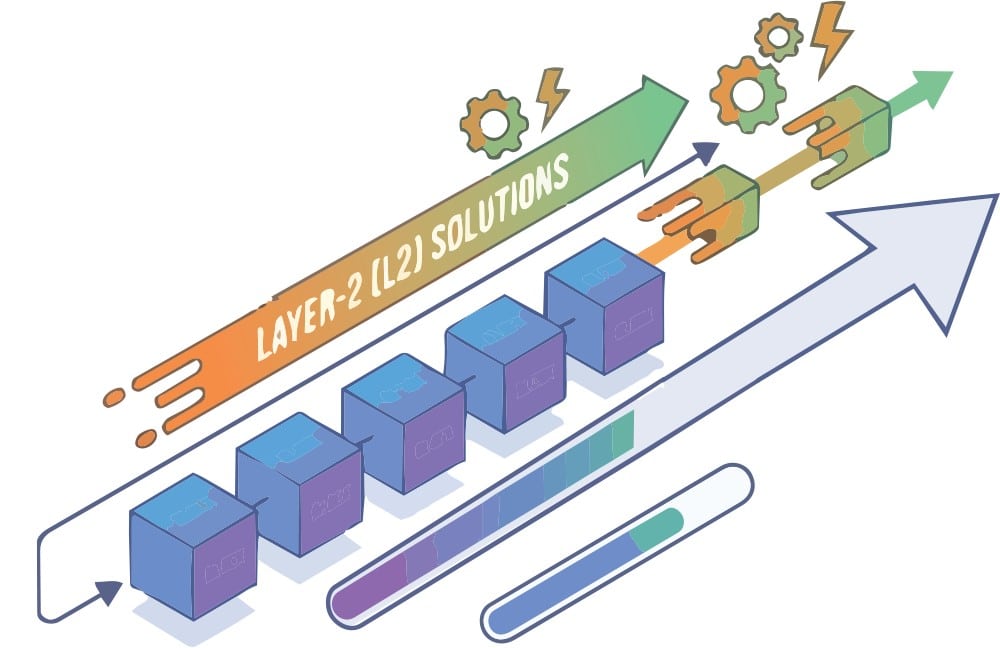

Layer-2 solutions are reshaping the speed and cost of blockchain technology for the better.
Imagine critical business deals being made on a one-lane highway at a time when traffic is at its peak. Vehicles will crawl, fuel costs will mount, tempers will flare, and profit margins will fall as precious moments are spent on the road instead of at work. Public blockchains such as Ethereum have encountered this problem since their inception. Basic blockchain activities like value transfer and dApp (decentralised application) usage cost more than ten dollars while users experience wait times that last between thirty minutes to several hours during periods of network congestion.
The year 2026 marks the end of this bottleneck. Layer-2 (L2) technologies can handle thousands of transactions using their off-chain processing system while maintaining security through a strong Layer-1 security framework. The data shows that L2 networks currently process approximately 2 million transactions per day, which is double the transaction volume of the Ethereum Mainnet. The total value locked (TVL) across major Layer 2 networks exceeds the $40 billion mark, while some networks reach $50 billion. Major players like Arbitrum and Base have attracted billions in TVL while they support both decentralised finance (DeFi) applications and consumer software applications at costs of less than one cent. Layer-2 technology enables blockchain technology to move from its experimental stage into its practical deployment phase, creating operational systems that support businesses.
Why blockchain felt like a crowded highway at rush hour
Layer-1 networks established security and decentralisation as their main goals but this design choice restricted their ability to expand operations. Under standard conditions Ethereum maintained a capacity of 15 to 30 transactions per second, which is one-tenth of the transaction volume handled by centralised networks such as Visa. Network congestion occurred during peak times when market conditions changed or when popular dApps were released. The cost of transactions increased sharply while the time needed for transaction confirmation expanded from seconds to several minutes or more.
The congestion blocked blockchain technology from achieving its potential as a system that enables transparent operations without trust requirements. Enterprises faced challenges when they needed to move their main operations to new systems while developers had difficulty creating simple user interfaces.
Enter Layer-2: The express lanes built above the main road
Layer-2 solutions function as architectural enhancements that improve Layer-1 blockchains without destroying their original design. They operate like express lanes running above a main highway that has reliable yet limited capacity. The upper levels enable fast transactions that operate at minimal expenses while maintaining their connection with the verified base system underneath.
This requires computation and execution to be processed outside of the Layer-1 main chain as the secondary work is completed, and then all proof materials to return to Layer-1. This approach retains the consensus, economic security, and decentralisation of Ethereum while dramatically improving performance.
Well-designed Layer-2 solutions provide strong security protection which other Layer-1 blockchains lose when they choose to prioritise speed. They do not create additional trust requirements which must be satisfied in order to achieve final settlement. The base layer security allows users and developers to conduct thousands of transactions each second for less than one cent. But they still access security that has been tested in actual combat.
Layer-2 makes blockchain accessible to working professionals because it transforms the blockchain from an expensive experiment into a practical business infrastructure solution. In 2026, Layer-2 networks have become the default environment for most user activity, proving that scalable decentralisation is not a theoretical ideal but an engineering reality.
# Simple simulation: Individual vs Batch processing
import time
def process_transaction(tx):
time.sleep(0.01) # Simulate small delay per transaction
return f”Processed {tx}”
# Without batching (Layer-1 style)
def individual_processing(transactions):
start = time.time()
for tx in transactions:
process_transaction(tx)
return time.time() - start
# With batching (Layer-2 rollup style)
def batch_processing(transactions, batch_size=100):
start = time.time()
for i in range(0, len(transactions), batch_size):
batch = transactions[i:i+batch_size]
# In real L2: compress + submit one proof
time.sleep(0.05) # One small delay for the whole
batch
return time.time() - start
txs = [“tx” + str(i) for i in range(1000)]
print(“Individual time:”, individual_processing(txs))
print(“Batch time:”, batch_processing(txs))
How Layer-2 solutions actually work
The core function of Layer-2 technology depends on rollup mechanisms that enable the system to combine and reduce operational data before it connects to the primary blockchain network. This is akin to a busy classroom where students work at their desks to solve problems, while the teacher collects only one summary sheet that shows the complete work of the entire class, which is verified by the main ledger.
The system executes transactions in a secure environment that maintains low costs while conducting off-chain activities, combining hundreds or thousands of transactions into one efficient package. It sends a small proof or state update to Layer-1, which gets protection from the base chain security system.
The main network experiences reduced data and processing demands because of this development. The system requires Layer-1 to check only the batch’s authenticity instead of tracking each separate transaction. This results in an impressive throughput increase, which enables the system to process thousands of transactions each second while charging fees that cost pennies or even less.
The system operates through two primary types, both of which implement the same batch-and-settle method. It achieves its design goals because it maintains high security standards without adding extra demands to the base system. Layer-2 enables professionals and researchers studying distributed systems to solve performance problems through architectural separation while maintaining the essential blockchain features of transparency and immutability.
Optimistic vs Zero-Knowledge rollups: Two paths to the same destination
Optimistic and Zero-Knowledge (ZK) rollups both aim to achieve scalable secure transaction processing systems. The operational principles of Optimistic rollups depend on their trust but verify system. They assume transactions are validwhen posted to Layer-1 and include a challenge window (typically seven days) during which anyone can submit
proof for a fraud if they detect an error. The system uses minimal resources and works well with existing Ethereum development tools that enable developers to migrate their work to new systems. The networks Arbitrum and Base follow this approach.
Optimistic rollups versus ZK rollups
| Aspect | Optimistic rollups |
Zero-Knowledge rollups |
| Finality | Delayed (challenge period) |
Near-instant |
| Computation | Lighter during execution |
Heavier (proof generation) |
| Privacy | Standard | Enhanced |
| Developer experience |
Excellent EVM compatibility |
Improving rapidly |
| Current strength |
Ecosystem maturity and TVL |
Speed and longterm efficiency |
Zero-Knowledge rollups take a cryptographic approach. The system creates concise mathematical proofs, which demonstrate that all transactions in a batch have been processed correctly without disclosing any confidential information. It provides instant transaction completion while protecting user data through more efficient security measures. ZK rollups are easier to implement nowadays because proving systems have
become more efficient. Projects such as zkSync and Polygon zkEVM demonstrate this emerging technological path.
Both the paths provide Layer-1 security while they enable systems to scale.
Leading Layer-2 networks shaping the landscape today
In 2026, a concentrated group of Layer-2 networks is dominating Ethereum scaling, each carving a distinct niche while contributing to overall ecosystem growth. The total value locked in Arbitrum exceeds $15 billion, leading all platforms to provide deep DeFi liquidity through Aave and Uniswap. This platform is popular among users who require advanced financial solutions because of its complete ecosystem and powerful development tools.
Base (built on the OP Stack) excels in user activity and consumer adoption, frequently accounting for over 60% of L2 transactions. The platform provides mainstream users
with easy access through its partnership with Coinbase, which creates simple onboarding processes that requireminimal effort.
Optimism and its OP Stack enable a ‘Superchain’ vision, which lets users create their own chains that maintain common security and interoperability standards. The modular system enables greater ecosystem development while providing funding support for public goods.
ZK-focused networks such as zkSync and Starknet develop advanced privacy features as well as better efficiency and complex computation capabilities. These benefit applications that require quick results and sophisticated encryption. The two organisations manage most of the L2 traffic while they create new solutions through their funding programs, developer resources, and efforts to create better system connections.
Transforming dApps: Speed, cost, and new possibilities for developers and enterprises
Layer-2 technology has completely transformed the operational capabilities of decentralised applications (dApps). Developers currently dedicate their efforts towards enhancing user experience, developing new products, and implementing business functions instead of addressing gas fees and confirmation delays. Users can now access smart contracts, which developers deploy through their existing knowledge of Solidity and Rust in production environments, at an af fordable cost for multiple users. The industry has experienced growth through the development of real-time gaming systems, which include on-chain economies and social platforms for continuous user interaction, and complex DeFi strategies that were previously too expensive to implement.
// SPDX-License-Identifier: MIT
pragma solidity ^0.8.20;
contract FastCounter {
uint256 public count = 0; // Simple state variable
// Anyone can increment — very cheap on Layer-2
function increment() public {
count += 1;
}
// Read the current count
function getCount() public view returns (uint256) {
return count;
}
}
Enterprises benefit immensely from blockchain technology. L2 blockchain-as-a-service integration deliver secure processes that organisations can monitor and record through their entire operational workflow, including supply-chain monitoring, trade finance activities and tokenized asset management. The combination of Layer-1’s security with Layer-2’s performance creates a foundation suitable even for regulated industries.
Emerging micro-payment systems for content, secure identity protection methods, and AIdriven decentralised applications establish new development paths. Layer-2 technology serves as a connection between blockchain theory and real-world implementation. It enables organisations to concentrate on developing value for their enterprises because it
eliminates infrastructure obstacles.
What to watch in the coming years
Layer-2 technology will transform blockchain systems with its advancements. Speed and low cost will become baseline expectations, freeing innovators to focus on higher-order value creation.
The major sector to monitor will be proving systems, which enhance efficiency and create cross-L2 interoperability solutions that eliminate network fragmentation and develop enterprise solutions through scalable and compliant technologies. The system will integrate with real assets and artificial intelligence agents while using technologies that protect user privacy to increase its speed of development. The use of modular architectures, which
separate execution, data availability, and settlement functions, will provide organisations with more effective system performance options.
Layer-2 systems are essential for organisationsthat want to create next-generation decentralised applications, explore new cryptographic technologies, and implement enterprise systems. The highway is becoming wider and traffic congestion has reduced, creating conditions for fast and accessible blockchain systems that operate at high scalability.