






















































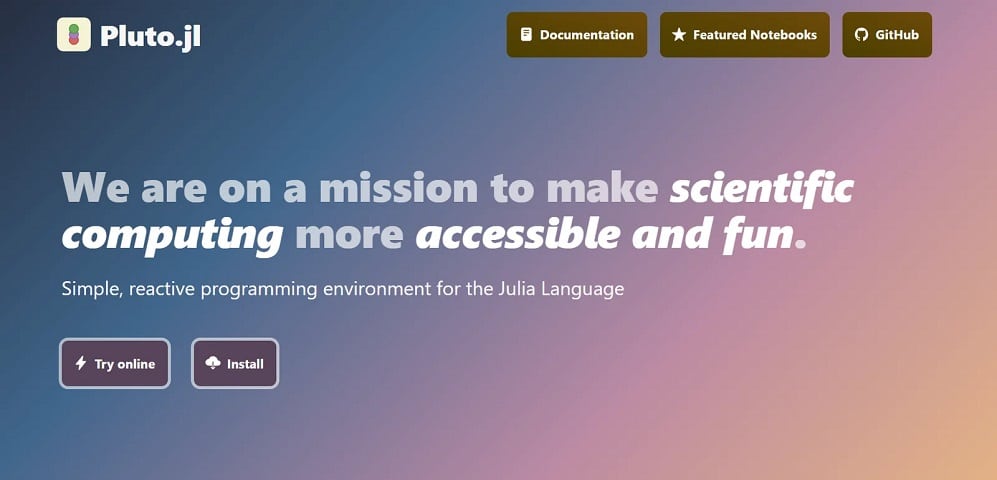

Pluto.jl, Julia’s most-starred open-source package, has reached version 1.0 with a stable API and a dependency-graph architecture designed to eliminate hidden-state bugs and improve research reproducibility.
Pluto.jl, Julia’s most-starred open-source package, has reached version 1.0, marking its transition to production-ready status and delivering a stable API that researchers, educators and institutions can rely on for long-term deployments.
The milestone is significant because Pluto was built to address reproducibility challenges that have long affected Jupyter notebooks. Studies cited by the project found that only 879 out of 10,388 biomedical Jupyter notebooks reproduced identical results when rerun in clean environments, while an analysis of 1.4 million GitHub-hosted Jupyter notebooks identified hidden state and out-of-order execution as major causes of reproducibility failures.
Pluto tackles the issue through an open-source dependency-graph architecture powered by ExpressionExplorer.jl and PlutoDependencyExplorer.jl. The system performs static code analysis, constructs a dependency graph and automatically re-executes affected cells whenever changes occur. Variables are removed from scope when their defining cells are deleted, ensuring notebook state always reflects the visible code.
While the 1.0 release itself involved only a small code update, its importance lies in the project’s commitment to API stability, long-term compatibility and reduced operational risk for research workflows.
Pluto further strengthens reproducibility through isolated package environments and exact version pinning embedded within every notebook. Stored as standard .jl source files, notebooks support clean version control, direct execution and easier collaboration than JSON-based notebook formats.
Developed alongside MIT’s Computational Thinking course, Pluto has gained adoption across computational biology, physics, climate science and data science education. Available under the MIT License, the project’s 1.0 release lowers barriers to institutional deployment, curriculum development and research infrastructure adoption.