




























































Researchers at the Morgridge Institute for Research have released FLIM Playground, an open source platform that streamlines complex fluorescence lifetime imaging microscopy analysis, improving reproducibility while reducing reliance on multiple software tools and coding expertise.
Researchers from the Melissa Skala Lab at the Morgridge Institute for Research have developed FLIM Playground, a new open-source platform designed to simplify and standardise fluorescence lifetime imaging microscopy (FLIM) data analysis. Published in Cell Reports Methods, the tool provides an end-to-end environment for processing, visualising and analysing complex cell imaging data.
FLIM is widely used to study cell metabolism, cancer treatment responses, autoimmune diseases and molecular dynamics. However, analysing FLIM datasets typically requires multiple software packages, custom scripts and extensive quality-control procedures.
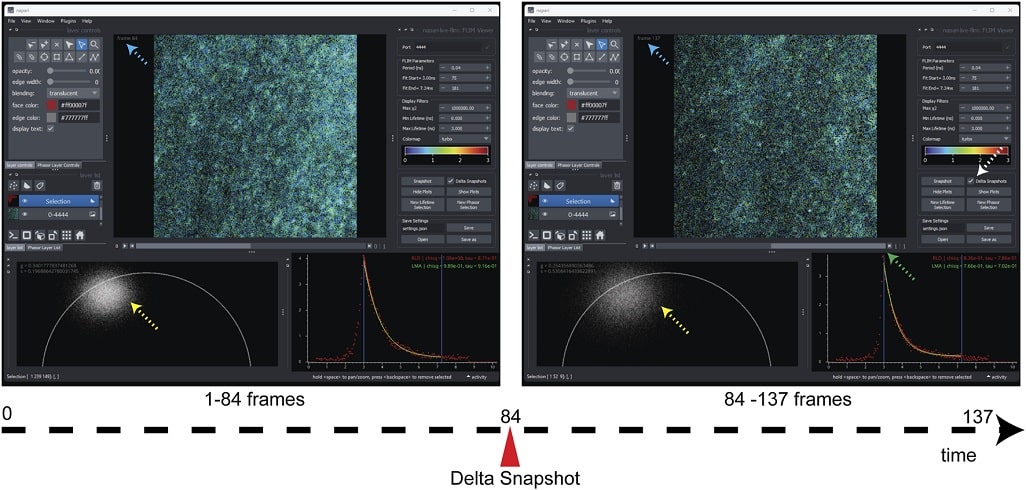
FLIM Playground addresses these challenges through a single graphical user interface that reduces the need to move data between different tools or repeatedly modify Python code.
Researchers can import FLIM images and cell masks, extract lifetime information, upload datasets, filter results, visualise patterns and perform advanced analyses such as dimensionality reduction and classification. Changes made within the interface are reflected instantly.
“In data analysis, especially FLIM data, there are so many settings you can adjust, but normally you have to go back into the Python code, change it, and re-run it to see the results,” said Wenxuan Zhao, lead developer and first author of the study. “It takes a lot of time and expertise. This lets you explore them on the fly—once you adjust something in the graphical user interface, the results are available instantly.”
The platform also incorporates built-in quality-control tools that help identify outliers and problematic measurements, improving reproducibility. Benchmark tests against a widely used commercial FLIM analysis package showed strongly correlated results, while validation across multiple biological samples and imaging systems successfully identified expected metabolic and immune-cell responses.
The modular platform could eventually expand to support additional imaging modalities, including quantitative phase imaging.