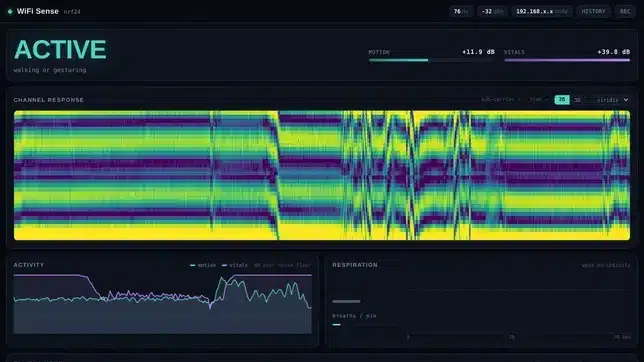
An open source project uses Wi-Fi signal disturbances to detect subtle movement and breathing, allowing it to identify human presence through walls.
The WifiSense-Pi project uses an ESP32-S3 and Raspberry Pi 4 to detect human presence through changes in Wi-Fi signals. The ESP32-S3 measures the radio channel 100 times per second, while the Raspberry Pi 4 handles signal processing. The system can detect subtle movements and identify a stationary person through changes caused by breathing.
Instead of transmitting dedicated sensing signals, the project analyses existing signals in the 2.4-GHz Wi-Fi band. Human presence and movement affect these signals, allowing the system to detect changes without traditional motion sensors. The technique can also detect presence through walls, which is an advantage over conventional motion sensors.
A single sensor cannot determine a person’s exact position, and it is also difficult to distinguish multiple people based on disturbances in the Wi-Fi signals. The project therefore focuses mainly on determining whether a person or another living creature is present in a particular area.
The project explores an alternative to cameras, millimetre-wave sensors and passive infrared sensors for presence detection. By combining an ESP32-S3 for high-speed Wi-Fi measurements with a Raspberry Pi 4 for processing, WifiSense-Pi demonstrates how existing wireless signals can be repurposed for sensing applications. The project is available as an open source implementation for further experimentation.