

















































The latest ESP-Miner prerelease makes low-frequency warnings depend on the selected device preset, targeting more accurate diagnostics across Bitaxe hardware.
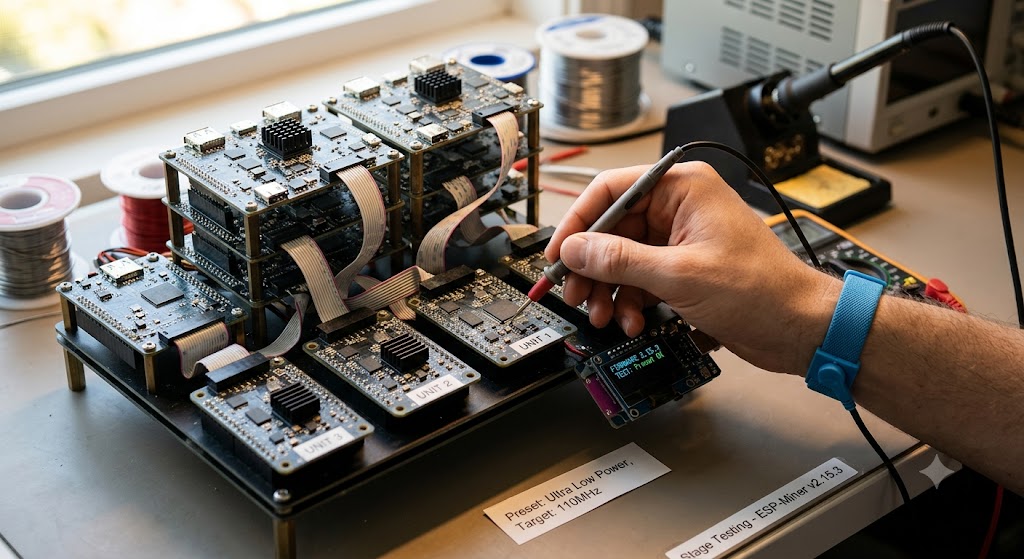
The Bitaxe project has released ESP-Miner v2.15.3 as a prerelease, with a focused change to how AxeOS generates low-frequency warnings. Instead of applying a common threshold, the firmware now derives the warning from the preset selected for the device. The change is intended to make the dashboard’s frequency warnings better match the operating range expected by each supported configuration.
The update is particularly relevant to open-source Bitcoin mining hardware, where different boards can use different ASICs, clock settings and operating profiles. A single frequency threshold can potentially flag a lower-power configuration even when it is operating as intended. Using the device preset gives AxeOS a reference based on the selected configuration when determining whether the observed frequency warrants a warning.
Version 2.15.3 follows ESP-Miner 2.15.2, which was released on 18 September with support for BM1372 and BM1373 ASICs along with several networking and interface fixes. The new 2.15.3 release is narrower in scope and does not introduce another ASIC driver or change the frequency-control mechanism itself.
The release does not claim an increase in hashrate, lower power consumption, improved efficiency or broader hardware compatibility. Its stated change is related to diagnostics: improving how the interface determines when to display a low-frequency warning. Any resulting improvement should therefore be evaluated through the warning behaviour rather than treated as a performance upgrade.
As v2.15.3 is a prerelease, Bitaxe users can test the firmware before wider deployment. For multiple miners, testing one device first while keeping the same preset, power supply and cooling can help determine whether the new warning behaviour matches the actual operating frequency. This also makes it easier to compare the new release with the previous firmware before deploying it across a larger fleet.