

















































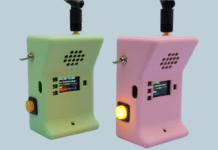


These open-source ESP32 walkie-talkies use ESP-NOW to exchange audio recordings without a Wi-Fi router, with Arduino firmware and 3D-printable enclosures available for DIY builds.
An open-source electronics project from Adafruit demonstrates how two ESP32-S3 development boards can communicate using ESP-NOW, a wireless protocol that exchanges data directly between compatible devices without requiring a conventional Wi-Fi network or internet connection. Called ESP-NOW Walkie Talkies, the project combines Arduino firmware, digital audio components and 3D-printable enclosures to create a pair of handheld devices that record and transmit voice messages. The firmware is published under the MIT licence, allowing developers to inspect, modify and reuse the code under its licence terms. Adafruit also provides circuit diagrams, component connections, assembly instructions and downloadable enclosure files, giving makers a practical starting point for building and adapting the design.
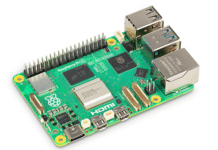
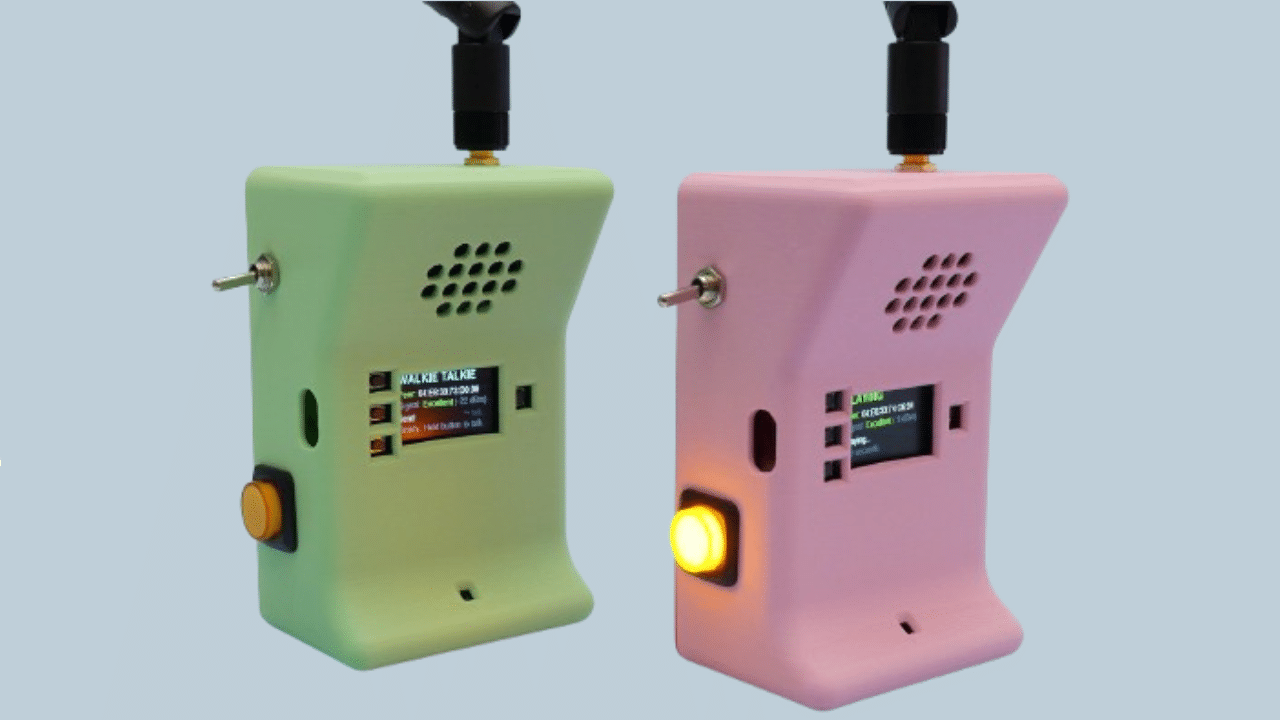
Each device uses an Adafruit Feather ESP32-S3 Reverse TFT board with an external antenna connection. An I2S MEMS microphone captures speech, while an I2S digital amplifier drives a small speaker for playback. The ESP32-S3 handles audio capture, packet transmission, reception and the user interface. A built-in TFT display presents information such as the device’s MAC address, signal strength and packet status. An illuminated push-button indicates pairing and message activity, while a separate button press controls recording. The hardware also includes a rechargeable lithium-ion battery, a power switch and a 2.4GHz antenna connected through an appropriate adapter. Two complete devices are required to demonstrate communication.
The firmware records audio at a sampling rate of 16kHz, using 16-bit samples, with each recording lasting up to 10 seconds. When the user releases the recording button, the ESP32-S3 divides the captured audio into smaller packets and sends them to the paired device through ESP-NOW. The receiver checks the packet sequence and message length against a manifest packet, then returns an acknowledgement when the complete recording has arrived. If confirmation is not received, the sender can retry the transmission. The receiving device then plays the audio through its I²S amplifier and speaker. This approach is different from conventional analogue walkie-talkies and continuous live voice communication: the project records a short message first and transmits it after the user finishes recording.
The project’s open-source value lies in the complete build guide and the opportunity to adapt its firmware and physical design. Adafruit provides the Arduino code as a precompiled UF2 file that can be transferred to the Feather board through its USB bootloader, while the guide explains how to install the Arduino IDE, configure ESP32 board support and upload the firmware. Wiring instructions cover the microphone, amplifier, display, controls and power connections. The enclosure is inspired by handheld walkie-talkies from the early 1990s, and downloadable STL files allow users to print the case themselves. Its internal mounting points and cut-outs accommodate the development board, microphone, amplifier, speaker, battery and controls. Developers can modify the code to experiment with packet handling, display information, message limits or alternative user-interface behaviour, provided their changes remain compatible with the hardware and ESP-NOW implementation.
The design offers a useful learning platform for embedded wireless communication, digital audio and rapid hardware prototyping. Makers could use the underlying approach to explore local messaging devices, educational electronics projects or communication links for applications where internet connectivity is unnecessary. However, communication range depends on the antenna, surroundings and radio conditions, and the project does not establish a guaranteed operating distance. ESP-NOW also operates in the 2.4GHz band, so interference can affect performance. The build relies on specific Adafruit hardware and additional audio components rather than being a universal firmware package for every ESP32 board.
For more information, click here.