



















































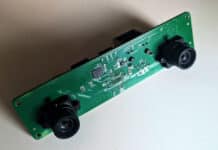

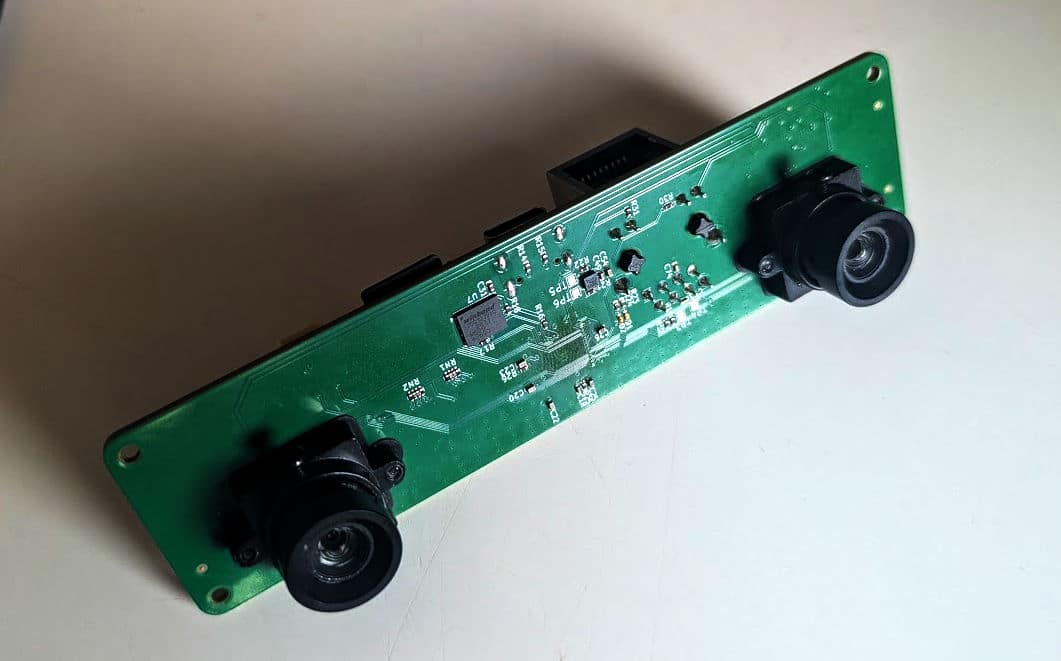

The 4reel open-source stereo vision board combines two global-shutter cameras with onboard depth processing, letting Arduino and ESP32 robots access spatial information without a separate single-board computer.
The 4reel open-source stereo vision board, developed by machinehum of Rootkit Labs, brings depth perception to compact robotics projects by processing images directly on its own hardware. Instead of sending camera feeds to a Raspberry Pi or PC for analysis, the board calculates stereo depth using a Rockchip RV1103 processor and provides results to an external microcontroller over UART. Its developer has published the KiCad hardware design files, Buildroot configuration and supporting scripts under the MIT licence, allowing other developers to inspect, modify and reproduce the design. The project targets outdoor mobile robotics and embedded vision applications where computing resources are limited.
The board pairs two OV9281 global-shutter cameras with the RV1103, which integrates a single-core 1.1GHz Arm Cortex-A7 processor and 64MB of DDR2 memory. Global-shutter sensors capture all pixels at approximately the same instant, reducing image distortion when a robot moves. The board also includes a three-axis accelerometer, 4MB of flash memory, a microSD card slot, 10/100 Ethernet, USB-C and a JST connector for UART communication. The serial interface can also supply 5V power, allowing compatible microcontroller-based robots to connect to the vision system without requiring a separate computer for image processing.
A key feature is the use of the RV1103’s hardware-accelerated sum of absolute differences (SAD) engine for stereo matching. The software captures images through Linux Video4Linux2 (V4L2) interfaces and passes the image data to the chip’s video engine for block-matching calculations. This reduces the processing burden on the Arm CPU. The developer reports continuous capture at 125,000 complex samples per second? No — the board’s published performance concerns camera processing, with the design using the hardware engine to accelerate stereo matching rather than relying entirely on software. The implementation uses Rockchip’s vendor kernel and a Buildroot-based Linux system to access the processor’s camera drivers and hardware acceleration.
The board can operate as a standalone Linux device or as a vision coprocessor connected to a host controller. When connected to a computer through USB-C, it appears as an Ethernet adapter, providing access to a web interface for camera viewing, calibration and focus adjustments. In a robotics setup, an Arduino or ESP32 can handle motor control and other real-time tasks while 4reel performs vision processing. The developer has identified simultaneous localisation and mapping (SLAM) and YOLO-based object detection as future development goals; these should not be treated as already validated capabilities.
The open-source release offers a reference design for developers interested in building embedded stereo-vision systems or adapting the board for their own robots. The repository includes the current tested RV1103 design and an RV1106 design intended for a later generation. The creator has also documented first-revision hardware issues, including an incorrect processor order and lens-mount hole dimensions, which may help others avoid similar mistakes.
For more information, click here.