




















































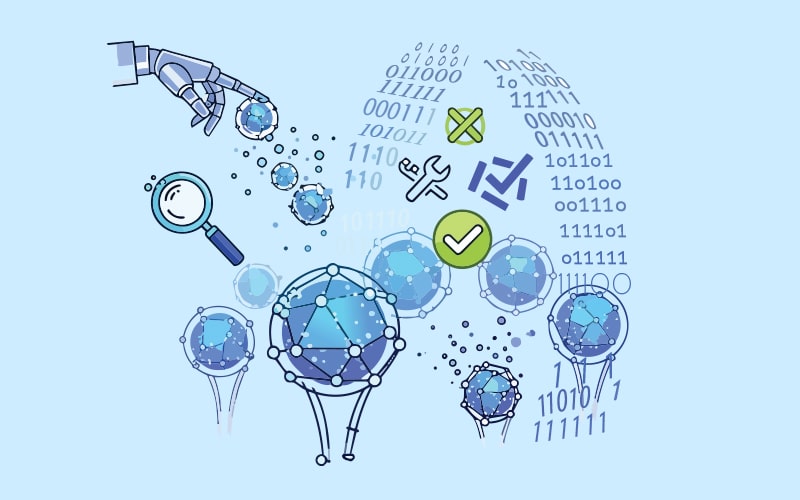

Quantum systems are powerful but prone to errors. Fortunately, there are codes that help correct these errors, but the process remains resource intensive.
Quantum computing stands at the forefront of technological innovation, promising computational capabilities far beyond classical systems. Its potential to solve complex problems in cryptography, material science, and optimisation has attracted significant interest from both academia and industry. However, the reliability of quantum computers remains a pressing concern due to the inherent fragility of quantum information.
Errors in quantum systems arise from various sources, making the development of robust error correction techniques essential. Unlike classical bits, quantum bits (qubits) are susceptible to disturbances from their environment, which can quickly degrade the quality of computations. As a result, quantum error correction has become a cornerstone in the pursuit of practical quantum computing.
Why quantum is prone to errors
Quantum computers operate using qubits, which can exist in superpositions and entangled states. These properties, while powerful, make qubits highly sensitive to external influences. Quantum decoherence, a process where quantum information dissipates into the environment, is one of the primary sources of errors in quantum systems.
Environmental noise, such as electromagnetic fluctuations and thermal vibrations, can disrupt the delicate states of qubits. Even minute changes in temperature or stray photons can cause a quantum computer to lose its coherence, rendering computations unreliable. In real-world quantum devices, error rates are often orders of magnitude higher than those seen in classical computers.
For instance, superconducting qubits used by companies like IBM and Google must be cooled to near absolute zero to minimise noise, yet errors persist due to imperfect control and measurement. Similarly, trapped ion systems face challenges from fluctuating magnetic fields and laser imperfections. These examples underscore the need for sophisticated error correction strategies.
Without effective error mitigation, scaling quantum computers to solve large, complex problems would be infeasible. The persistent threat of errors makes the quest for reliable quantum computing a multidisciplinary effort, involving physics, engineering, and computer science.
Foundations of quantum error correction codes
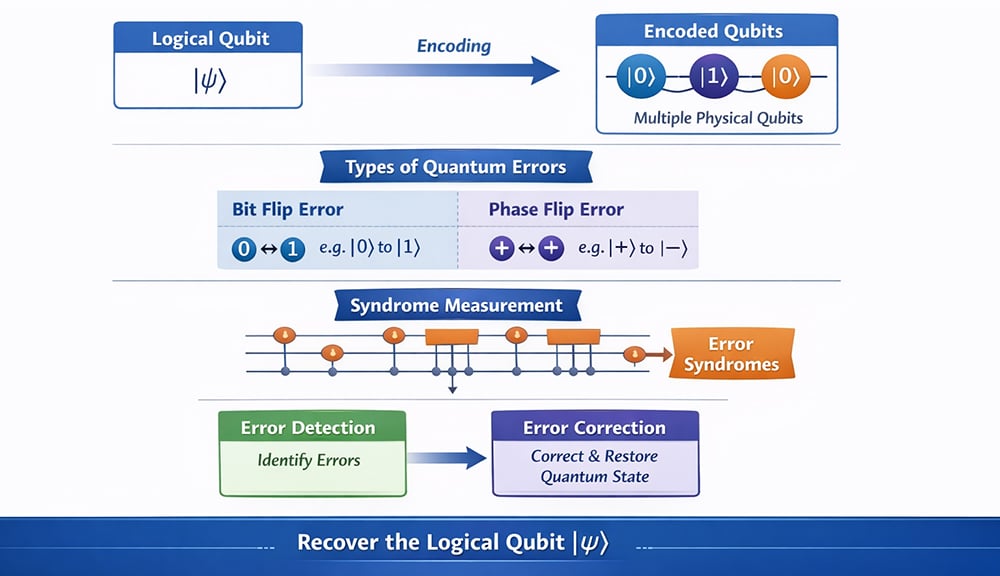
Quantum error correction codes are designed to protect quantum information from the various errors that plague qubits. Unlike classical error correction, which deals with bit flips, quantum codes must address both bit and phase errors due to the nature of quantum mechanics. The basic principle is to encode logical qubits into multiple physical qubits, allowing for the detection and correction of errors without directly measuring the quantum state.
The pioneering work of Shor and Steane introduced the first quantum error correction codes, demonstrating that quantum information could be safeguarded against certain types of noise. These codes leverage redundancy and entanglement, enabling error detection through carefully orchestrated measurements known as syndrome extraction.
In practical terms, the repetition code is a simple example: a single logical qubit is represented by several physical qubits, and majority voting is used to correct errors. More advanced codes, such as the stabiliser codes, generalise this approach to handle a broader range of error types. These foundational concepts have paved the way for scalable quantum error correction protocols.
Use cases include quantum communication networks, where error correction ensures the integrity of transmitted information, and quantum memory devices, which rely on robust coding schemes to preserve data over extended periods. The principles behind quantum error correction are fundamental to the advancement of quantum technology.
Surface codes and topological protection
Surface codes represent a significant leap in quantum error correction, offering a practical solution for large-scale quantum systems. These codes arrange qubits in a two-dimensional lattice, exploiting topological properties to protect quantum information. The key advantage of surface codes lies in their ability to tolerate high error rates while maintaining efficient error detection and correction.
Topological protection, an idea borrowed from condensed matter physics, ensures that logical information is encoded in global properties of the lattice rather than local qubit states. This makes surface codes resilient to local disturbances, as errors must affect many qubits before the logical information is compromised.
Implementations of surface codes are found in superconducting quantum processors, where thousands of physical qubits are arranged in a grid. Error syndromes are measured through ancillary qubits, and correction procedures are applied based on the detected patterns. This approach has enabled some of the most advanced demonstrations of fault-tolerant quantum computation.
Real-time use cases include quantum error correction in Google’s Sycamore processor, which utilises surface codes to extend the coherence time and reliability of computations. The scalability and robustness of surface codes make them a promising candidate for future quantum computers.
Error detection and correction in practice
Translating theoretical error correction concepts into practical systems presents significant challenges. Error detection typically involves periodic measurements of stabiliser operators, which reveal the presence and location of errors without collapsing the quantum state. The correction process then applies targeted operations to restore the logical qubit.
One challenge is the overhead associated with error correction. Each logical qubit requires multiple physical qubits, and the complexity of syndrome extraction increases with system size. Nevertheless, real-time error correction has been demonstrated in several quantum platforms, including superconducting circuits and trapped ions.
For example, IBM’s Quantum System One employs continuous error detection cycles, enabling reliable computations for small-scale quantum algorithms. In quantum communication, error correction protocols such as entanglement purification are used to maintain fidelity across noisy channels.
Despite progress, practical error correction remains resource-intensive, and maintaining low error rates in large systems is an ongoing area of research. The interplay between hardware advancements and algorithmic improvements is critical to achieving robust error correction in operational quantum devices.
Thresholds and resource demands
The concept of error thresholds is central to quantum error correction. A threshold represents the maximum error rate that a code can tolerate before logical errors become overwhelming. Surface codes, for example, have thresholds around 1% per gate, making them attractive for current quantum hardware.
Resource demands are substantial, as each logical qubit may require hundreds or thousands of physical qubits depending on the desired fidelity. This scaling challenge is a major barrier to building large, fault-tolerant quantum computers. Optimising resource allocation while maintaining error correction performance is a key focus of ongoing research.
Scalability examples include Google’s demonstration of logical qubits with error rates below threshold, paving the way for larger quantum processors. Similarly, the development of modular quantum architectures seeks to balance resource demands with practical implementation constraints.
As quantum technology matures, understanding thresholds and resource requirements will be essential for designing systems capable of tackling real-world problems. The trade-off between reliability and scalability continues to shape the direction of quantum error correction research.
Recent progress and open questions
Recent advances in quantum error correction have pushed the boundaries of what is achievable in laboratory and commercial settings. Breakthroughs include improved surface code implementations, novel error correction algorithms, and hybrid approaches that combine classical and quantum techniques.
Emerging use cases span quantum chemistry simulations, secure quantum communication, and optimisation problems, where reliable computation is paramount. Researchers are also exploring new materials and qubit types to enhance error resilience and reduce resource overhead.
Despite these achievements, several open questions remain. How can error correction be made more efficient for near-term quantum devices? What are the limits of fault-tolerant computation given current hardware constraints? Addressing these issues requires interdisciplinary collaboration and continued innovation.
The pace of progress suggests that robust error correction will soon become standard in quantum systems, but the journey is far from complete.
Building robust quantum systems for the future
Building robust quantum systems requires a transition from isolated demonstrations of qubits to fault-tolerant, system-level architectures where hardware, control software, and error correction operate as a tightly integrated stack. Future quantum computers will not rely only on improving physical qubit quality; instead, reliability will emerge from combining low-noise qubit technologies, scalable quantum error correction, real-time decoding, and fault-tolerant logic operations.
At the hardware level, progress is being driven by improved superconducting circuits, trapped ions, neutral atoms, photonic qubits, and emerging spin-based platforms. Each technology offers different advantages in coherence time, gate fidelity, connectivity, and manufacturability. For large-scale systems, maintaining stable qubit operation requires advanced cryogenic engineering, precise microwave or laser control, low-latency classical electronics, and automated calibration. Modern quantum processors increasingly use feedback-based control loops that continuously monitor device drift and correct variations in qubit frequency, gate parameters, and measurement fidelity.
From the architectural perspective, robust systems will depend heavily on ‘logical qubits’ protected by surface codes, colour codes, bosonic codes, or hybrid schemes. Surface code-based systems remain among the most practical candidates because of their high error thresholds and compatibility with two-dimensional qubit layouts. However, the large physical qubit overhead means that future designs must optimise layout, connectivity, syndrome extraction cycles, and decoder performance. Real-time classical decoders, including minimum-weight perfect matching and machine-learning-assisted approaches, will be essential for identifying error patterns quickly enough to preserve logical information.
Another important direction is the development of ‘fault-tolerant quantum operations’, where gates, measurements, and state preparation are executed without spreading errors uncontrollably. Techniques such as lattice surgery, magic-state distillation, transversal gates, and code deformation are expected to play a central role in scalable quantum computation. In parallel, quantum networking and modular architectures may allow multiple smaller processors to be connected through photonic links, reducing the engineering burden of building one monolithic quantum chip.
Ultimately, robust quantum systems will be built through co-design: quantum algorithms must be adapted to hardware constraints, error correction must be matched to noise models, and control systems must operate with high precision and low latency. This holistic approach will enable reliable quantum cloud platforms, secure quantum communication networks, and practical applications in chemistry, optimisation, cryptography, and materials discovery.
Best practices for building robust quantum systems
Design for fault tolerance from the architectural stage:
Robust quantum systems should be planned around fault-tolerant quantum computing principles from the beginning, rather than treating error correction as an add-on layer. The physical qubit layout, coupling topology, control wiring, readout architecture, and classical feedback path must be compatible with repeated syndrome extraction, logical-qubit encoding, and scalable correction cycles. Architectures based on surface codes, colour codes, bosonic codes, or hybrid quantum error correction schemes should be selected according to the hardware noise profile and connectivity constraints.
Maintain physical error rates below the fault-tolerance threshold
A core requirement is that single-qubit gates, two-qubit gates, idle operations, and measurement errors remain below the error threshold of the selected code. For surface-code architectures, this typically requires physical error rates well below the percent level, with practical systems aiming for much lower values to reduce logical error rates and physical-qubit overhead. Continuous improvement in gate fidelity, coherence time, leakage suppression, and readout accuracy is therefore essential for building reliable logical qubits.
Perform continuous noise characterisation and hardware-aware modelling:
Quantum processors must be monitored using detailed noise diagnostics, including relaxation time, dephasing time, gate infidelity, leakage errors, crosstalk, measurement assignment errors, correlated noise, and non-Markovian behaviour. Techniques such as randomized benchmarking, gate-set tomography, cycle benchmarking, and noise spectroscopy should be used to construct accurate error models. These models allow engineers to select suitable error correction codes, optimise pulse schedules, and design compilers that avoid noisy qubit regions or error-prone gate sequences.
Optimise qubit layout, connectivity, and control routing
Scalable robustness depends heavily on physical layout. In superconducting processors, qubits should be arranged to support nearest-neighbour interactions required by surface codes while minimising unwanted coupling, frequency collisions, and microwave crosstalk. In trapped-ion or neutral-atom systems, ion shuttling, optical addressing, and reconfigurable connectivity must be engineered to reduce control errors. The layout should also support efficient placement of data qubits, ancilla qubits, readout resonators, couplers, and cryogenic wiring without compromising thermal stability or signal integrity.
Implement fast and reliable syndrome extraction cycles
Quantum error correction depends on repeated measurement of stabilisers without directly measuring or destroying the encoded logical quantum state. Therefore, systems must support high-fidelity ancilla preparation, controlled entangling gates, rapid measurement, and reset operations. The syndrome extraction cycle must be short compared to the coherence time of physical qubits, and measurement-induced errors must be carefully controlled. Any delay in syndrome extraction increases the probability of accumulated errors and reduces the effectiveness of logical protection.
Use low-latency classical decoding and real-time feedback
A robust quantum system requires close integration between the quantum processor and classical control hardware. Syndrome data must be processed by fast decoders such as minimum-weight perfect matching, union-find decoders, tensor-network decoders, or machine-learning-assisted decoders. These decoders must operate within strict latency limits so that correction information can be applied or tracked in real time. Hardware accelerators such as FPGAs, GPUs, or cryogenic CMOS controllers may be required to support large-scale decoding for thousands or millions of physical qubits.
Minimise leakage, crosstalk, and correlated errors
Error correction codes are often designed under assumptions of mostly local and independent errors, but real quantum hardware can exhibit leakage outside the computational subspace, correlated multi-qubit errors, parasitic coupling, and control-pulse spillover. Robust systems should include leakage reduction units, dynamical decoupling, calibrated pulse shaping, tunable couplers, isolation structures, and frequency-allocation strategies. Suppressing correlated errors is particularly important because they can bypass the protection assumptions of many quantum error correction codes and cause logical failures more rapidly.
Adopt automated calibration and drift correction
Quantum devices are highly sensitive to thermal fluctuations, magnetic-field variations, charge noise, laser instability, and control-electronics drift. Manual calibration is not scalable for large processors. Robust systems should use automated calibration routines driven by real-time diagnostics and feedback. These routines should continuously update qubit frequencies, gate amplitudes, pulse phases, readout thresholds, coupler biases, and timing parameters. Machine learning-based calibration and Bayesian optimisation are increasingly useful for maintaining stable device performance across large qubit arrays.
Develop fault-tolerant logical operations, not only protected memory
Preserving quantum information is only one part of robustness; useful computation requires fault-tolerant logical gates, measurements, and state preparation. Techniques such as lattice surgery, code deformation, transversal gates, magic-state distillation, and logical teleportation should be incorporated into the system design. These methods allow logical operations to be performed while keeping errors contained. Since magic-state distillation can dominate resource cost in universal quantum computation, architectures should optimise distillation factories, logical-routing paths, and scheduling of logical operations.
Benchmark performance at the logical level
Improvements in physical qubit fidelity are important, but the true measure of a robust quantum system is whether the logical error rate decreases as code distance increases. Systems should therefore be evaluated using logical benchmarking, repeated syndrome-cycle experiments, memory lifetime tests, logical gate fidelity measurements, and error-suppression scaling studies. Demonstrating that larger codes produce lower logical error rates is a critical milestone towards practical fault-tolerant quantum computing.
Use hardware-aware compilation and error mitigation together with error correction
Near-term and early fault-tolerant systems should combine quantum error correction with hardware-aware software methods. Compilers should map circuits onto the most reliable qubits, reduce two-qubit gate depth, avoid high-crosstalk regions, and schedule operations to minimise idle errors. Error mitigation methods such as zero-noise extrapolation, probabilistic error cancellation, symmetry verification, and dynamical decoupling can also improve output quality, especially before fully fault-tolerant logical computation becomes available.
Plan for modularity, manufacturability, and thermal scalability
Large-scale quantum systems may require millions of physical qubits for commercially relevant fault-tolerant applications. Therefore, robustness must include practical engineering concerns such as chip yield, cryogenic heat load, interconnect density, packaging, signal multiplexing, and modular expansion. Modular quantum computing architectures using photonic interconnects, distributed logical qubits, or networked quantum processing units can reduce the difficulty of scaling a single monolithic processor. Robust quantum systems must be designed not only to function in laboratory demonstrations but also to operate reliably in cloud-accessible, continuously maintained quantum computing environments.
Future outlooks envision quantum computers with integrated error correction, capable of tackling complex tasks across industries. Examples include quantum cloud services offering reliable computation for finance and pharmaceuticals, and quantum networks with built-in error correction for secure communication.
Building robust systems will require holistic approaches, combining error correction with fault-tolerant architectures and adaptive algorithms. Collaboration between hardware manufacturers, software developers, and end users is critical to realising the full potential of quantum computing.