






















































An open source hardware platform enables high-voltage automation with relay outputs, programmable interfaces, and ready-to-use software examples.
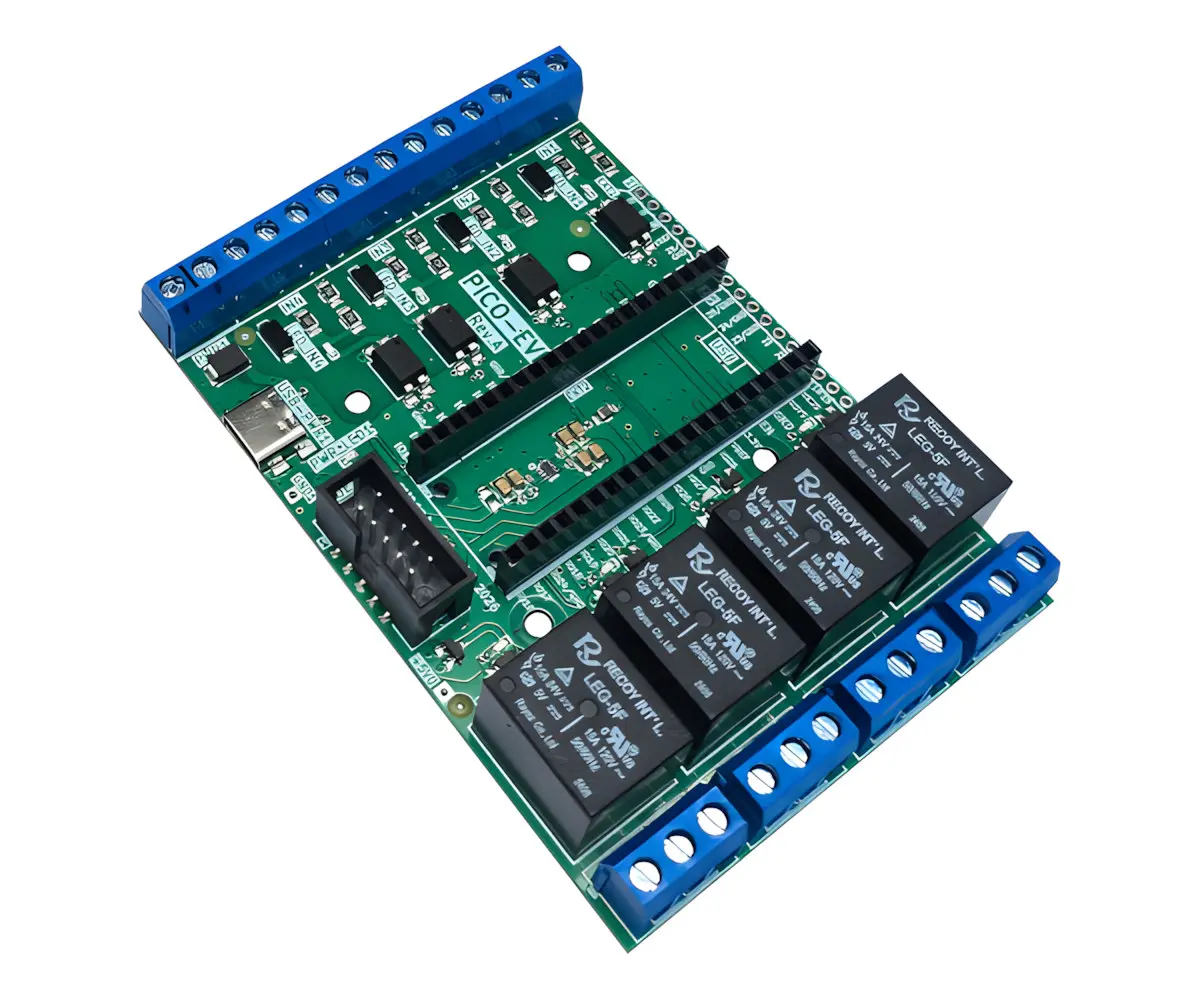
Olimex PICO-EVB is an open source hardware automation board for the Raspberry Pi Pico family and other RP2040-compatible microcontrollers, allowing high-voltage signal monitoring and control in industrial and household applications. The board features four optically isolated inputs with voltage ranges from 3.3-30V DC to 110-220V AC and four relays that can switch up to 15V DC or 240V AC loads.
For easier development, the board comes with two 20-pin Pico-compatiable module headers, a USB Type-C connector for power and programming, and a UEXT port exposing I2C, UART, and SPI communication interfaces. An additional 18-pin GPIO header is provided for microcontroller signal access, and specific LEDs inform about the state of relay outputs and high-voltage input signals. The board measures 100x70mm, its operating temperature range is -45°C to +85°C, and the board can be powered via USB-C, a screw-terminal power input, or directly from the Pico module.
As an open source hardware platform, the hardware design files can be modified by developers to suit their applications. The software includes examples of using Arduino and MicroPython for getting data from the optically isolated inputs and controlling the relays. Among the included MicroPython examples is one that demonstrates the simple web interface that allows remote monitoring and controlling of the relays via a browser.
ESPHome support is also available through a YAML configuration, enabling integration with Home Assistant. This allows the monitoring of digital inputs, control of relay outputs and integrating the board in larger smart home or industry systems without developing the software configuration from scratch.
Unlike most relay boards based on Pico, PICO-EVB combines multiple relays with high-voltage AC/DC inputs. Therefore, it can be used in applications such as the monitoring of industrial equipment, the monitoring of electrical panels, building automation and other relay-based control applications.