






















































ESP32 Bit Pirate 1.7 adds LoRa and Meshtastic analysis, browser-based BPIO2 control and Python scripting for hardware debugging and experimentation.
ESP32 Bit Pirate has released version 1.7 of its ESP32-S3-based hardware debugging platform, adding LoRa support for SX1262 transceivers, a Meshtastic analysis shell and BPIO2, a USB-based hardware control interface. The open-source project also expands its browser-based tools for hardware debugging, programming and experimentation.
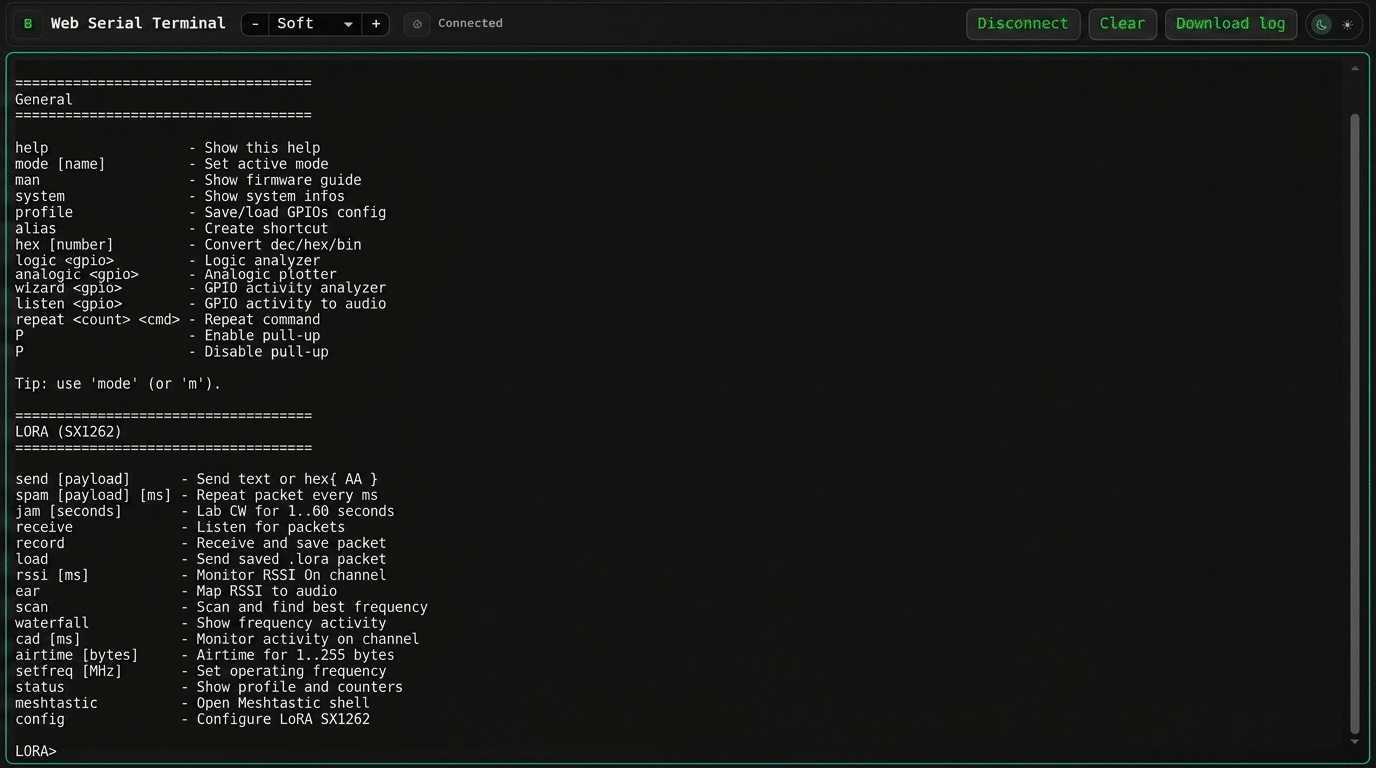
The new LoRa mode can transmit and receive packets. It also supports frequency scanning using LoRa RSSI, waterfall visualisation and channel activity detection. Captured LoRa packets can be recorded to the LittleFS filesystem on the ESP32. The recorded packets can later be retransmitted using the same settings, including frequency, bandwidth, spreading factor, coding rate, power level, preamble and sync word.
Version 1.7 also includes a Meshtastic shell that allows users to send, receive and analyse packets using LoRa radio parameters. Another addition is BPIO2, which allows users to control GPIO pins and I2C and SPI interfaces from a host computer over USB. A browser-based controller communicates with the ESP32 Bit Pirate firmware through the Web Serial API.
The BPIO2 framework also supports reusable automation sequences combining GPIO, I2C, SPI and delay operations. The update introduces a Python Scripting Lab where users can run Python scripts locally in a browser and communicate with the ESP32 Bit Pirate through Web Serial. This allows users to perform I2C scanning, SPI communication, hardware testing and debugging without requiring a local Python installation.
Hardware compatibility has also expanded to include the Heltec Vision Master T190 and Heltec WiFi LoRa 32 V4, both featuring the SX1262 LoRa radio chip. Initial build support has also been added for the Waveshare ESP32-S3-GEEK module. Other improvements include fallback support for I2C raw-read operations, an increased infrared receiver buffer, improved Wi-Fi reinitialisation and larger Flashrom transfer buffers.