































































An open-source receiver design built around an ESP32 and SX1281 radio demonstrates how Chirp Spread Spectrum can provide reliable long-range drone control.
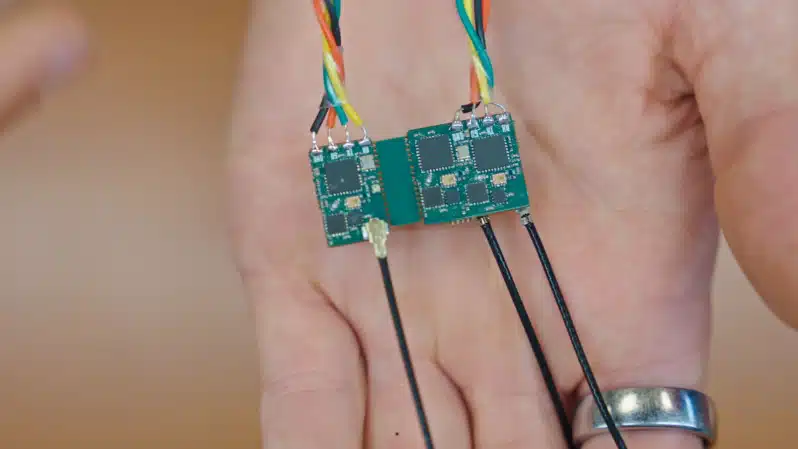
Stan has developed four open-source ExpressLRS (ELRS) receiver designs as part of a drone electronics stack built from scratch. Although ExpressLRS can operate in the 900 MHz bands, these receivers primarily use 2.4 GHz. In testing, the system maintained a connection over more than five kilometres even with a forest obstructing the signal path.
The system’s performance is mainly attributed to the modulation scheme used by ExpressLRS. Instead of conventional frequency modulation, the system uses Chirp Spread Spectrum. Each bit is represented using a chirp, a radio signal whose frequency changes gradually over time. The data is encoded through the chirp’s starting frequency. At the receiver, an inverse chirp is used to process the signal before a Fast Fourier Transform extracts the transmitted data.
The receiver hardware consists of an ESP32 processor, an SX1281 radio chip and supporting components. All four designs operate at 2.4 GHz, while two of them also include an additional 900 MHz antenna. One design connects the antenna through PCB vias, which can introduce impedance mismatch. However, nearby ground-plane vias help counteract the resulting effect.
The modulation technique provides an equivalent gain of 24 dB, allowing the receiver to decode weak signals and contributing to long-range communication at lower data rates. ExpressLRS builds on LoRa technology and provides a dedicated control link for applications such as FPV and drones.
The four receiver designs demonstrate how open-source hardware can be used to build long-range radio-control systems. By combining an ESP32, SX1281 and appropriate RF design with ExpressLRS modulation, the project provides a practical approach to long-range wireless communication.