




























































As blockchains increase exponentially in size, managing them is a challenge.
Kubernetes and containerisation are essential components of new age blockchain
infrastructure management.
Setting up a blockchain network in a test setup is not difficult as most frameworks and tools make the process fairly straightforward. The challenge begins when the same system
has to run continuously in production. In many cases, the issue is not with the blockchain itself, but with the infrastructure around it.
At the core of any blockchain network are nodes. A node is simply a system that stores the blockchain data, validates transactions, and communicates with other nodes in the network. For example, in Ethereum, a node keeps downloading new blocks, verifies them, and tries to stay in sync with the rest of the network. This is a continuous process.
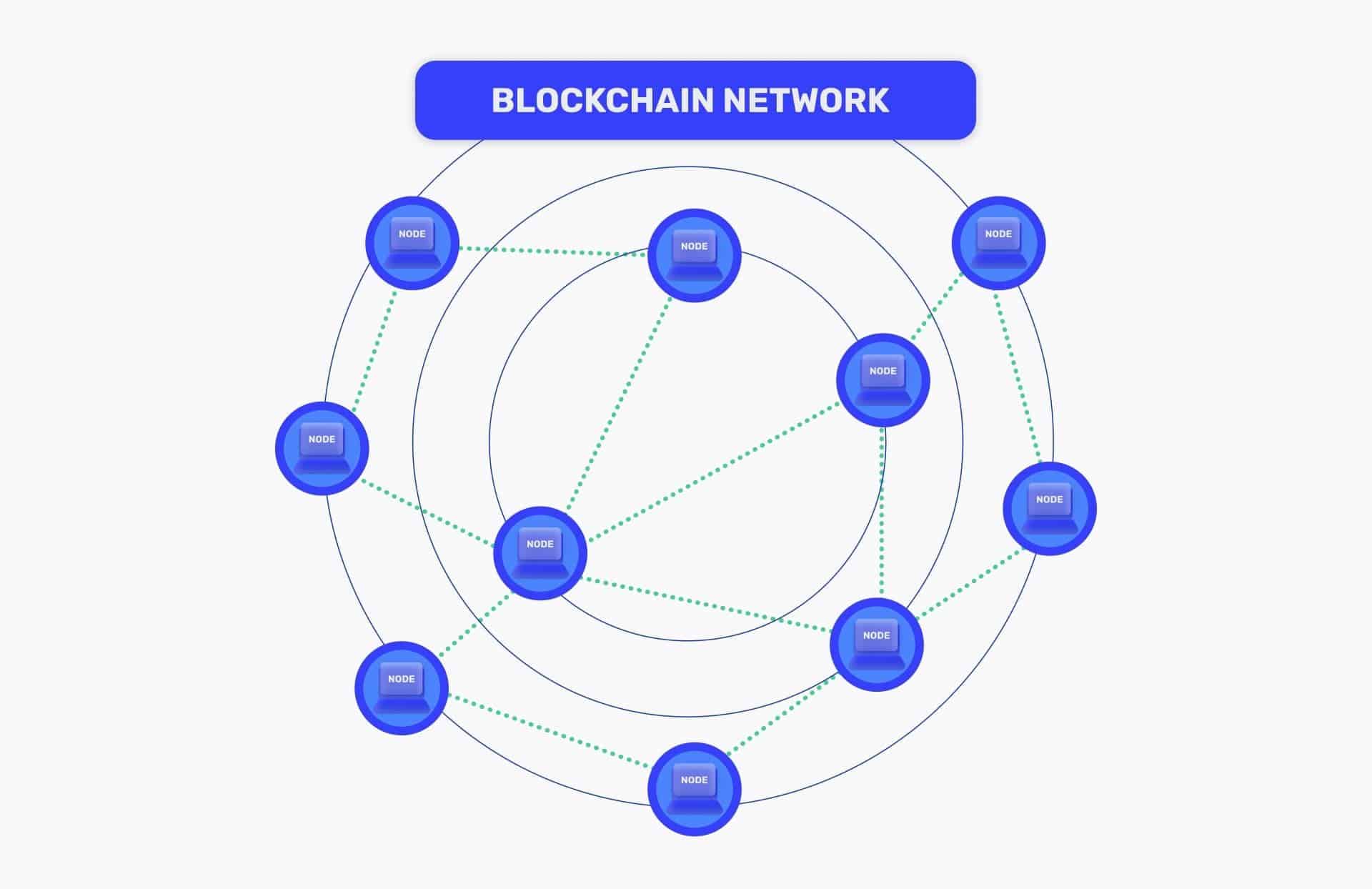
As the network grows, it becomes harder to manage it. More data means more storage requirements. More nodes mean more communication and synchronisation. Nodes need to stay updated continuously. If a node crashes or goes out of sync, bringing it back to a fully synced state can take a long time. Managing a few nodes manually is manageable, but handling many using virtual machines or standalone servers becomes challenging over time. This is where Kubernetes becomes useful.
Used to run containerised applications, Kubernetes helps automate deployments, restart failed components, and scale systems when required. It also brings consistency across environments, which is important when dealing with distributed systems like blockchain networks.
Why blockchain node infrastructure matters
The blockchain network depends entirely on its nodes. Each node plays a role in maintaining the system, validating the transactions, and ensuring that all participants see the same version of the ledger. In simpler terms, a node is responsible for mainly three tasks: storing blockchain data, verifying the transactions, and communicating with other nodes. In networks like Ethereum or Bitcoin, full nodes maintain a complete copy of the blockchain, while other types of nodes may store partial data but still participate in the network.
The importance of nodes becomes more visible when systems move to production.
For example, consider a financial application that uses blockchain for transaction validation. If the node handling those transactions is slow, out of sync, or unavailable, then the entire application is affected. Delays in block synchronisation or transaction validations can directly impact the user experience and system reliability.
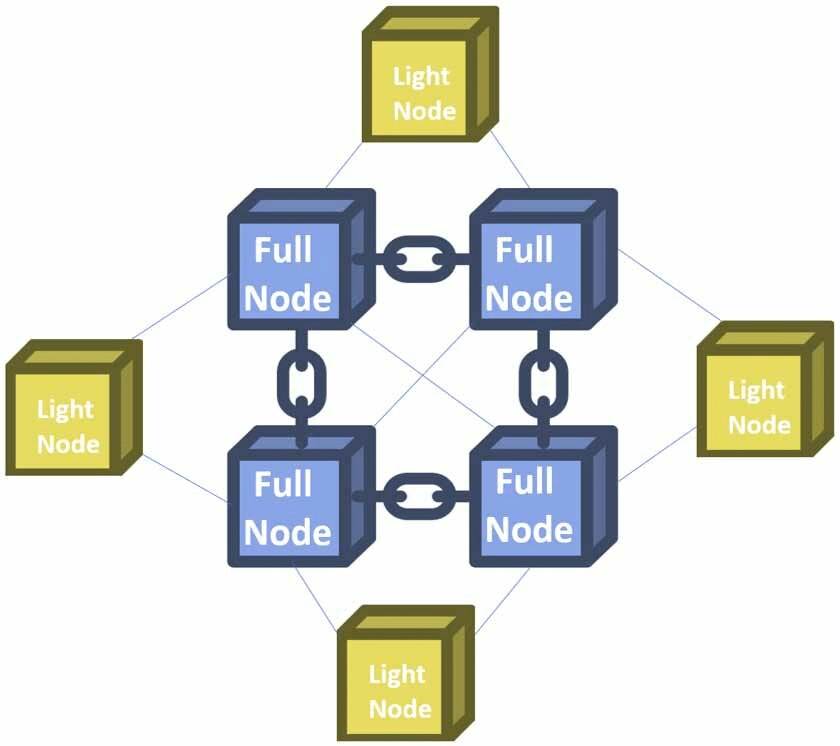
Another aspect is data growth. Blockchain data continuously increases over time. A full node may need to store hundreds of gigabytes or even terabytes of data depending on the network. This would require careful planning for storage, backup, and recovery.
There is also the issue of synchronisation. When a new node joins the network or an existing node restarts, it needs to sync with the blockchain. This process can take significant time, especially in large networks. If not managed properly, this can lead to downtime or inconsistent system behaviour.
In addition, the nodes must be connected to other peers in the network. Network instability or configuration issues could cause nodes to fall out of sync or lose connectivity, which would affect their ability to validate and share the data.
Because of these factors, managing blockchain nodes is about maintaining a distributed system that is reliable, scalable, and is monitored continuously.
Challenges in running blockchain nodes
While blockchain networks are designed to be decentralised and resilient, running the underlying nodes in production could introduce several practical challenges, the biggest one being storage. Blockchain data keeps growing continuously, and a full node is required to store the entire chain. Over time, this can reach hundreds of gigabytes, or even more, depending on the network. Managing this data, ensuring sufficient disk space, and handling backups become critical.
Another issue is synchronisation time. When a node is started for the first time or restarted after failure, it needs to be synced with the network. This process could take several hours or even days in case of larger networks. During this time, the node is not fully usable, which can affect system availability.
Node failures are also common in real-world environments. Hardware issues, network interruptions, or software crashes can cause nodes to go down. Recovering from these failures manually often requires intervention, which increases operational overload.
The other concern is about configuration management. When multiple nodes are deployed across various environments, keeping configurations consistent may become difficult. Even small differences in setup can cause unexpected behaviour or connectivity issues between nodes.
Networking adds another layer of complexity. Blockchain nodes depend on stable communication with their peers. Latency, firewall rules, or misconfigured networking can disrupt node communication, which can cause delays and synchronisation issues.
Scaling is equally challenging. As demand increases, more nodes are required to handle load or improve redundancy. Adding and managing these nodes manually is extremely time consuming and error prone.
Keeping these challenges in mind, managing blockchain nodes using traditional methods such as standalone servers or manually provisioning virtual machines becomes difficult at scale. This creates a need for more automated, scalable, and resilient infrastructure.
Why Kubernetes for blockchain infrastructure
Given the challenges involved in running blockchain nodes, there is a clear need for a more structured and automated way to manage infrastructure. Kubernetes provides us with a practical solution.
Originally designed to manage containerised applications, Kubernetes has become a standard platform for running distributed systems. Its features align well with requirements of blockchain node infrastructure.
One of the key advantages of Kubernetes is automation. It allows nodes to be deployed and managed using declarative configurations. So instead of manually setting up each node, the entire environment can be defined as code and deployed consistently across systems. Another important capability is its selfhealing feature. If a node crashes or
becomes unresponsive, Kubernetes can automatically restart it or replace it with a new instance. This reduces downtime and minimises manual intervention. Kubernetes also supports scaling. As the network grows, additional nodes can be easily added without a complex setup. This helps in handling increasing load and improving system resilience.
Storage management is another area where Kubernetes helps. With support for persistent volumes, it allows blockchain data to be stored reliably even if containers restart. This is important for maintaining the integrity of node data. Networking within Kubernetes makes it easier for nodes to communicate with each other. It provides a built-in service discovery
and stable communication between components, which is essential for peer-to-peer blockchain networks. Additionally, Kubernetes integrates well with both monitoring and logging tools. This makes it easier to track node performance, detect issues early, and maintain overall system health.
Because of all these capabilities, Kubernetes is being increasingly used as a foundation for running blockchain node infrastructure in a scalable and reliable way.
Blockchain node architecture on Kubernetes
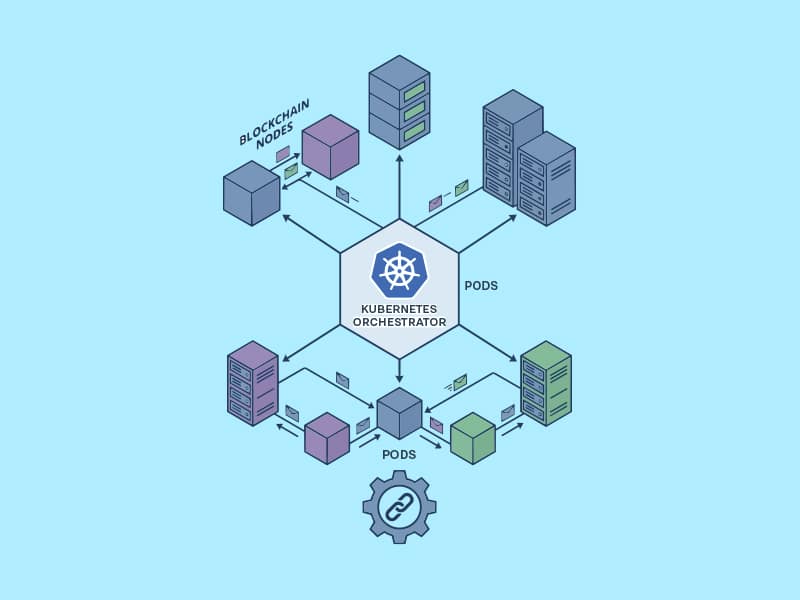
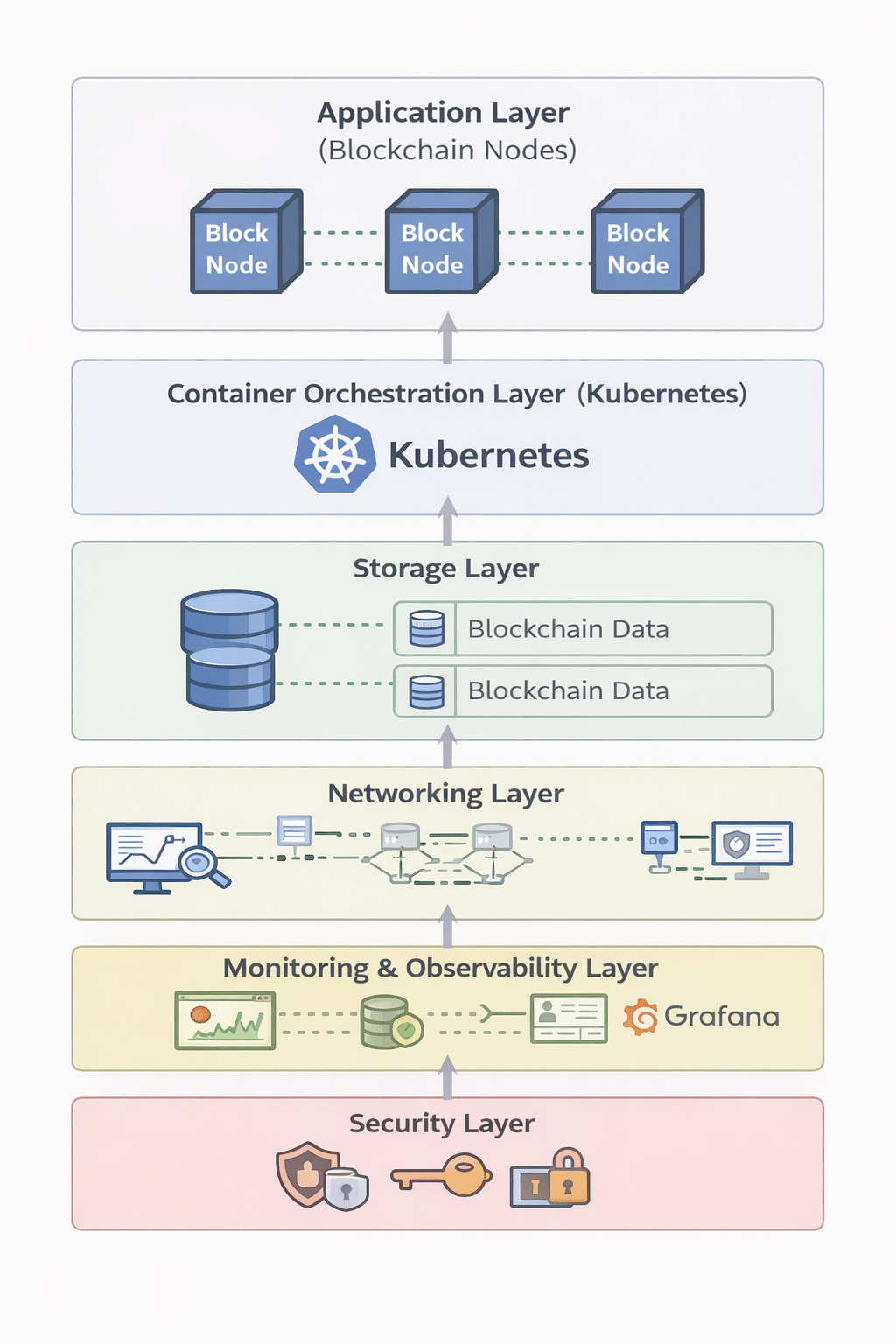
Running blockchain on Kubernetes involves organising the system into multiple layers. Each layer is responsible for a specific function. This structured approach makes it easier to manage, scale, and monitor the overall infrastructure.
Application layer (blockchain nodes): This is the core layer where blockchain nodes run as containerised applications. Each node operates within a container and performs tasks such as transaction validation, block synchronisation, and peer communication. Multiple nodes can be deployed depending on the requirements of the network.
Container orchestration layer(Kubernetes): The next layer is the orchestration layer, where Kubernetes manages the lifecycle of the nodes. It handles the deployment, scaling, and recovery of the containers. In case a node fails, Kubernetes automatically restarts it. Workloads are typically managed using constructs like StatefulSets, which are useful for applications that require stable identities and persistent storage.
Storage layer: As we are aware by now, blockchain nodes require persistent storage to maintain ledger data. Kubernetes provides these persistent volumes to ensure data is retained even if containers are restarted or moved across nodes. This layer is critical for maintaining blockchain state and avoiding re-synchronisation from scratch.
Networking layer: The nodes need continuous communication with their peers. Kubernetes provides an internal network and service discovery mechanism that allows nodes to communicate reliably. Services and network policies help manage traffic flow and ensure secure communication.
Monitoring and observability layer: The health and monitoring tools are integrated into architecture to maintain system health. Metrics such as node availability, synchronisation status, and resource usage are tracked. Tools like Prometheus and Grafana are commonly used to provide visibility into system performance.
Security layer: Security is handled at multiple levels. Kubernetes supports role-based access control (RBAC), secret management, and network policies to protect node communication and sensitive data such as keys and credentials.
Running Ethereum nodes on Kubernetes: An example
To understand how architecture works in real life, consider a simple example of Ethereum nodes on Kubernetes.
An organisation may need multiple nodes to support applications that interact with blockchain. Instead of running these nodes on separate virtual machines, they can be deployed as containers within a Kubernetes cluster. Each node can be packaged using a container image such as Geth. Then these nodes can be deployed using StatefulSets, which ensure that each node has a stable identity and persistent storage. Persistent volumes are attached to each node to store blockchain data. This ensures that even if a container is restarted, the node doesn’t lose its synchronisation state.
Kubernetes services are used to enable communication between nodes and external applications. This allows nodes to interact with each other and remain connected to the blockchain network. If a node fails, Kubernetes automatically restarts it. Additional nodes can be added easily when required, helping improve availability and distribute load.
This approach simplifies management and ensures that blockchain nodes run reliably without requiring constant manual intervention.
Running blockchain nodes in production is not just about deploying the software; it requires managing a distributed system that demands reliability, scalability, and continuous operation. As blockchain adoption grows, the limitations of traditional infrastructure become more visible. Managing nodes manually using standalone systems does not scale well and introduces operational challenges. Kubernetes offers a practical way to address these challenges. With its capabilities around automation, scaling, and self-healing, it provides a stable foundation for running blockchain node infrastructure.
By combining blockchain technologies with cloud-native platforms like Kubernetes, organisations can build systems that are not only decentralised but also resilient and easier to manage.