























































As AI agents begin to act on behalf of executives (signing contracts, moving funds), how
do we verify their identity? In the framework proposed here, open source decentralised
identifiers act as the ‘passport’ for AI agents, ensuring every autonomous action is
cryptographically signed and authorised.
In the rapid transition towards an AI-driven enterprise, leadership focus has largely remained on model performance and accuracy. However, emerged: the ‘accountability gap’. As organisations move from ‘assistive AI’ (chatbots) to ‘agentic AI’ (autonomous actors), these digital entities are being empowered to negotiate contracts, access sensitive repositories, and execute financial transactions.
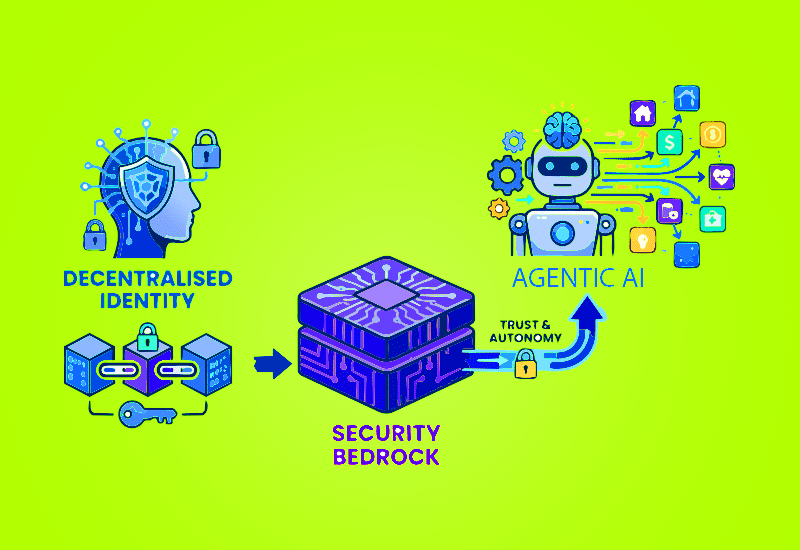
Traditional identity and access management (IAM) systems, designed for human users and static service accounts, are proving insufficient for a workforce of ephemeral, highvelocity AI agents. To secure the modern enterprise, architects must look towards decentralised identity (DID). By providing every AI agent with a cryptographically verifiable ‘passport’, we can ensure that every autonomous action is authorised, auditable, and revocable in real-time.
The ‘who’ problem in the age of ‘what’
In the current AI gold rush, enterprises have focused on what AI can do—generate code, summarise reports, or automate customer service. But as we move into the era of agentic AI, where autonomous models are empowered to move funds, sign contracts, and access sensitive PII, a far more critical question emerges: ‘who’ is performing this action, and ‘who’ authorised it?
For technology organisations, the risk is no longer just a ‘hallucination’; it’s an ‘unauthorised execution’. Traditional identity systems were built for humans and static service accounts, not for autonomous agents that mutate and scale. To scale AI safely, enterprise architecture must pivot towards decentralised intelligence— using open source DID frameworks to give AI agents a verifiable, cryptographically-backed ‘passport’ to the corporate ecosystem.
The shift to decentralised intelligence
The core challenge for senior leadership is no longer just ‘AI safety’, but ‘agent governance’. When an AI agent performs an action, the receiving system must be able to verify three things: What is the agent, who does it represent, and what specific rights has it been granted?
Centralised identity providers create a bottleneck and a single point of failure that cannot keep pace with the thousands of agents a global enterprise might deploy. Decentralised identity, built on open source standards like the W3C DID specification, allows for a peer-to-peer trust model. This enables ‘sovereign AI’—agents that carry their own credentials and can prove their authority across cloud boundaries without needing a constant handshake with a central server.
Most AI identity discussions stop at ‘Can the agent log in?’ You can differentiate by introducing ‘credentialed reasoning’. This is the requirement that an AI agent must not only prove who it is but also provide a cryptographically signed ‘reasoning trace’ (the chain of thought) before a high-value action is authorised. This turns the DID from a simple passport into a black box flight recorder for enterprise logic.
A timely concern is ‘agentic drift’—where an autonomous agent’s behaviour slowly deviates from its original intent due to recursive loops or tool-use errors. Hence a section on ‘automated identity revocation’ should be added. Just as a corporate credit card is frozen for suspicious activity, an AI agent’s DID should be programmatically revoked by a ‘guardian agent’ if its behaviour signature (monitored via an Open Policy Agent) deviates from the architectural baseline.
Senior leadership cares about the bottomline, so the total cost of ownership (TCO) should be discussed. While proprietary ‘Identity-as-a-Service’ models charge per-agent seat, an open source DID stack (Hyperledger/Indy) allows the enterprise to scale from 10 to 10,000 agents with zero marginal licensing costs. This is not mere ‘tech exploration’ but a ‘strategic financial decision’.
Strategic use cases: From procurement to compliance
The most immediate ROI for DID-enabled AI lies in highstakes autonomous workflows. In ‘autonomous procurement’, agents can be issued ‘spending credentials’ linked to a department’s DID, allowing them to execute purchases within strict cryptographic guardrails. In ‘regulated data access’, a ‘researcher agent’ can present a Verifiable Credential (VC) to a data lake, proving it has passed a specific bias-audit or security clearance before it is allowed to ingest sensitive information.
Consider the ‘financial close’ use case: An auditor agent from an external firm needs to verify records. Instead of a manual login, it presents a DIDbacked credential. Your internal ledger agent verifies the signature against the external firm’s public key on a distributed ledger; grants temporary, scoped access, and logs the entire interaction. This is not just automation; it is verifiable autonomy.
The open source ecosystem: Tools for the 2026 architect
Building this trust layer requires a commitment to open source frameworks to avoid vendor lock-in and ensure maximum interoperability.
Identity and trust: Hyperledger Aries and Indy remain the gold standard for managing the lifecycle of DIDs and Verifiable Credentials. They provide the ‘wallet’ infrastructure where agents store their identity.
Orchestration: LangGraph and Microsoft’s Agent Governance Toolkit (released April 2026) are essential for defining the stateful logic of agents while intercepting actions for policy enforcement.
Communication: The ModelContext Protocol (MCP) is increasingly used to standardise how these identified agents connect to enterpr ise tools and data sources.
Reference architecture: The verified agent mesh
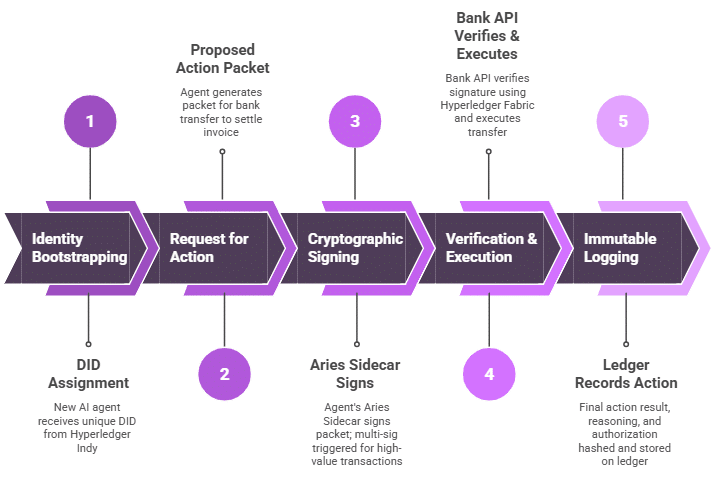
The architecture for decentralised intelligence is built on the separation of cognition and authority. At the core sits the ‘agent sovereign layer’, which treats every AI model instance as a unique identity rather than a shared service account. This layer utilises an ‘identity sidecar’—a lightweight, open source microservice (typically built on Hyperledger Aries) that sits alongside the LLM. This sidecar holds the agent’s private keys and manages its ‘wallet’ of Verifiable Credentials. By decoupling the identity from the model, you ensure that even if a model provider is swapped (e.g., moving from a proprietary API to an on-premises Llama 4), the agent’s corporate identity and historical audit trail remain intact.
| Do | Don’t |
| Do prioritise W3C standards for DIDs to ensure future interoperability between different AI agents. |
Do prioritise W3C standards for DIDs to ensure future interoperability between different AI agents. |
| Do start with ‘read-only’ agents to prove the identity framework before moving to ‘write/execute’ agents. |
Don’t build on closed source identity silos that charge ‘per-agent’ fees; the costs will scale exponentially. |
| Do use Zero-Knowledge Proofs (ZKPs) to allow agents to prove they have authorisation without revealing sensitive backend data. |
Don’t ignore the ‘liveness’ problem— ensure your architecture can rotate or revoke an AI’s identity instantly. |
The executive’s guide: Dos and don’ts
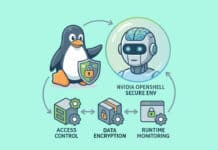
Above this sits the ‘governance orchestration layer’, which acts as the ‘policy enforcement point’. Before an AI agent can call an enerprise tool—such as an ERP system or a payment gateway—the request must pass through an Open Policy Agent (OPA) or a similar engine. This engine doesn’t just check if the AI has access; it cryptographically challenges the agent to prove it possesses a specific, time-bound credential signed by a human supervisor or the enterprise architecture office. This creates a ‘zero trust’ environment where no agent is inherently trusted based on its network location, but only through its proven, decentralised identity.
A robust architecture for decentralised intelligence separates the ‘brain’ (the LLM) from the ‘passport’ (the DID).
The identity layer: A distributed ledger (e.g., Hyperledger Fabric) acts as the ‘root of trust’, hosting the public keys (DID documents).
The agent wallet: Each agent instance has a sidecar ‘wallet’ (Aries) that handles cryptographic signing.
The policy engine: Before an agent executes a tool call, an open source governance engine verifies the agent’s credentials against corporate policy.
Implementation guide: Dos and Don’ts
To implement this architecture effectively, leadership must prioritise the issuance of short-lived, taskspecific credentials rather than persistent administrative rights, as AI agents are ephemeral, and their access should expire the moment a mission is completed. It is vital to embed model explainability alongside identity so that every cryptographically signed action is accompanied by a ‘reasoning trace’ for future audits. Yet one must never rely on static API keys or hard-coded secrets which represent the single greatest vulnerability in automated workflows. Furthermore, while the goal is full autonomy, architects should avoid removing the human-in-the-loop for high-value transactions; instead, use multisignature requirements where an agent’s decentralised identity must be co-signed by a human supervisor’s credential to execute a final ‘write’ operation. Finally, do not build these systems on closed source, proprietary identity silos that charge per-agent fees, as the resulting vendor lock-in and exponential scaling costs will quickly undermine the economic advantages of an autonomous AI workforce.
Leadership in the era of accountability
The marriage of AI and open source decentralised identity is the next frontier of enterprise architecture. For the C-Suite, this isn’t just a technical upgrade—it’s a risk management imperative. By establishing a cryptographically verifiable identity for every intelligent agent in your organisation, you transform AI from a risky experiment into a trusted, scalable workforce.
The move towards decentralised intelligence is a strategic pivot from “Can we build it?” to “Can we trust it?” For the enterprise architect, the mission is to build a fabric where AI can scale without compromising the security posture of the firm. By leveraging open source DID frameworks, organisations can create a transparent, accountable, and highly resilient AI workforce that is ready for the complexities of the next decade.
In 2026, the most successful organisations won’t just have the smartest AI; they will have the most accountable AI.