

















































OpenAMRobot 2.0 is evolving into an open-source dual-arm mobile robot with ROS 2 control, demonstration-based learning and hardware designs that developers can inspect and adapt.
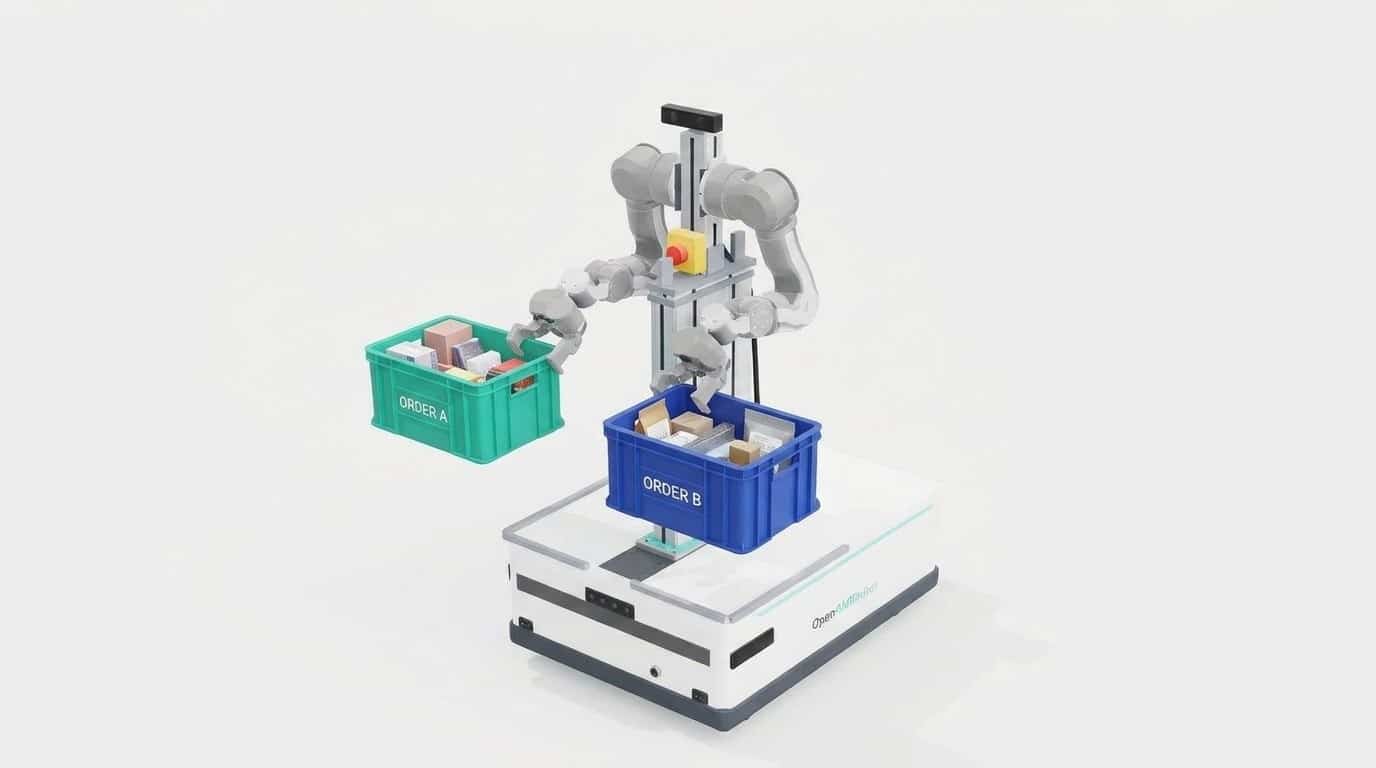
OpenAMRobot 2.0 is being developed as an open-source mobile manipulation platform that combines a dual-arm robot with software for embodied artificial intelligence (AI). The update expands the project beyond autonomous mobile robotics to include manipulation, teleoperation and learning tasks from human demonstrations. Its hardware designs, embedded firmware, ROS 2 software and AI development tools are organised across public repositories, allowing developers to examine and modify individual parts of the system.
The planned 2.0 configuration features two OpenArm 2.0 robotic arms, each with seven degrees of freedom, mounted on a lifting column. The shoulder height is designed to adjust between 1,000mm and 1,350mm to support different manipulation tasks. An NVIDIA Jetson Orin NX serves as the main computing platform, while an STM32H723 microcontroller manages the mobile base through micro-ROS. The drive system uses hub motors with holding brakes, powered by a 25.6V lithium iron phosphate battery. The design also includes wireless charging and emergency-stop controls intended to cut motor power. These specifications describe the planned configuration and remain subject to release validation.
The software stack combines ROS 2 with Navigation2 (Nav2), MoveIt 2 and ros2_control for navigation, motion planning and hardware control. Sensors include a SLAMTEC RPLIDAR S3, ultrasonic sensors, cliff-detection sensors and an inertial measurement unit. The platform is designed for mobile manipulation applications such as warehouse operations, retail order picking, research and industrial assistance. A browser-based interface provides access to robot monitoring, mapping, navigation, camera feeds and mission management, while the modular architecture allows developers to work on separate software and hardware components.
A major addition is the embodied AI workflow, which aims to let users teach a robot through demonstrations instead of programming every action manually. The planned toolchain includes demonstration recording, dataset preparation, an Action Chunking with Transformers (ACT) imitation-learning baseline and policy evaluation. Developers can record examples of tasks, train a model and evaluate its behaviour before deploying it on the robot. This approach could help researchers explore how robots learn manipulation tasks from human input, although the advanced AI capabilities remain under active development.
OpenAMRobot uses separate licences for different parts of the project: MIT for software, Creative Commons Attribution 4.0 for documentation and CERN Open Hardware Licence Version 2 – Permissive for hardware designs. The project is moving towards a modular repository structure covering hardware, firmware, ROS 2 software, manipulation, communications and AI training. Physical integration and acceptance testing are planned in Berlin between late November and December 2026. Until the release candidate and final package become available, the stated 2.0 features should be treated as planned rather than fully validated capabilities.
For more information, click here.