






















































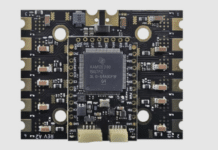

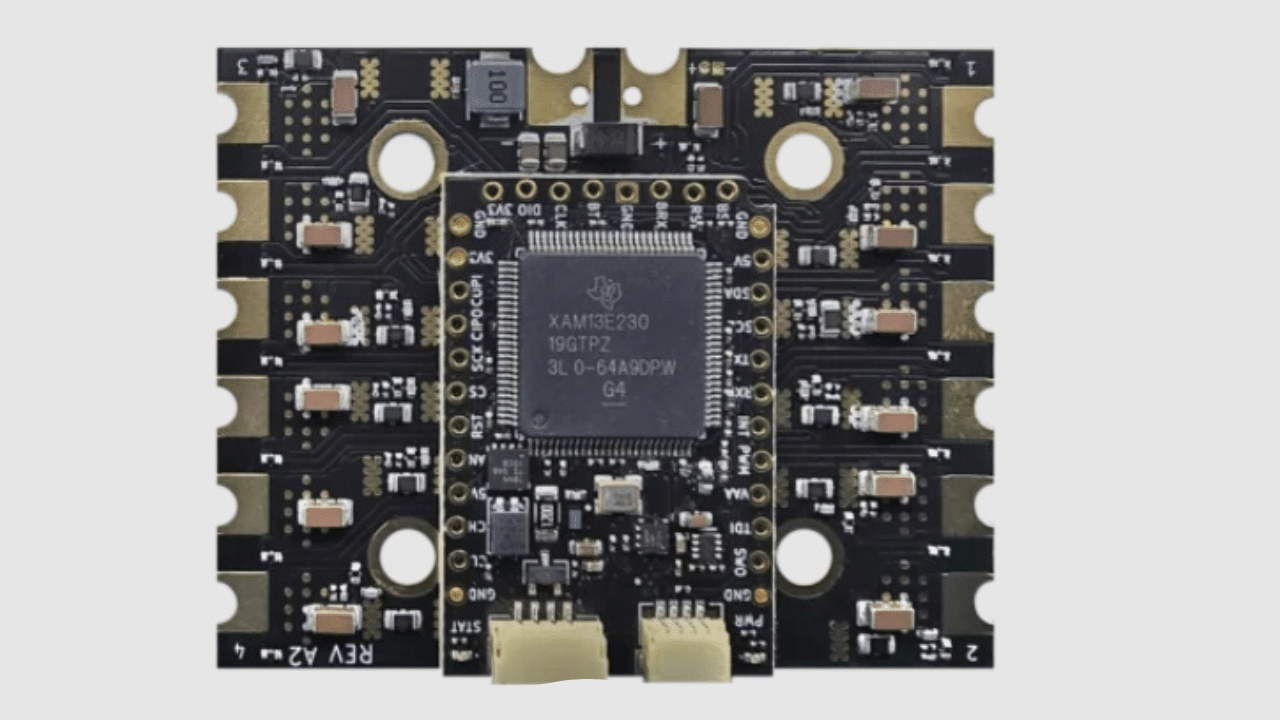

BeagleConnect QuadESC is an open-source motor-control board that drives four brushless motors using an Arm Cortex-M33 microcontroller, TinyEngine AI acceleration and editable KiCad hardware designs.
BeagleBoard.org has introduced BeagleConnect QuadESC, an open-hardware controller designed to operate four brushless DC (BLDC) motors independently for robotics, drone propulsion and embedded control experiments. Its hardware design files, firmware resources and technical documentation are publicly available, enabling developers to inspect the circuit, modify the PCB and build custom motor-control systems. The 60 × 48mm board combines four three-phase power stages with current and voltage sensing, temperature monitoring and onboard power regulation. It also integrates BeagleConnect Torque, a controller module built around Texas Instruments’ AM13E23019 microcontroller, providing real-time processing and neural-network acceleration.
At the centre of the board is a 200MHz Arm Cortex-M33 processor with 512KB of flash memory and 128KB of SRAM. The microcontroller includes floating-point support, a trigonometric maths unit for control calculations and a TinyEngine neural-network accelerator for application-specific inference. These resources could support custom motor-control algorithms and local fault-detection models without requiring a separate application processor. However, AI-based diagnostics and advanced motor-control functions depend on the firmware developed and loaded by the user; they are not automatically available simply by powering the board.
The QuadESC provides four three-phase motor channels, each with dedicated pulse-width modulation (PWM) timing resources. Every channel uses a Texas Instruments DRV8323SRTAR gate driver and three half-bridge power devices to control a motor’s phases. Feedback circuitry measures phase currents, phase voltages and temperatures near the power stages, while a separate input monitors battery voltage. Three 12-bit analogue-to-digital converters support current sampling for field-oriented control (FOC), with firmware coordinating measurements across the four motors. The board is designed for 3S–6S batteries, covering 9V to 25.2V, and includes CAN connectivity for communication with other controllers.
An eight-pin flight-controller interface provides four command-signal routes, telemetry, current reporting, battery power and ground. Additional connections support motor-phase wiring, programming, debugging and a buzzer. The board’s architecture allows developers to experiment with synchronised motor control, multi-motor robotics, propulsion systems and condition monitoring. Its hardware resources also provide a foundation for investigating AI-assisted anomaly detection, although users must implement the relevant algorithms and validate them for their motors and operating conditions. The manufacturer lists design targets of 40A continuous and 70A burst per motor, but these figures are not yet validated operating ratings; actual current capacity depends on cooling, ambient temperature and load duration.
The project’s open-hardware approach is central to its value for embedded developers. BeagleBoard.org provides editable KiCad designs, schematics, hardware manuals, connector references and firmware-development resources through its official website and associated repositories. Developers can use these materials to study the power stages, adapt the circuit for specific applications or design systems around the BeagleConnect Torque controller. The board requires suitable application firmware before the motors can operate, and pricing and commercial availability have not yet been announced.
For more information, click here.