
























































An open-source firmware project transforms Raspberry Pi Pico boards into configurable digital audio processors, with source code and build instructions available for developers.
DSPi is an open-source digital signal processing (DSP) firmware project that turns Raspberry Pi Pico and Pico 2 boards into programmable audio processors. Released under the GNU General Public License v3.0 (GPL-3.0), the project provides its firmware source code, technical documentation, build scripts and test tools through a public GitHub repository. Developers can inspect the implementation, modify audio-processing functions and build firmware for compatible RP2040- and RP2350-based hardware.
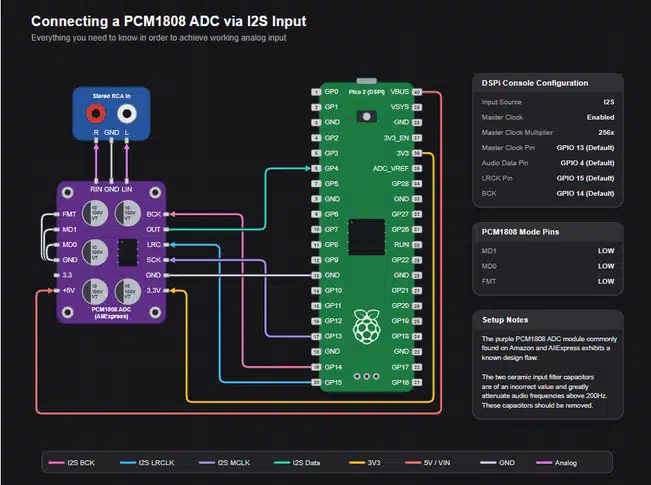
The project gives developers access to a range of audio-processing functions, including parametric equalisation, active crossovers, room correction, time alignment, loudness compensation, headphone crossfeed and channel mixing. It also supports USB audio input, S/PDIF and I2S outputs, allowing users to configure audio routing for different speaker and amplifier setups. The firmware supports up to four independent stereo output slots on the RP2350, compared with two on the RP2040, with output configurations adjustable through software.
DSPi’s architecture is designed to make efficient use of the microcontrollers’ hardware resources. It distributes processing across the two CPU cores and uses programmable I/O (PIO) and direct memory access (DMA) for functions such as S/PDIF encoding and pulse-density modulation (PDM) generation. The firmware also includes configurable GPIO assignments, a ten-slot preset system, per-channel gain and delay controls, and diagnostic information for monitoring processor load and audio-buffer performance.
The repository includes instructions for compiling the firmware using CMake, the Arm GNU toolchain and the Raspberry Pi Pico SDK. Developers can build separate firmware images for the Pico and Pico 2, then flash the resulting UF2 files directly to the board. The project also includes a test harness and an optional USB audio-loopback mode for measuring the output signal and validating filter behaviour. These resources allow developers to investigate the signal-processing implementation and adapt it to their own audio hardware.
By making the firmware and its technical documentation available under GPL-3.0, DSPi provides a reusable foundation for DIY audio equipment, multi-channel speaker systems and embedded audio experiments. Developers can fork the repository, contribute improvements and build customised DSP configurations without starting from scratch. The project also has separate macOS and Windows control applications, available through the developer’s GitHub repositories, for configuring the firmware from a computer.
For more information, click here.