
























































The Xerxes Pi 2026 and Xerxes Nano combine accessible hardware design files and open-source management software with modular computing for self-hosted servers and edge AI projects.
Rapid Analysis has introduced the Xerxes Pi 2026 and Xerxes Nano carrier boards as part of its Xerxes Home Lab ecosystem, with an emphasis on compact, modular computing. The project includes KiCad hardware design files for the Xerxes Pi 2026, hardware documentation and an open-source management application, giving developers resources to examine the board design and customise their own home lab setups. The larger Xerxes Nano targets AI development using compatible NVIDIA Jetson and Turing RK1 compute modules.
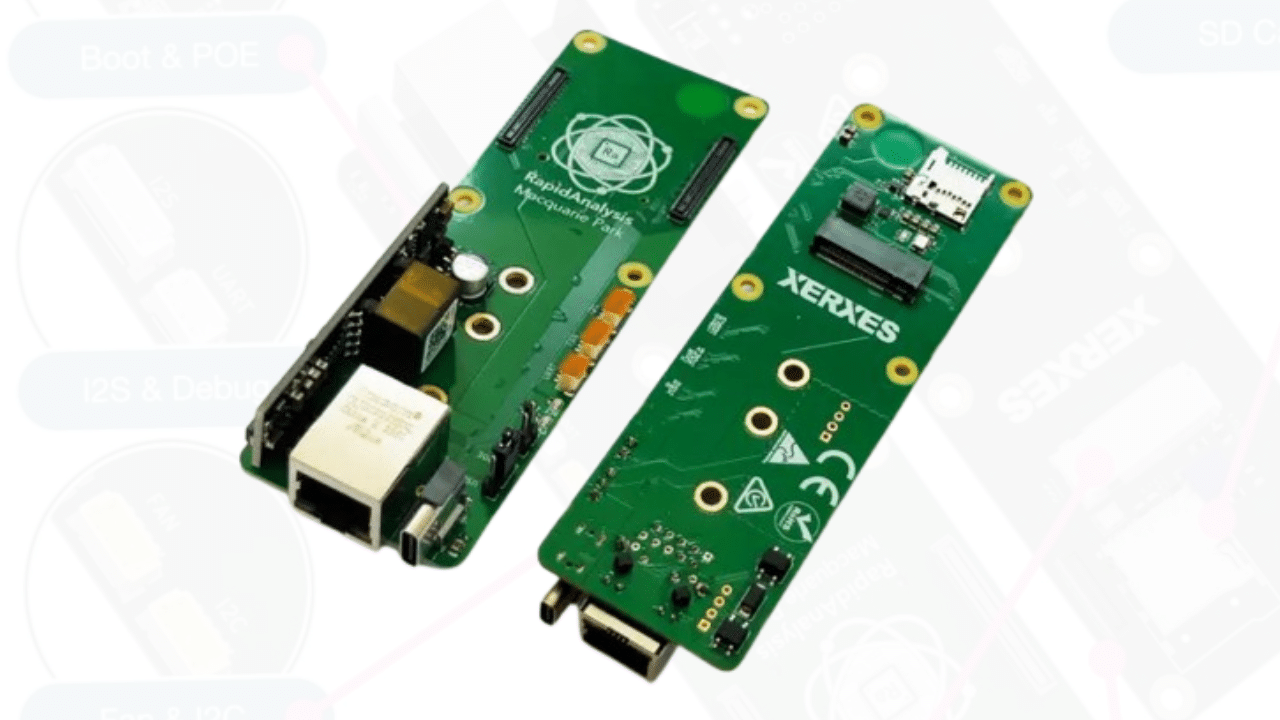
The Xerxes Pi 2026 supports Raspberry Pi Compute Module 4 and Compute Module 5, along with compatible alternatives. Its 120 × 40mm design fits vertically into a 1U rack and includes an M.2 M-key PCIe Gen 2 ×1 socket for NVMe SSDs, Gigabit Ethernet with optional Power over Ethernet (PoE/PoE+), a microSD slot for modules without eMMC, and expansion for camera and HDMI signals. A Qwiic connector supports I²C and I²S peripherals, while dedicated serial debugging and boot-selection jumpers simplify headless setup and system recovery.
The wider Xerxes Nano is designed for NVIDIA Jetson Orin Nano and Turing RK1 modules. Measuring 120 × 60mm, it provides M.2 PCIe Gen 3 storage connectivity, Gigabit Ethernet with PoE, an SFP+ cage and an OCuLink connector for compatible external GPUs, AI accelerators and other PCIe devices. SPI, UART, I²C and I²S interfaces support connections to sensors and other peripherals. Actual OCuLink compatibility depends on the compute module, software drivers and available power.
On the software side, the open-source Xerxes Home Lab management tool is currently available for macOS, with Windows and Linux versions planned. It can discover systems over SSH, monitor RAM and disk usage, check fan speed, manage Docker containers and handle SSH keys. The boards can run operating systems supported by their respective compute modules, including Raspberry Pi OS, Ubuntu Server and NVIDIA JetPack. Rapid Analysis also provides hardware documentation and 3D-printable enclosure and rack designs for building compact multi-board installations.
The Xerxes Home Lab ecosystem is being offered through a Kickstarter campaign, with rewards reported to start at US$49 for a package based on one Xerxes Pi 2026 board. While the released KiCad files provide an entry point for inspecting and adapting the Xerxes Pi 2026 hardware, developers should check the repository’s licence and release terms before modifying or redistributing the designs. The availability of these resources should not be taken to mean that every board in the ecosystem is fully open hardware.
For more information, click here.