



















































To prevent transition failures when moving ML models from production to deployment, development teams need to radically rethink their review workflows. They must move away from isolated code validation and adopt context-aware review systems.
Compiling a custom Linux kernel from source is a familiar rite of passage. You configure your flags, carefully select the drivers needed for your hardware architecture, run the compilation, and wait. If the compiler finishes without throwing syntax errors, you install the kernel and reboot. But if you overlooked a crucial hardware module during configuration, you are met with a catastrophic kernel panic. The code was syntactically perfect and compiled beautifully, but it lacked the necessary environmental context to run correctly on your specific machine.
Deploying a machine learning model into a production environment often follows a strikingly similar pattern. A data scientist might spend weeks training a complex model. In their local environment—perhaps a high-end Ubuntu workstation or within a carefully curated Docker container—the model runs flawlessly. The validation metrics look fantastic, the Python scripts execute without a traceback, and the pull request is confidently opened.
From there, the continuous integration pipeline takes over. It runs standard open source linters, executes unit tests, and packages the model. Everything passes with flying colours, and the code is merged. Yet, once that model is deployed behind a production API and exposed to the real world, unexpected issues surface. The system does not crash with a loud, easily traceable error. Instead, pipelines fail silently, API endpoints return logically flawed predictions, and the overall quality of the service degrades over time.
The root cause of these failures is rarely bad code syntax; it is a profound lack of context. To build reliable open source artificial intelligence systems, developers and DevOps engineers must look beyond standard syntax checks. We must adopt context-aware workflows to address the hidden gaps where data, input formats, and pipeline assumptions mutate between the training environment and the production server.
The containerisation illusion and missing context
In the open source ecosystem, we have largely solved the problem of isolated application environments through containerisation. Tools like Docker and Podman use underlying Linux kernel features to ensure that the application runs in the exact same operating system state everywhere. If your machine learning application requires specific Python library versions or a particular GPU driver architecture, you bake that directly into your container image.
However, containerisation only solves the infrastructure parity problem. It does not solve the context parity problem.
A machine learning system is fundamentally different from a standard web server or database application. A traditional web server’s behaviour is dictated entirely by its source code. A machine learning model’s behaviour, on the other hand, is dictated by the intersection of its code, its learned mathematical behaviour weights, and the shape, distribution, and semantics of the incoming data.
When a developer tests a model locally, they are usually feeding it a static, sanitised dataset. The data is pre-aligned with the model’s expectations. In production, the model is usually wrapped in a REST API or gRPC microservice. It is exposed to real-time, streaming data from message brokers, which is often malformed or fundamentally different in structure from the training set. Containerisation ensures the Python script executes, but it cannot ensure the data fed into the script matches the original business intent.
Anatomy of silent machine learning failures
In traditional open source software development, if an API expects an integer and receives a string, standard strongly typed languages or validation frameworks will immediately throw an exception. The error is loud, it is caught in the application logs, and it triggers an alert.
Machine learning systems are notoriously prone to silent failures because they rely heavily on external context, such as data distributions and feature expectations. When these assumptions are violated, the system rarely throws an explicit exception. Instead, it processes the malformed data, passes it through the model’s matrix multiplications, and outputs a prediction that is completely wrong—but formatted perfectly as a valid JSON response.
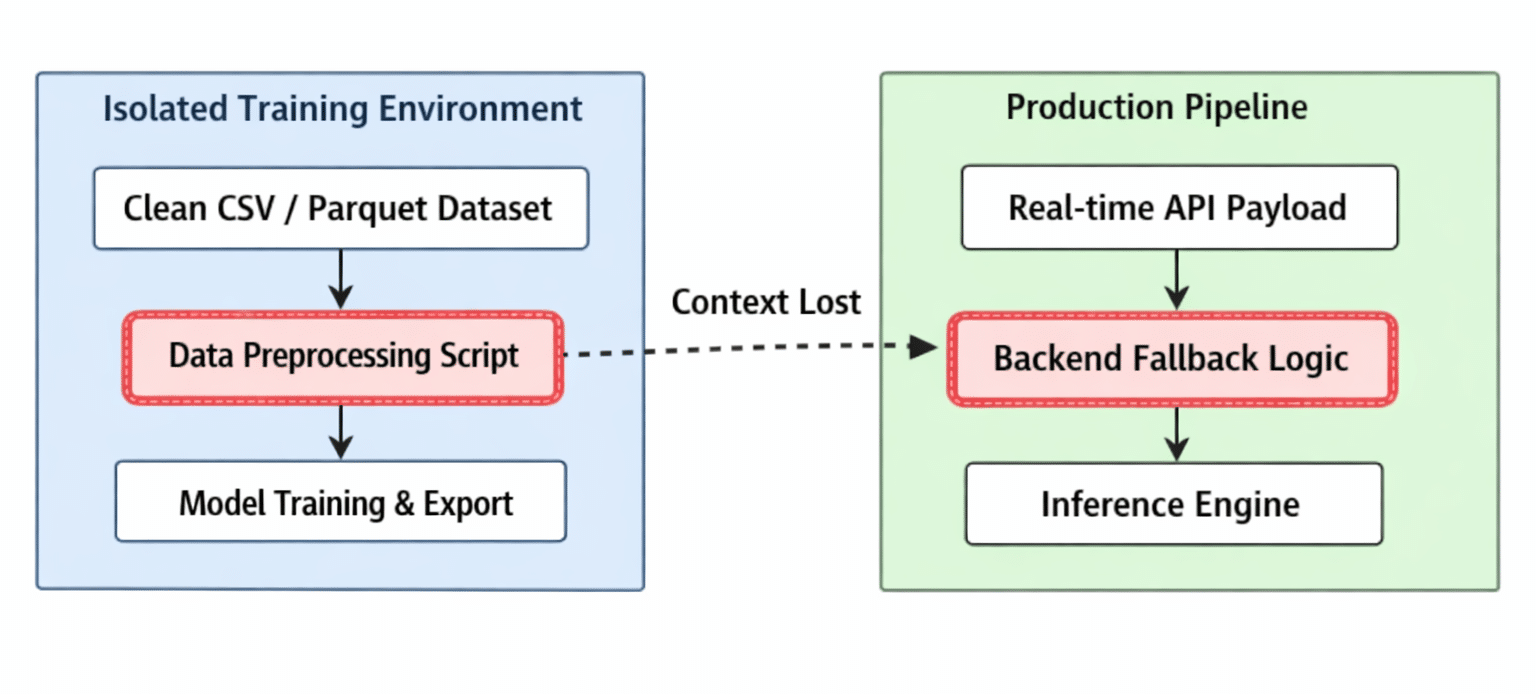
A common trap occurs during preprocessing. During the training phase, a developer may normalise a dataset or handle missing values. Utilising an open source library like scikit-learn, missing user ages might be imputed using the dataset’s historical average. This historical average is a core assumption baked into the model’s understanding of the world.
However, in production, the backend engineering team might process a real-time data stream and write a quick fallback mechanism. To ensure the API does not crash when a payload arrives without an age field, an engineer might default the missing age to zero.
The model still executes perfectly. But the predictions for users with missing ages will be heavily skewed because the model perceives a user age of zero completely differently than a user age of thirty-two. Because machine learning failures are rarely explicit, automated pipelines focusing purely on code syntax will completely miss this broader system context.
The limits of traditional continuous integration
In most engineering teams, code review and automated continuous integration pipelines focus heavily on implementation details. Linters check for syntax errors, static analysis tools check for vulnerabilities, and unit tests verify isolated functions. These checks are built on a fundamental assumption: that correctness is fully expressed within the codebase itself.
If you are reviewing a pull request for a standard web framework, this assumption holds true. You can read the code and understand exactly what it does. But in machine learning architectures, a massive portion of correctness lives entirely outside the code. It exists in data contracts, feature expectations, model assumptions, and the overarching ticket requirements.
Reviewing a machine learning deployment script without knowing the original data assumptions is exactly like debugging a complex bash script without knowing the environment variables it expects. The review becomes focused entirely on the how instead of the why. Reviewers will point out variable naming conventions or suggest optimising a loop, but they will completely miss the fact that a critical data normalisation step was omitted because they simply do not have the context of the original data science task.
Bridging the gap with context-aware systems
To prevent these transition failures, development teams need to radically rethink their review workflows. We must move away from isolated code validation and adopt context-aware review systems. Instead of simply asking if a Python script compiles or passes a generic linter, a context-aware system asks a much more difficult question: Does this code align with the original data assumptions and architectural constraints of the project?
While working on collaborative, open source machine learning projects, it became abundantly clear that open source contributors and peer reviewers often lacked visibility into the original task or the specific data assumptions behind a core change. A data scientist might document their assumptions in a local notebook, but the DevOps engineer deploying the model months later will likely never see that notebook.
To solve this fragmentation, developers can integrate intelligent developer tools, which serves as a context-aware artificial intelligence reviewer. The core philosophy of a context-aware system is that code cannot be evaluated in a vacuum. Rather than just reading isolated scripts line-by-line, a context-aware system triangulates multiple pieces of information across the entire development lifecycle.
This triangulation happens in three distinct phases.
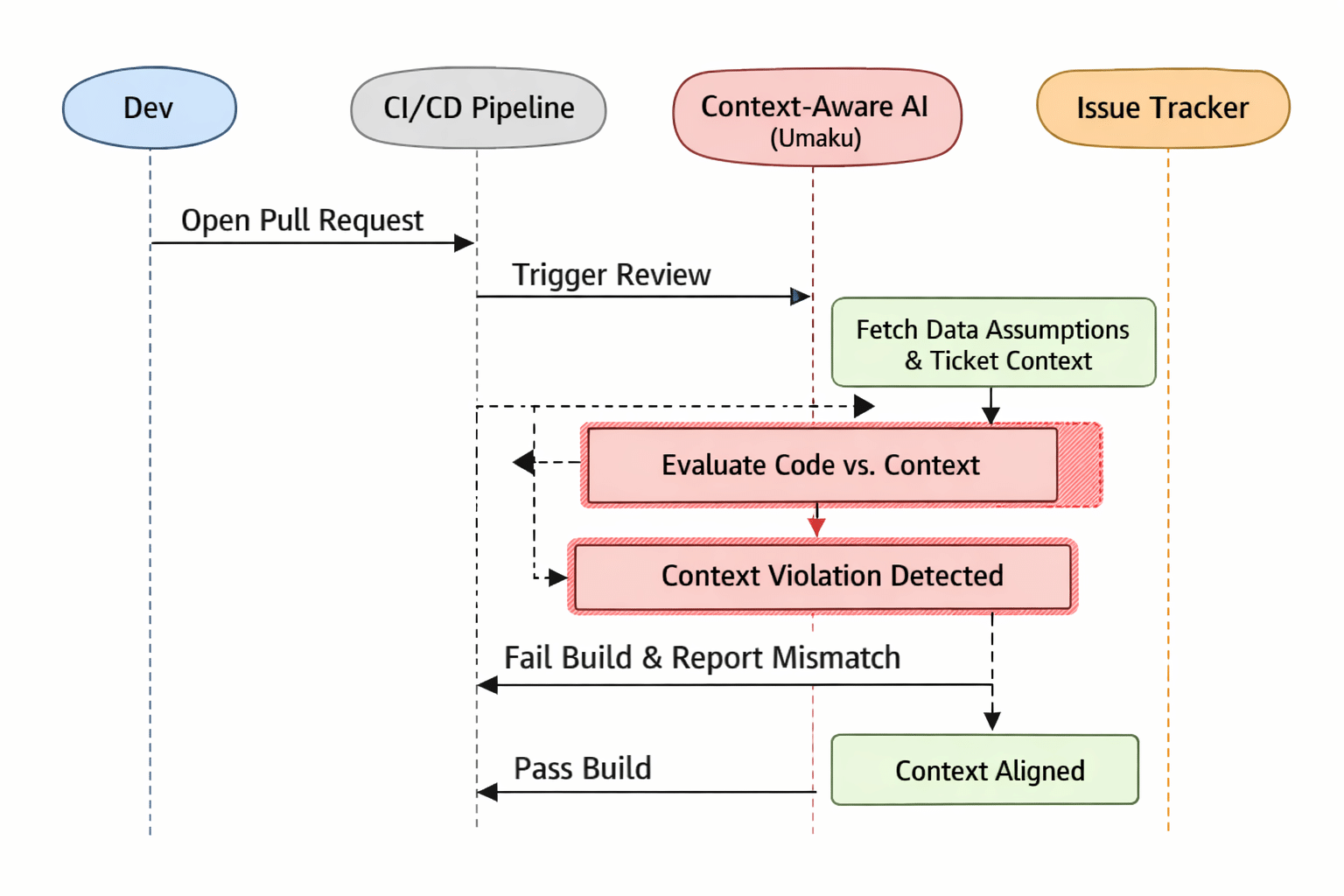
First, the system ingests the overarching project architecture, usually defined in markdown files or architecture decision records within the repository. It learns the broad goals of the system.
Second, it pulls the linked issue ticket—such as a GitHub issue or GitLab epic—to read the specific data assumptions, acceptance criteria, and edge cases defined by the data science team for that specific feature branch.
Finally, only after understanding the intent and the assumptions, it evaluates the actual pull request code.
By understanding how the ticket aligns with the project description first, the system can accurately evaluate whether the attached code fulfils the required business and data logic. Returning to our earlier example: if a backend payload in the pull request handles missing values by defaulting to zero, but the original task ticket explicitly required using a dataset meant for imputation, the context-aware system will catch the mismatch. It flags the behavioural violation before the code is ever merged into the main branch, preventing a silent data drift in production.
Integrating context into the open source pipeline
The enduring power of the open source ecosystem relies on building modular tools that communicate clearly through standard streams, such as stdin and stdout. Context-aware reviews adopt this exact UNIX philosophy.
Instead of acting as proprietary black boxes, context-aware tools function as standard pipeline filters within your continuous integration workflow. They read standard input, specifically the git diff of the proposed code and the metadata from the linked issue tracker, and produce standard output—a pass or fail status code along with actionable feedback regarding business logic violations.
Teams can utilise these tools to automate context checks during the local development stage. By utilising standard git hooks, developers can ensure their code is validated against the issue tracker’s context before a commit is even created. If a local command-line tool detects a schema mismatch between the training data expectations and the newly written API endpoint, it returns a non-zero exit code. This rejects the commit locally, saving continuous integration compute minutes, preventing a broken build, and providing immediate, contextual feedback directly in the developer’s terminal.

Managing data contracts as infrastructure
In modern DevOps, we treat our infrastructure as code using open source declarative tools. We define our desired server states, network configurations, and container orchestration rules in YAML files. We must begin treating our machine learning data expectations with the exact same level of rigour. Data contracts must be codified, version-controlled, and injected as context alongside the application source code.
Open source tools have paved the way for this. When a model is trained or versioned, the metadata regarding its input schema and preprocessing requirements is often stored as JSON or YAML artifacts. A context-aware system acts as the enforcement mechanism for these contracts. It bridges the gap by reading these declarative artifacts and cross-referencing them against the application code during the review process.
For instance, if a version-controlled data contract specifies that a missing account balance must trigger a payload rejection, the context-aware reviewer will scan the backend API implementation. If it finds that the API is carelessly defaulting the balance to zero to prevent an application crash, it will block the deployment. This ensures that the infrastructure executing the code is always perfectly synchronised with the mathematical assumptions of the model.
A real-world context failure: API contract drift in LLMs
To truly understand the value of context-aware systems, consider a real-world open source deployment scenario involving generative artificial intelligence. A team is building a natural language processing service using an open source large language model, serving it on Linux servers equipped with GPUs.
Language models are highly sensitive to text encoding and tokenization. The model expects input text to be strictly sanitised: HTML tags removed, Unicode characters normalised to UTF-8, and trailing whitespace stripped. The data science team documents these exact contextual requirements in a GitLab epic and implements a Python script utilising regular expressions to clean the training data.
Months later, a frontend developer updates the client web application, inadvertently changing the way text is encoded before it is sent to the API, falling back to ISO-8859-1. The backend engineer writes an API wrapper that accepts the payload without throwing an HTTP bad request error and passes the raw, improperly encoded bytes directly to the language model.
Because the API contract drifted and the context was lost, the model began receiving text filled with unescaped HTML entities and broken Unicode characters. The GPU does not crash; it simply processes the bad tokens and generates degraded, nonsensical text. In a traditional workflow, finding this bug requires days of digging through application logs, using network analysis tools to examine raw payloads, and tracing the execution path from the load balancer down to the Python application.
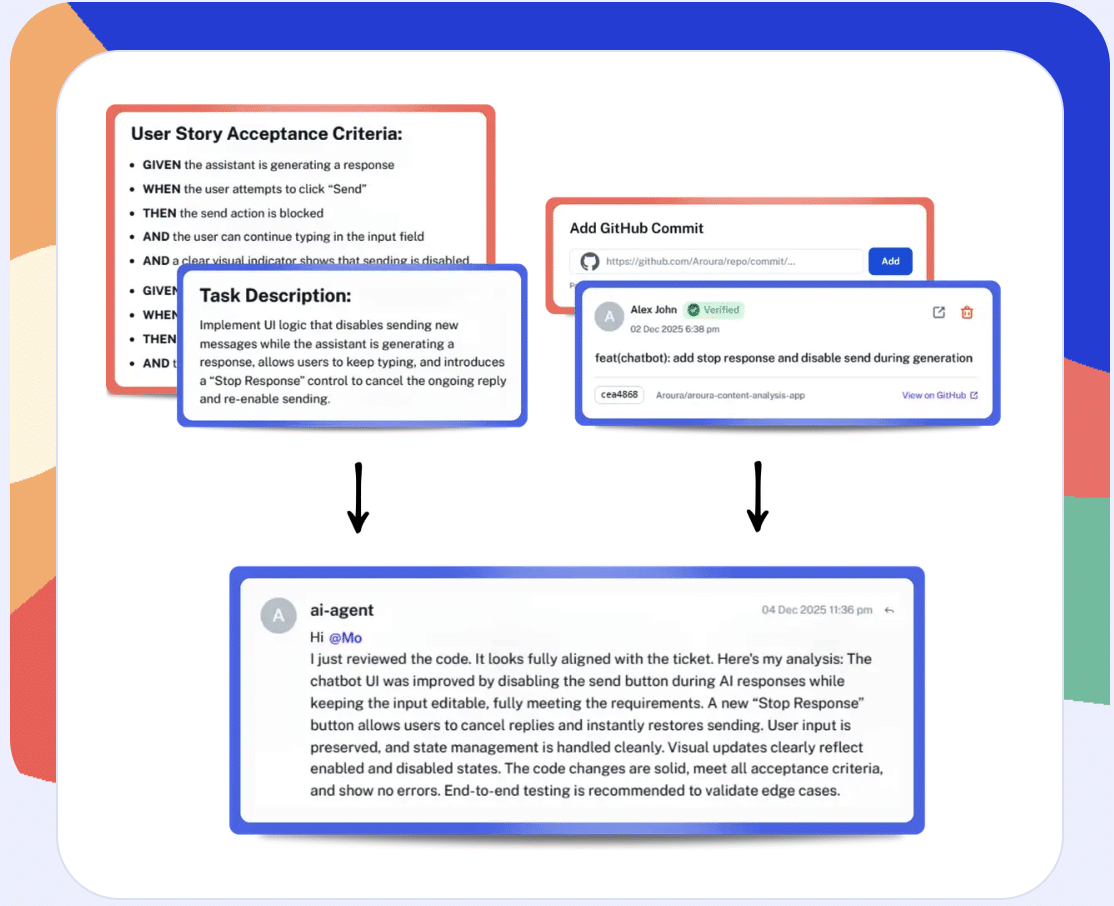
In a context-aware workflow, the issue is flagged the moment the backend engineer attempts to merge the API endpoint without including the UTF-8 sanitisation step defined in the original architecture. The context-aware reviewer cross-references the pull request against the original project guidelines, reads the original data science requirements from the ticket, and points out the missing logic. It turns a multi-day production nightmare into a five-minute code review fix, proving the immense value of maintaining contextual state throughout the deployment lifecycle.
Observability as the second line of defence
Even with the best context-aware review systems in place at the continuous integration level, production environments are chaotic. Upstream data sources change, client applications send unexpected payloads, and data drift occurs naturally over time. Therefore, context-aware deployment must be paired with robust, open source observability to monitor the runtime context.
When deploying machine learning models, tools like Prometheus and Grafana are essential for catching the silent failures that manage to slip through. By exposing custom metrics from your machine learning API, you can monitor not just system health—like CPU usage or HTTP latency—but data health. You can track the rate of missing values, the distribution of input features, and the variance in model predictions to ensure the runtime context matches the assumed context.
If the mean value of an input feature suddenly shifts by three standard deviations, Prometheus can trigger an alert. This allows the engineering teams to investigate whether the shift is due to a genuine change in user behaviour, or a silent pipeline failure caused by an upstream API contract drift. Context-aware review systems prevent these errors from entering the codebase at the pull request stage, while open source observability tools ensure that external factors do not quietly violate the context at runtime.
Redefining ‘done’
Ultimately, the goal of code review, automated continuous integration pipelines, and DevOps culture remains unchanged: building reliable, highly available, and maintainable systems. But as software engineering increasingly intersects with data science, the definition of done needs to fundamentally evolve.
Passing unit tests, satisfying the linter, and achieving a successful container build is no longer enough. Syntactical correctness does not guarantee behavioural correctness in a data-driven system. Just as a successfully compiled software package is useless if it lacks its required system dependencies, a successfully deployed machine learning service is useless if it misinterprets its incoming data expectations.
For a machine learning feature to truly be ready for a production environment, it must meet a much higher standard rooted in context. It must align with the original intent of the task as defined in the issue tracker. It must respect the data assumptions and feature distributions established during the training phase. And it must behave consistently across both isolated, pristine training containers and chaotic, real-world production environments.
By bringing overarching project context directly into automated pipelines and code reviews, developers can bridge the massive gap between data science and engineering. We can utilise open source principles to build modular, intelligent checks that enforce data contracts automatically. By doing so, we ensure that our machine learning models perform just as flawlessly on a live, production server as they did in a local development environment.