






















































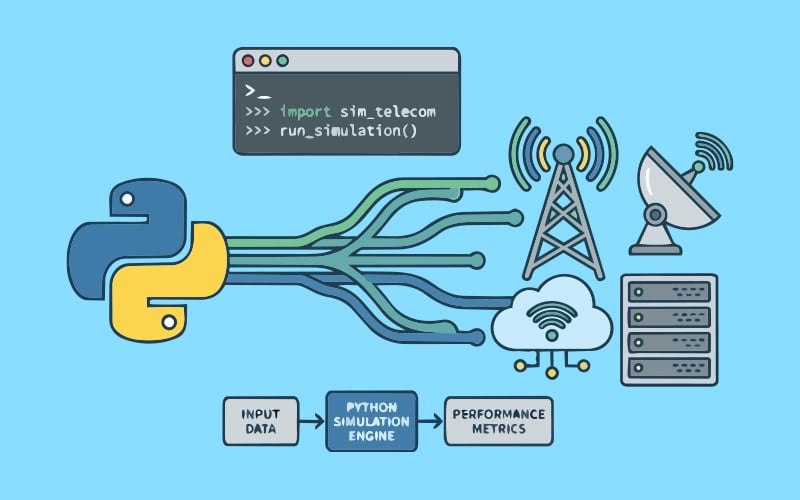

Did you know that apart from its many other utilities, Python can also be used for
simulating a range of telecom and wireless applications?
Several programming libraries are being used today for simulating and deploying real world applications in telecommunications, software defined radio (SDR), antenna design, electromagnetic pattern analysis, satellite communications, etc. The Indian telecom and wireless market is currently investing in 6G, silicon carbide (SiC), and gallium nitride (GaN) technologies, and other future wireless domains.
A number of programming platforms and languages are being used for radio frequency analysis and antenna design for real world telecom and wireless applications:
- EM (electromagnetic) simulation tools (CST, HFSS, FEKO): Core for antenna design
- Circuit tools (ADS, LTspice): RFID chip and front-end design
- Programming tools (Python, MATLAB): Algorithm and signal modelling
- PCB tools (KiCad, Altium, EasyEDA): Physical implementation
- System tools (Simulink, GNU Radio): Full RFID communication workflow
Python, GNU Radio, Simulink, Octave, and Julia are among the programming languages being used for signal processing and RF modelling, RF analysis and automation, RFID reader prototyping, communication system simulation, and high-speed scientific computing so that real-world applications can be analysed before actual deployment on site.
Table 1: Popular programming platforms for RFID engineering and antenna design
| Category | Type | Tool/Platform | Key role in RFID/ antenna design |
| EM (electromagnetic) simulation | 3D EM solver | ANSYS HFSS | High-accuracy antenna and RFID tag simulation |
| EM simulation | EM solver | CST Studio Suite | Time/frequency domain antenna optimisation |
| EM simulation | EM solver | FEKO | Large-scale RFID system simulation |
| EM simulation | Multiphysics | COMSOL Multiphysics | RF + thermal coupled analysis |
| EM simulation | Time-domain solver | XFdtd | Radiation and SAR analysis |
| EM simulation | Open source EM | OpenEMS | Low-cost antenna prototyping |
| EM simulation | Planar EM | Sonnet Suites | Microstrip RFID antenna design |
| EM simulation | 3D EM tool | EMPro | EM + circuit co-simulation |
| EM simulation | Lightweight EM | NEC (Numerical Electromagnetics Code) | Wire antenna modelling |
| Circuit design | RF circuit tool | ADS (Advanced Design System) | RF front-end and co-simulation |
| Circuit design | Circuit simulator | LTspice | Analog RFID circuit design |
| Circuit design | IC design | Cadence Virtuoso | RFID chip/ASIC development |
| Circuit design | Circuit simulator | PSpice | SPICE-based RF simulation |
| Circuit design | Circuit tool | QUCS | RF circuit prototyping |
| System tools | System control | LabVIEW | RFID testing and automation |
| System tools | Network simulator | OMNeT++ | RFID protocol simulation |
| System tools | Network simulator | NS-3 | Wireless/RFID modelling |
| System tools | Security tool | RFIDIOT | RFID protocol testing |
| PCB design | PCB tool | Altium Designer | Professional RFID hardware design |
| PCB design | PCB tool | KiCad | Open source PCB prototyping |
| PCB design | PCB tool | Autodesk Eagle | Rapid prototyping |
| PCB design | PCB tool | OrCAD PCB Designer | Industry-grade PCB layout |
| PCB design | PCB + simulation | Proteus | Embedded RFID system design |
Python is a popular programming language for various domains including blockchain, cloud computing, cybersecurity, digital forensics, image processing, etc. It is now also available for radio frequency (RF), software defined radio (SDR), antenna design and many other telecom and wireless applications (Table 2).
Table 2: Python libraries for RF, electromagnetic waves and SDR applications
| Library | Key features | Domain | Typical use in EM/RF/ SDR |
| OpenEMS | 3D EM simulation with Python API | EM | Antenna prototyping |
| NumPy | Fast array computation, linear algebra | EM/RF/SDR | Field calculations, signal processing |
| SciPy | Optimisation, integration, FFT | EM/RF | EM modelling, RF analysis |
| Matplotlib | Visualisation, plotting graphs | EM/RF/SDR | Radiation patterns, spectrum plots |
| scikit-rf | Network analysis, S-parameters | RF | RF circuit and antenna analysis |
| PyNEC | Antenna modelling via NEC engine | EM | Wire antenna simulation |
| Meep | FDTD solver for EM fields | EM | Wave propagation, antenna research |
| PyLayers | Indoor propagation modelling | RF | RFID and wireless channel simulation |
| PySDR | Educational SDR toolkit | SDR | Learning SDR concepts |
| GNU Radio | Signal processing blocks, SDR integration | SDR | RFID reader implementation |
| PyRTLSDR | Interface for RTL-SDR devices | SDR | Signal capture, spectrum analysis |
| SoapySDR | Hardware abstraction layer | SDR | Multi-device SDR integration |
| PyUSRP | USRP device control | SDR | Advanced SDR experiments |
| TensorFlow | Deep learning models | RF/SDR | Signal classification, anomaly detection |
| PyTorch | Neural networks, GPU support | RF/SDR | RF signal recognition |
| PyVISA | Control of RF instruments | RF | Spectrum analyser automation |
| PySerial | Serial device communication | RF/SDR | RFID reader interfacing |
| Dask | Parallel computation | EM/RF | Large-scale EM simulations |
| Numba | JIT acceleration | EM/RF | Speeding up EM calculations |
| CuPy | GPU-based computation | EM/RF | High-speed EM simulation |
| Plotly | Interactive plots | RF/SDR | Spectrum dashboards |
| Seaborn | Statistical plotting | RF | RF data analysis |
| NetworkX | Network modelling | RF | RFID network topology |
| SymPy | Symbolic computation | EM | EM equation derivation |
| PyWavelets | Wavelet analysis | RF/SDR | Signal denoising, feature extraction |
OpenEMS: Free and open source platform for electromagnetic analysis, radio and antenna engineering
https://www.openems.de)
OpenEMS is available under free distribution as an electromagnetic field solver for telecom, radio and antenna engineering applications. Its programming interfaces are available for Python, Octave, and MATLAB for simulation by researchers and engineers
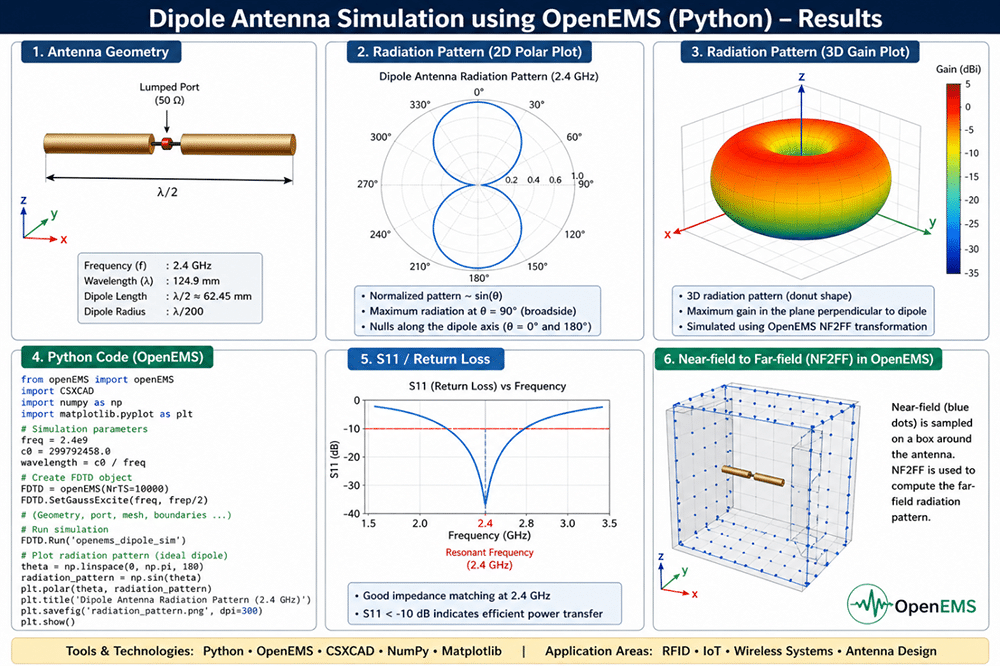
Here’s an example of how Python OpenEMS can be used for detecting dipole RF antenna and output radiations:
# OpenEMS imports
from openEMS import openEMS
from openEMS.physical_constants import *
import CSXCAD

import numpy as np
import matplotlib.pyplot as plt
import os

# Research Simulation parameters for Implementation
freqt = 2.4e9 # 2.4 GHz (RF band)
cunit = 1e-3 # mm
wavelengtht = c0 / freq
c0 = 299792458

# Dipole parameters
dipolelength = wavelength / 2
dipole_radius = wavelength / 200

# Create simulation
FDTDt = openEMS(NrTS=10000)
FDTDt.SetGaussExcite(freqt, freqt/2)

# Create geometry
CSXt = CSXCAD.ContinuousStructure()
FDTDt.SetCSX(CSX)

# Define mesh
mesht = CSX.GetGrid()
mesht.SetDeltaUnit(cunit)

# Add dipole (two arms)
start1t = [-dipolelength/2, 0, 0]
stop1t = [0, 0, 0]
start2t = [0, 0, 0]
stop2t = [dipolelength/2, 0, 0]

CSXt.AddMetal(“dipole”)
CSXt.AddCylinder(“dipole”, 0, start1t, stop1t, dipoleradius)
CSXt.AddCylinder(“dipole”, 0, start2t, stop2t, dipoleradius)

# Add excitation port

tport = FDTD.AddLumpedPort(1, 50, start1t, stop1t, [0, 0, 1], True)

# Boundary conditions
FDTDt.SetBoundaryCond([‘PML_8’] * 6)

# Run simulation
simpath = “openemsdipolesim”
if not os.path.exists(simpath):

os.mkdir(simpath)

CSX_file = os.path.join(sim_path, “dipole.xml”)
CSXt.Write2XML(CSX_file)

FDTDt.Run(sim_path)

# Post-processing (simplified radiation pattern)
theta2 = np.linspace(0, np.pi, 180)
radiation_pattern2 = np.sin(theta2) # ideal dipole approximation

# Radiation Analytics
plt.figure()
plt.polar(theta, radiation_pattern)
plt.title(“Dipole Antenna Radiation Pattern (2.4 GHz)”)
plt.savefig(os.path.join(sim_path, “radiationpattern.png”))
plt.show()
Researchers and telecom engineers can simulate wireless and telecom scenarios using openEMS and the Python interfacing library for high performance applications before deploying the devices and modules on the physical location. Radiations, signals and associated parameters can be evaluated for error-free implementations.