














































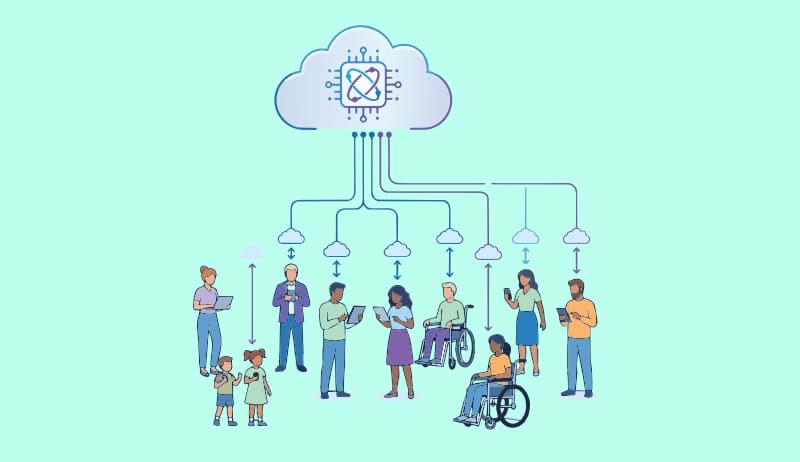

Cloud quantum computing is a democratising force. It has transformed quantum processors from rare laboratory instruments into remotely accessible resources that can be explored through software. But this does not mean that the quantum advantage is already routine.
Quantum computing is no longer restricted to a small circle of researchers with access to specialised cryogenic equipment, custom control electronics, and highly trained experimental teams. Cloud quantum computing has changed that access model. By placing quantum processors behind familiar cloud interfaces, providers have made it possible for a student, researcher, software developer, or enterprise architect to submit quantum programs remotely, observe real hardware behaviour, and learn from results without owning a quantum computer.
The phrase ‘access for all’ does not mean that every user can immediately solve industrial-scale problems with today’s quantum processors. What it means is that the tools, educational material, simulators, and selected real quantum hardware are now reachable through online platforms. A learner can write a simple Bell-state circuit in a browser, an academic group can test a variational algorithm on a trapped-ion processor, and an enterprise team can compare different quantum hardware technologies through managed services such as Amazon Braket and IBM Quantum.
The importance of this transformation becomes clearer when one considers the physical reality of quantum hardware. Superconducting processors require extremely low temperatures, often close to absolute zero. Trapped-ion systems depend on carefully controlled electromagnetic fields and laser pulses. Neutral-atom systems use optical tweezers and precise laser arrangements to position and manipulate atoms. These are not machines that most organisations can purchase and maintain like conventional servers. Cloud access therefore removes a major barrier: users interact with quantum resources through software while the provider manages calibration, maintenance, hardware upgrades, queuing, scheduling, and much of the operational complexity.
At the same time, cloud quantum computing is still an emerging field. Current quantum processors are noisy, limited in scale, and highly sensitive to errors. Many experiments must be repeated thousands of times to obtain statistically meaningful results. Queue times can vary depending on demand and hardware availability. A program that runs correctly on a simulator may behave differently on a real quantum device because of decoherence, gate errors, measurement imperfections, and hardware topology constraints. These limitations do not reduce the value of access; rather, they help users understand quantum computing as it truly exists today. Cloud platforms allow people to learn not only the ideal theory but also the practical realities of noisy intermediate-scale quantum systems.
What is quantum computing in the cloud?
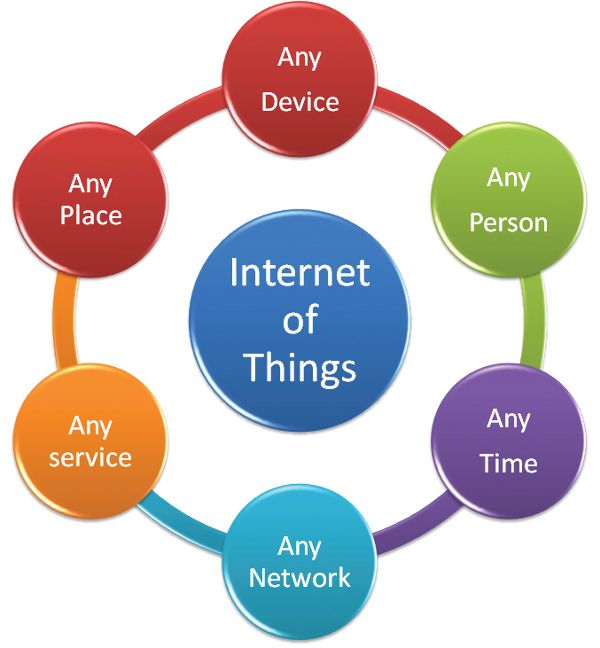
Quantum computing in the cloud refers to the delivery of quantum computing resources through online platforms, application programming interfaces, software development kits, notebooks, and managed execution environments. Instead of physically accessing a quantum processor, users create quantum circuits or quantum-inspired workflows on their own computers or in cloud-hosted notebooks, submit them to a remote service, and receive results after execution. The service may run the program on a simulator, a real quantum processing unit, or a hybrid environment that combines classical and quantum resources. This model is often described as Quantum Computing as a Service or QCaaS (Figure 1).
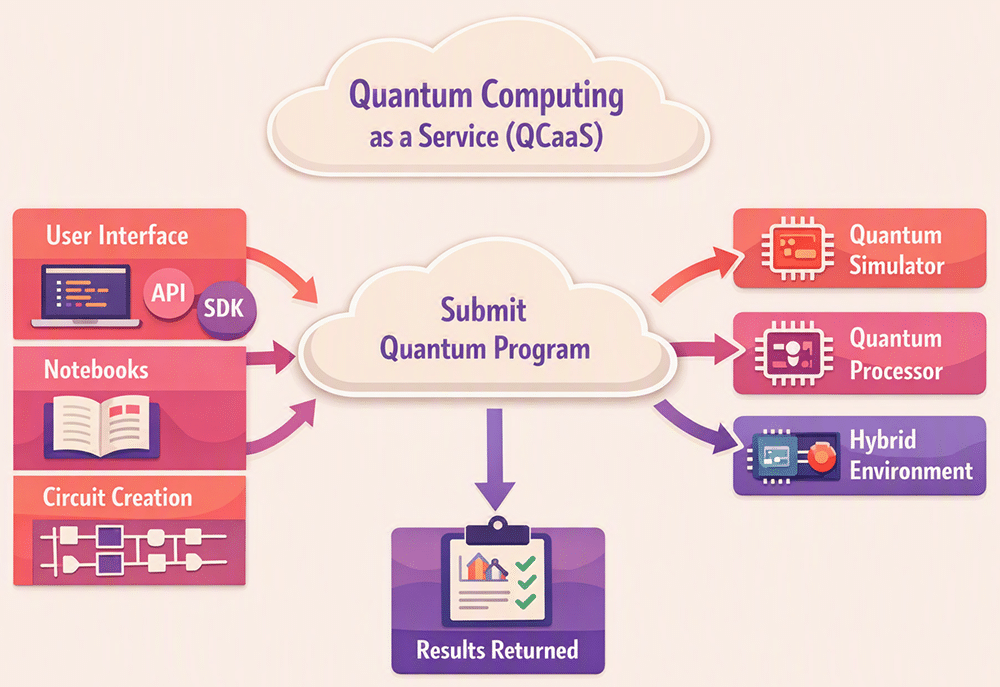
The core workflow is conceptually simple. A user defines qubits, applies quantum gates, measures the qubits, and submits the circuit to a backend. For example, a beginner may create a two-qubit Bell state by applying a Hadamard gate to one qubit and a controlled-NOT gate between two qubits. On a simulator, the outcome may appear clean and balanced. On real hardware, the result may include noise, imperfect probabilities, and occasional unexpected measurements. This difference is educational because it shows that quantum computing is not only about abstract mathematics; it is also about engineering, calibration, noise management, and statistical interpretation.
Cloud platforms typically provide several layers of capability. The first layer is education: tutorials, documentation, visual circuit composers, and example notebooks. The second layer is simulation: users can test circuits locally or on cloud simulators before spending time or money on physical hardware. The third layer is hardware access: submitted jobs are compiled for a specific quantum device and placed in a queue. The fourth layer is orchestration: hybrid algorithms such as the Variational Quantum Eigensolver or Quantum Approximate Optimisation Algorithm require repeated interaction between classical optimisation loops and quantum circuit execution.
Quantum cloud computing also abstracts hardware diversity. A superconducting processor, a trapped-ion system, and a neutral-atom device may all appear as selectable targets within a platform, even though their physical implementations are very different. This abstraction allows users to compare how the same algorithm behaves across hardware types. A chemistry researcher may prefer high-fidelity trapped-ion gates for a small molecular simulation, while an optimisation researcher may experiment with neutral-atom systems for certain graph-related problems. A developer testing circuits may begin with a simulator and later run selected experiments on physical hardware.
In practical terms, quantum computing in the cloud should be understood as an ecosystem rather than a single machine. It includes quantum processors, classical infrastructure, compilers, transpilers, error mitigation techniques, identity and access controls, billing systems, dashboards, documentation, and communities. The user experience may feel similar to running a workload on a cloud GPU or submitting a data engineering job, but the underlying physics is fundamentally different. The cloud does not remove the complexity of quantum computing; it organises that complexity into manageable interfaces so more people can participate, learn, and contribute.
Major platforms: IBM, Google, Amazon, and others
The cloud quantum landscape is shaped by a mix of hardware builders, hyperscale cloud providers, academic initiatives, and specialist platforms. IBM has played a pioneering role by making quantum hardware available through the cloud and building a broad software ecosystem around Qiskit. The IBM Quantum Platform provides access to documentation, learning resources, circuit tools, Qiskit Runtime, and quantum processing units. IBM’s approach is vertically integrated: it develops superconducting quantum hardware, maintains the Qiskit software stack, and offers cloud-based execution services.
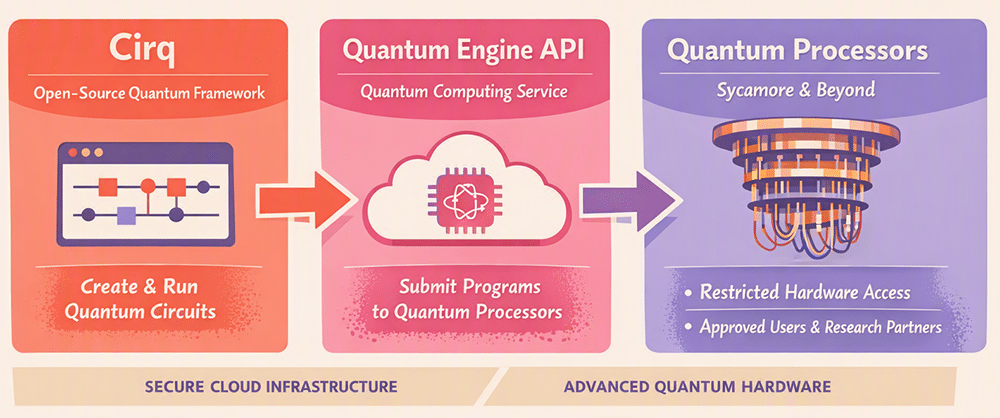
Google’s quantum ecosystem has been closely associated with Cirq, an open source Python framework for creating, manipulating, and running quantum circuits. Google’s Quantum Computing Service uses the Quantum Engine API for submitting programs to quantum processors, although hardware access is typically restricted to approved users or research partnerships.
Google’s contribution is visible through Cirq, Colab notebooks, tutorials, and published research. Google’s work has also influenced discussions on quantum supremacy, error correction, and scalable quantum architectures. While not as openly accessible to the public as some other platforms, it remains important in research-oriented quantum computing.
Amazon Braket represents a different model. Rather than focusing on one hardware technology, it provides a managed service for accessing multiple quantum hardware providers and simulators through a unified AWS experience. Users can work with superconducting, trapped-ion, and neutral-atom systems, depending on current provider availability.
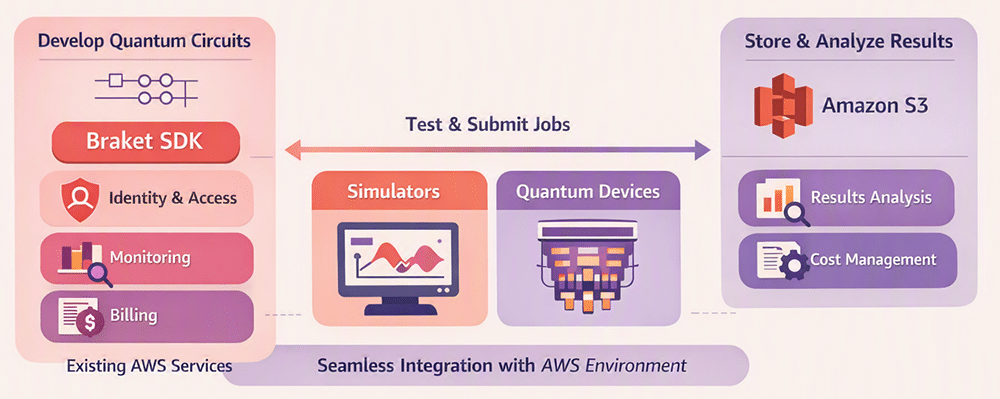
Braket also integrates with familiar AWS services such as identity management, storage, monitoring, and billing. This makes it valuable for enterprises that already use AWS and want to experiment with quantum computing without creating a separate operational model.
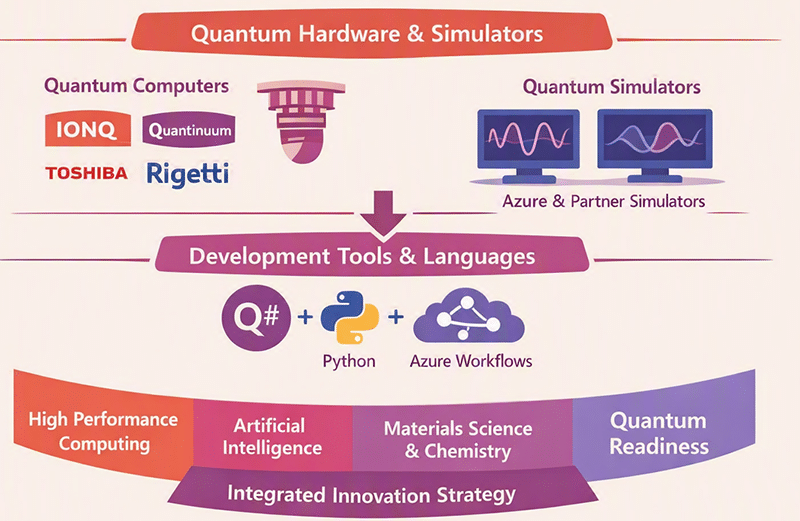
Microsoft Azure Quantum also takes an aggregator and ecosystem-oriented approach. It provides access to quantum hardware and simulators from multiple providers and supports development through tools such as Q#, Python integrations, and Azure-based workflows. Azure Quantum is often positioned within a broader strategy that combines high-performance computing, artificial intelligence, materials science, chemistry, and quantum readiness.
Beyond these large platforms, several other players contribute to access and diversity. D-Wave offers cloud access to quantum annealing systems and hybrid solvers, which are particularly relevant for optimisation-style problems. IonQ, Quantinuum, Rigetti, Pasqal, QuEra, IQM, and other hardware companies provide access either directly or through cloud marketplaces.
Getting started: User access and interface
Getting started with cloud quantum computing is far easier today than it was a decade ago. A user typically begins by creating an account on a quantum platform, reviewing the available plans or credits, installing a software development kit, and running a first circuit through a notebook or command-line environment. Some platforms also provide graphical circuit composers that allow users to drag and drop gates, which is helpful for beginners who are still learning the relationship between mathematical operations and visual circuit diagrams. The most common entry point is Python because major frameworks such as Qiskit, Cirq, Braket SDK, PennyLane, and many quantum machine learning tools support Python-based workflows.
A practical first experiment is often the creation of a Bell state. The user initialises two qubits, applies a Hadamard gate to the first qubit, applies a controlled-NOT gate using the first qubit as control and the second as target, and then measures both. In theory, the result should be strongly correlated: the system is observed as either 00 or 11. Running this experiment on a simulator helps the learner understand ideal quantum behaviour. Running it on real hardware adds another layer of insight because the output may include small probabilities for 01 or 10 due to device noise. This simple example teaches superposition, entanglement, measurement, and hardware imperfection in a compact and memorable way.
The user interface differs by platform but usually follows a familiar pattern. IBM provides web-based resources, learning modules, visual tools, and Qiskit Runtime access. Amazon Braket offers managed notebooks, SDK-based development, device selection, and integration with AWS services. Azure Quantum provides workspace-style access through Azure, with provider selection and development options. Google’s ecosystem relies heavily on Cirq, Google Cloud projects, and access-controlled quantum hardware workflows. In each case, the user must understand the relationship between local code, cloud authentication, device selection, job submission, and result retrieval. This may sound complex, but it becomes natural once a few small circuits are executed end to end.
For enterprise users, the starting process includes additional considerations. Identity and access management, cost controls, project tagging, data storage policies, network restrictions, and audit requirements may matter as much as the quantum code itself. A research notebook that works for an individual learner may need to be adapted for a governed enterprise environment.
Experimenting remotely: Benefits and limitations
Remote experimentation is one of the greatest strengths of cloud quantum computing. It allows users to work with quantum hardware that would otherwise be unreachable. A university classroom can run demonstrations on real devices. A startup can test a prototype algorithm without investing in hardware. A global research group can share notebooks and compare results across platforms. An enterprise innovation team can evaluate whether a quantum approach has long-term relevance to portfolio optimisation, molecular simulation, scheduling, or risk analysis. In each case, cloud access transforms quantum computing from a facility-bound activity into a network-accessible resource.
The most immediate benefit is cost avoidance. Building and operating a quantum computer requires specialised facilities, highly skilled teams, and continuous maintenance. The cloud model converts that capital burden into usage-based access. Another benefit is flexibility. Users can test the same circuit on a simulator, a superconducting device, a trapped-ion processor, or a neutral-atom system, depending on platform availability. This comparison is valuable because quantum hardware differs in connectivity, gate fidelity, coherence time, speed, and noise behaviour. The cloud makes it easier to learn which hardware characteristics matter for a given algorithm.
Remote experimentation also improves reproducibility when used carefully. A researcher can preserve code, circuit definitions, device metadata, calibration information, shot counts, and result files. Managed notebooks and job histories help document the conditions under which experiments were run. This is important because quantum hardware changes over time. A circuit executed today may produce slightly different results next week because the device has been recalibrated or upgraded. Good experiment tracking therefore becomes part of responsible quantum research. The cloud provides many of the tools needed for such tracking, but users must still apply disciplined documentation practices.
The limitations are equally important. Current quantum devices are noisy, and many problems remain too large for available hardware. Queue delays can slow experimentation, especially when popular devices are heavily used. Some platforms restrict access to advanced hardware or require approval. Costs can accumulate if users run many shots, large simulations, or repeated hybrid jobs without monitoring usage.
A useful way to view today’s remote quantum experimentation is to compare it with early classical computing or early cloud machine learning. The systems are not yet universally practical for every business problem, but they are mature enough for education, benchmarking, algorithm research, workforce development, and early application exploration.
Collaborative research and open science
Cloud quantum computing has strengthened collaborative research by giving distributed teams a common experimental environment. In the past, quantum hardware access was concentrated in specialised laboratories, and collaboration often depended on direct institutional relationships. Today, a research group spread across countries can use shared repositories, cloud notebooks, open source SDKs, and managed quantum services to design, run, and analyse experiments. This does not eliminate the need for deep expertise, but it broadens participation. Students, physicists, computer scientists, chemists, mathematicians, and engineers can work together around a common software workflow.
Open source software is central to this collaborative model. Qiskit, Cirq, PennyLane, Braket SDK, Q#, and other frameworks allow users to inspect code, contribute improvements, reproduce tutorials, and build extensions. Open source libraries also reduce the psychological barrier to entry. A learner can read example code, modify a circuit, run it locally, and then submit it to a cloud backend when ready. Researchers can publish notebooks along with papers so others can reproduce experiments or adapt methods. This style of work aligns closely with open science, where transparency, reproducibility, and shared learning are valued.
Education benefits strongly from this openness. Instructors can design laboratory assignments where students simulate circuits first and then run selected jobs on real hardware. Hackathons and bootcamps can introduce participants to quantum programming within a few hours. Research communities can share benchmark problems and compare results across hardware providers. Open datasets, public tutorials, and community forums help newcomers learn from the mistakes and successes of others.
However, open science in quantum computing also requires care. Not every experiment is fully reproducible unless device details, calibration data, noise assumptions, and execution parameters are recorded. Not every platform offers identical access. Some advanced hardware remains restricted, and commercial terms may limit sharing in certain contexts. Even so, the direction is clear: cloud quantum computing has made quantum research more collaborative, more transparent, and more teachable.
Security and privacy in the quantum cloud
Security and privacy are essential considerations in cloud quantum computing because quantum workloads often sit inside broader enterprise and research environments. A quantum circuit may appear harmless, but the surrounding workflow can involve proprietary algorithms, sensitive research data, customer information, optimisation models, or commercially valuable intellectual property. When quantum experiments are executed through a cloud platform, users must think about authentication, authorisation, encryption, logging, data residency, job metadata, result storage, and provider trust. These are familiar cloud security topics, but quantum computing adds new dimensions because the field is still evolving and many workflows are experimental.
The first layer of protection is conventional cloud security. Users should protect API keys, avoid embedding secrets in notebooks, use role-based access controls, restrict who can submit paid jobs, and store results in approved locations. Enterprise teams should integrate quantum projects with identity providers, audit logs, cost monitoring, and policy controls.
The second layer concerns intellectual property and experimental confidentiality. Quantum algorithms, circuit designs, parameter choices, and benchmarking results may reveal strategic information. A pharmaceutical company exploring molecular simulation, for instance, may not want competitors to infer which compounds it is investigating.
The third layer is the broader impact of quantum computing on cybersecurity. Large-scale fault-tolerant quantum computers could threaten widely used public-key cryptographic schemes such as RSA and elliptic-curve cryptography. This does not mean that today’s cloud quantum devices can break enterprise encryption, but it does mean organisations should prepare for post-quantum cryptography. Quantum cloud platforms can help security teams build awareness, test quantum-safe concepts, and understand the timeline of risk. The practical recommendation is to develop crypto-agility: the ability to inventory cryptographic dependencies and migrate to quantum-resistant algorithms when standards and organisational readiness align.
Privacy in the quantum cloud should also be approached thoughtfully. Many quantum experiments do not require raw personal data; they can operate on abstracted, anonymised, or synthetic problem instances. Whenever possible, users should minimise sensitive inputs and separate confidential business context from the circuit submitted to a provider. Good privacy practice means asking simple questions: What data is being sent? Who can view it? Where is it stored? How long is it retained? Can it be deleted? Is it encrypted in transit and at rest? These questions are ordinary in cloud computing, and they remain equally relevant as quantum workloads become more common.
The promise of cloud quantum computing lies not only in hardware access but also in education, collaboration, and readiness. It enables students to learn by doing, researchers to test ideas across devices, enterprises to build early competence, and communities to share knowledge openly. It also brings responsibilities: users must understand noise, avoid exaggerated claims, protect sensitive data, manage costs, and prepare for the security implications of future quantum capability. Responsible access is as important as broad access.