



















































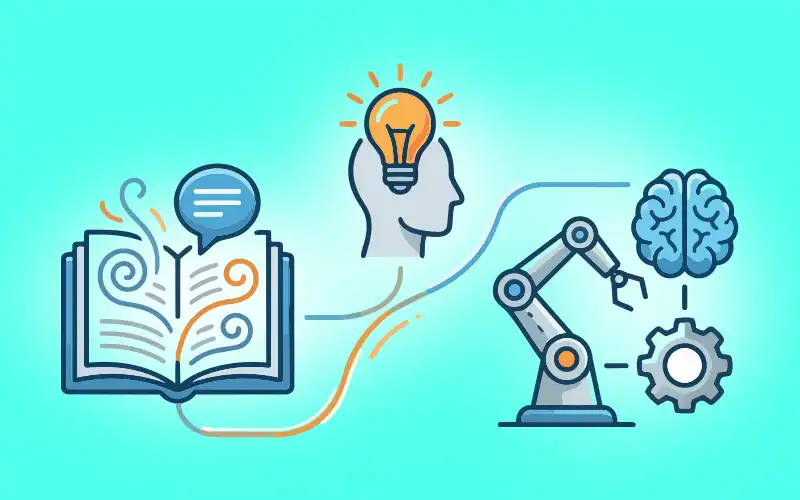

Even with AI transforming how we create, the human touch in storytelling remains unmatched. Here’s a close look at how creativity and technology can come together to craft stories that truly resonate.
In today’s rapidly changing digital landscape, I have come to believe that storytelling is still the most powerful and human way to connect, inspire, and make sense of innovation. Even in a world increasingly shaped by artificial intelligence, storytelling remains at the heart of how we communicate, persuade, and build.
My fascination with storytelling goes back to its roots. One of the earliest cave paintings ever discovered, found in Indonesia and nearly 50,000 years old, shows stick-like human figures hunting animals. That is storytelling in its most primitive form with humans using images to convey meaning, memory, and imagination.
What strikes me is how little that essence has changed. Even today, we use similar stick figures, not on stone walls, but in software architecture diagrams and Unified Modelling Language (UML) modules. The tools have evolved, but the instinct remains the same.
How I see storytelling in software development
I often hear people separate technology from creativity, but in my experience, the two are inseparable. Software development, at its core, is a form of storytelling. We use terms like ‘user stories’, ‘epics’, ‘journeys’, and ‘personas’. These are not arbitrary words. They are the building blocks of narrative.
Every time I work on a product, I realise that I am not just solving a technical problem. I am building a narrative arc. I am designing for users with motivations, goals, and challenges. I am creating tension, offering solutions, and guiding them through a journey. It is storytelling, translated into function and design.
Why storytelling must catch up with technology
We are now in an age where development cycles have shrunk dramatically. Children are creating apps over a weekend using platforms like Replit, Cursor, and Gemini. What once took months is now built in days.
This acceleration demands a new kind of storytelling that should be faster, sharper, and more resonant. No matter how groundbreaking your idea, if you cannot tell a compelling story around it, it will not stick. That is why we started Script Factory — to help others craft stories that are immersive, emotionally resonant, and tailored for a new kind of digital audience.
Storytelling as a leadership tool
I have always seen storytelling not just as a creative act but as a form of leadership. Whether you are a monarch, a chief executive officer (CEO), or a coder, the ability to tell a story determines how well you connect and lead.
Back in school, my lunch breaks were rarely about eating. They were filled with discussions about cosmology and ancient civilisations. Those sessions shaped my worldview. They taught me that curiosity and storytelling go hand in hand.
Later, when I moved into filmmaking, this belief was reaffirmed. I saw first-hand how even the most stunning visuals fall flat without a compelling story. Directors who left a mark were those who could tell stories that lingered in the audience’s mind. A good story is unforgettable. It has gravity.
When we combined AI with ancient stories
One of the most ambitious projects I have worked on involved building a cinematic universe rooted in Indian mythology and culture. We decided to combine human creativity with artificial intelligence.
Our team fed the AI models with thousands of years of folklore, character archetypes, and traditional plot structures. But the story itself, like the arcs, emotional beats, and the twists came from us. AI simply helped us do it faster.
What we created was more than just a script. It was a living, breathing fictional world, designed for future adaptation into augmented reality (AR) and virtual reality (VR) experiences. I am confident it will appear on screens within the next few years.
The day I was arrested by my own characters
Every good story has a twist, and mine came during the International Film Festival of Kerala. I was creating a live comic generated in real time using AI, when I was unexpectedly arrested by characters I had created.
This surreal event became a metaphor for just how immersive and unpredictable storytelling can be. It was also a personal reminder that as storytellers, we often become part of the very worlds we create.
The coupe glass that travelled the world
One of my favourite projects came from an unusual brief. A bar owner, Sidecar’s Minakshi Singh, approached me with a story idea, but insisted there be no human characters. That constraint sparked our imagination.
We created a story from the perspective of a coupe glass. This glass travelled through 12 countries, collecting flavours and experiences. It finally found its place on the menu at Sidecar in Delhi. If you visit the bar, you will see that coupe glass featured as the protagonist. That story even won us an award at one of the largest AI storytelling conferences.
The tools I use (and why I stopped building my own)
Like many others, I once tried building my own large language model (LLM). It was a typical startup decision. But I soon realised that the pace of advancement in AI was too fast. By the time we built something, it would already be outdated.
So I shifted focus. Today, I use tools like Gemini AI Studio’s application programming interface (API), and the most advanced models from ChatGPT. These tools help us move quickly. But what sets us apart is the human input like the nuance, emotion, and the structure.
One challenge we faced was maintaining character consistency in AI-generated visuals. To address this, we have built an internal platform that streamlines everything from writing to final output.
The question of ownership
One question I am asked often is: who owns AI-generated content? It is a legal grey area. While we are consulting intellectual property experts, I believe that the narrative — the soul of the story — belongs to us. The AI may assist, but the creative direction comes from human minds.
As legislation catches up with technology, I hope we find frameworks that protect creators while still encouraging innovation.
Democratising storytelling
I believe the future of storytelling is as widespread as coding. Just as no-code platforms have enabled millions to create apps, AI tools will allow anyone to tell stories, whether through comics, films, or immersive experiences.
At Script Factory and Naadan Comics, we are already working with brands, creators, and event organisers to bring stories to life in unconventional ways. One project involves helping founders visualise their minimum viable product (MVP) as a comic instead of a technical document. We are simplifying a lot of complex topics and one such space is systems thinking for schools, colleges and think tanks through card games. This helps teams and investors understand the product quickly, and with greater emotional clarity.
However, just like in cooking, while everyone can tell a story, not everyone can tell a great one. The real skill lies in knowing how to structure, pace, and flavour the story! Where to pause, where to surprise, and how to land the final moment.
My advice to the next generation
To those wondering whether this emerging field is worth pursuing, I would say ‘Yes’ without hesitation. Storytelling, especially when combined with technology, is one of the most exciting spaces today.
There is still room to define what this industry will look like. If you are observant, empathetic, and curious, you have all the raw material you need. Learn from people. Study history. Listen closely. That is how you become a storyteller.
Technology will change. Tools will come and go. But the human desire to share experiences and ideas? That is timeless.
We have moved from cave paintings to software modules. Artificial intelligence is just the latest tool. At our core, we still want the same thing: to tell a story that others will remember.
The article is based on a talk titled ‘AI in Storytelling’ by Kamalakkannan Durairaju, founder of Script Factory, at AI DevCon 2025 in Bengaluru.