



























































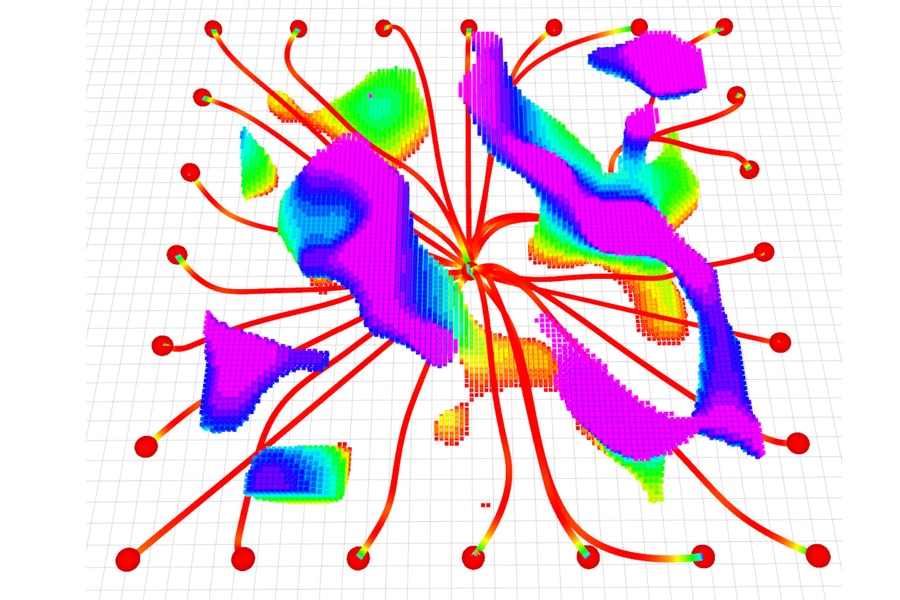

MIT researchers release an open-source trajectory planning system enabling robots and drones to navigate complex, dynamic environments in real time, improving autonomy, safety, and accessibility for robotics developers globally.
Researchers at the Massachusetts Institute of Technology have released an open-source robotics navigation framework that significantly improves how autonomous machines compute real-time movement paths in complex, obstacle-rich environments. The system is designed to help drones and mobile robots make faster and safer decisions while navigating unpredictable real-world conditions.
At its core, the framework addresses a key limitation in robotics: the trade-off between computational speed and optimal path planning. Traditional trajectory planning systems often struggle to deliver smooth, collision-free motion in real time, especially when environments are dynamic. The new open-source approach overcomes this by restructuring the underlying motion optimization process, allowing robots to continuously update their trajectories within milliseconds without sacrificing stability or efficiency.
The most important impact of the release is accessibility. By making the system open source, MIT researchers are removing one of the biggest barriers in advanced robotics development—dependence on expensive, closed navigation software. Developers, startups, and academic labs can now integrate high-performance trajectory planning directly into their robotics stacks without licensing constraints or proprietary dependencies.
Technically, the framework introduces a simplified mathematical formulation for trajectory optimization. Instead of solving computationally heavy global optimization problems at every step, the system breaks motion planning into lightweight, incremental updates. This enables onboard processors in drones and embedded robotic systems to handle real-time navigation tasks locally, reducing reliance on cloud or external compute infrastructure.
In practical terms, the system enhances performance in scenarios such as disaster response, where drones must quickly adapt to collapsed structures and shifting obstacles, or industrial inspection environments where pathways change dynamically. It is also relevant for autonomous delivery systems and warehouse robotics, where efficiency and safety are equally critical.
The open-source release is expected to accelerate experimentation and deployment across the robotics ecosystem. Researchers can build upon the framework, extend it to multi-robot coordination, or adapt it for specialized hardware platforms used in electronics and embedded systems design.
Looking forward, the MIT team aims to expand the system’s capabilities for coordinated swarm robotics and more complex multi-agent navigation tasks. This positions the framework as a foundational tool for next-generation autonomous electronics systems, where adaptability, speed, and openness are becoming essential design requirements.