
























































Fine-tuning an AI model on an organisation’s internal codebase helps teams improve the quality of code and develop software faster, among other things.
As artificial intelligence becomes deeply integrated into software development, organisations are discovering that generic AI models often fail to fully understand their unique codebases, internal libraries, and engineering standards. Although large language models are trained on vast public datasets and can generate syntactically correct code in many programming languages, they lack awareness of proprietary APIs, architectural patterns, and company-specific conventions that define real-world enterprise systems.
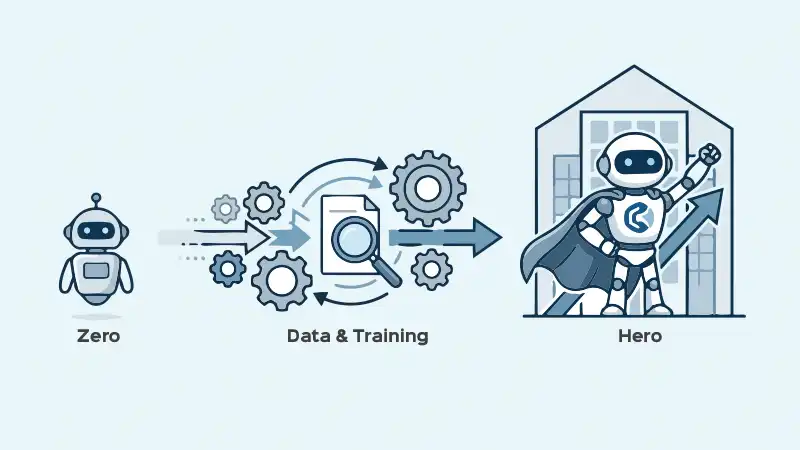
Internal codebases are shaped by custom business logic, naming conventions, and workflows that generic models cannot fully capture. As a result, their output may be technically correct but practically misaligned with organisational needs. Fine-tuning a model on an organisation’s own codebase transforms it from a general assistant into a domain-aware engineering partner. This journey from ‘zero’ understanding to ‘hero’ performance enables teams to achieve faster development, improved code quality, and more reliable automation.
Understanding fine-tuning in the context of code
Fine-tuning is the process of taking a pre-trained model and further training it on a custom dataset so that it adapts to a specific domain. In the context of a codebase, this means feeding the model structured examples of your source code, documentation, commit history, and internal APIs. Instead of learning programming concepts from scratch, the model learns how your organisation writes code, names variables, structures modules, and handles errors. This approach is far more efficient than training a model from zero and results in better contextual awareness and relevance.
From a business perspective, fine-tuned models reduce onboarding time and documentation overhead. Technically, they improve code generation accuracy, reduce repetitive tasks, and help developers understand legacy systems faster. This leads to shorter development cycles and improved maintainability.
Preparing your codebase for training
Before fine-tuning begins, data preparation is the most critical step. The codebase must be carefully curated to ensure quality and security. Sensitive credentials, private keys, and personally identifiable information must be removed or masked. Files should be organised into meaningful input-output pairs, such as code with comments, functions with docstrings, or bug reports with their fixes. Cleaning up inconsistent formatting and removing deprecated or experimental code helps the model learn stable and reliable patterns. High-quality data leads directly to high-quality model behaviour.
Organisations can choose between full fine-tuning or parameter-efficient methods such as LoRA or adapters. Instruction tuning is especially effective when the dataset is converted into prompt–response pairs derived from internal coding tasks.
Fine-tuning on an internal utility library: An example
Assume an organisation has a small internal Python utility library for logging and validation.
Sample internal code (training data) is as follows:
# utils/validator.py

def validate_email(email: str) -> bool:

“””

Validates an email address using internal business rules.

“””

return “@” in email and email.endswith(“.com”)

def validate_user(user: dict) -> bool:

“””

Ensures user object contains mandatory fields.

“””

required_fields = [“id”, “name”, “email”]

return all(field in user for field in required_fields)
Task: Explain what validate_user does.
Answer: It checks whether the user dictionary contains id, name, and email keys.
To prepare a fine-tuning dataset (simplified), type:
[

{

“prompt”: “Explain the function validate_user.”,

“completion”: “It checks whether the user dictionary contains the keys id, name, and email.”

},

{

“prompt”: “Write a function to validate phone number using internal style.”,

“completion”: “def validate_phone(phone: str) -> bool:\n return phone.isdigit() and len(phone) == 10”

}

]
This structure teaches the model:
- How internal functions are written
- Naming conventions
- Business validation logic
The training pipeline (conceptual code) is as follows:
from transformers import AutoModelForCausalLM, AutoTokenizer, Trainer, TrainingArguments

model = AutoModelForCausalLM.from_pretrained(“base-model”)

tokenizer = AutoTokenizer.from_pretrained(“base-model”)

dataset = load_dataset(“json”, data_files=”internal_data.json”)

training_args = TrainingArguments(

output_dir=”./fine_tuned_model”,

per_device_train_batch_size=2,

num_train_epochs=3

)

trainer = Trainer(

model=model,

args=training_args,

train_dataset=dataset[“train”]

)

trainer.train()
This pipeline fine-tunes the model so that it understands:
- Internal utility functions
- Expected response style
- Domain logic
Evaluation tasks may include generating validation functions, explaining internal APIs, and suggesting refactoring. Engineers review model outputs for correctness and compliance with standards. Automated tests can measure consistency with internal logic.
The fine-tuned model can be integrated into IDEs and internal chat systems. Developers can ask: “Generate a validator for employee ID using company format.” The model responds using learned conventions, ensuring consistent code generation.
All training and inference must occur in a secured internal environment. Proprietary algorithms must never leave organisational boundaries. Access controls and audit logs prevent misuse and data leakage.
Fine-tuned models improve productivity, reduce repetitive work, and help new employees understand internal systems. They also act as living documentation by encoding organisational knowledge.
But there are some risks, limitations, and ethical concerns. Models can inherit bad practices if trained on poorly written code. Over-automation may reduce human oversight. Governance policies must define acceptable usage and review requirements.
Fine-tuning a model on an internal codebase transforms AI into a domain-specific assistant. By preparing clean data, applying efficient training strategies, and integrating these securely into workflows, organisations can move from generic AI usage to highly specialised internal intelligence. This journey from zero to hero empowers developers rather than replacing them.